Zhang Hong-Xiang, Zhang Ming-Li
Key Laboratory of Biogeography and Bioresource in Arid Land, Xinjiang Institute of Ecology and Geography, Chinese Academy of Sciences, Urumqi, China.
Institute of Botany, Chinese Academy of Sciences, Beijing, China.
Front Plant Sci. 2017 Dec 13;8:2134. doi: 10.3389/fpls.2017.02134. eCollection 2017.
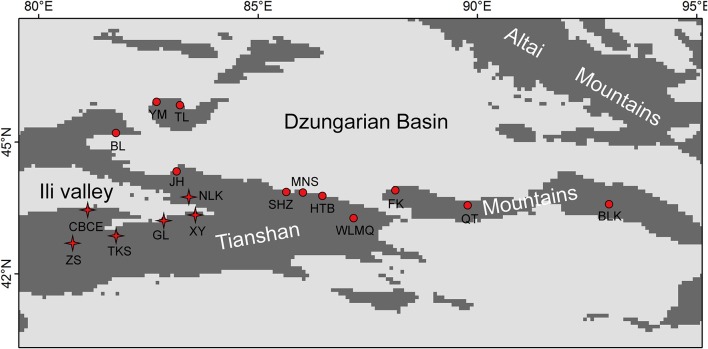
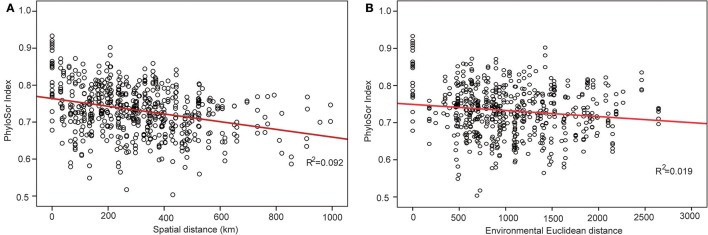
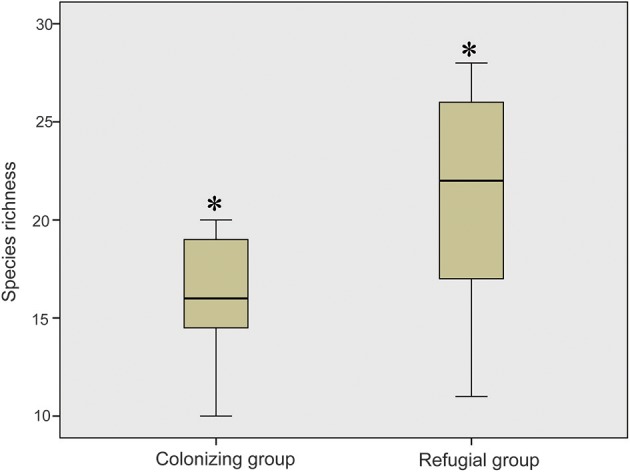
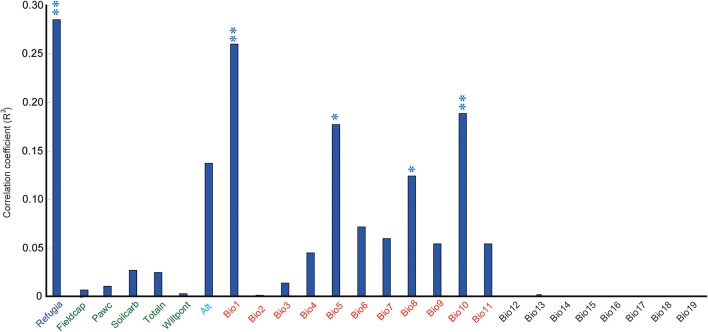
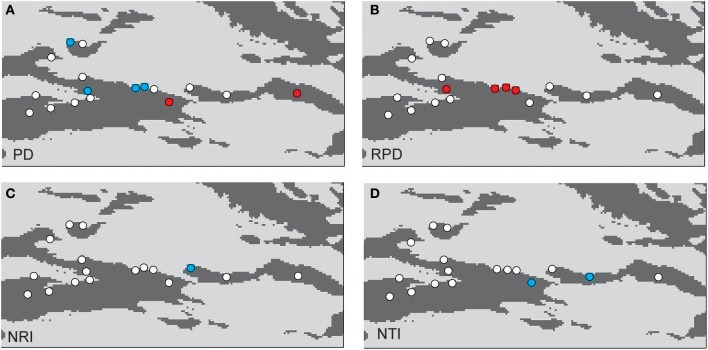
The Tianshan Mountains, located in arid Central Asia, have a humid climate and are biodiversity hotspots. Here, we aimed to clarify whether the pattern of species diversity and the phylogenetic structure of plant communities is affected by environmental variables and glacial refugia. In this study, plant community assemblies of 17 research sites with a total of 35 sample plots were investigated at the grassland/woodland boundaries on the Tianshan Mountains. Community phylogeny of these plant communities was constructed based on two plant DNA barcode regions. The indices of phylogenetic diversity and phylogenetic community structure were calculated for these sample plots. We first estimated the correlation coefficients between species richness (SR) and environmental variables as well as the presence of glacial refugia. We then mapped the significant values of indices of community phylogeny (PD, RPD, NRI, and NTI) to investigate the correlation between community phylogeny and environmental structure or macrozones in the study area. The results showed that a significantly higher value of SR was obtained for the refugial groups than for the colonizing groups ( < 0.05); presence of refugia and environmental variables were highly correlated to the pattern of variation in SR. Indices of community phylogeny were not significantly different between refugial and colonizing regions. Comparison with the humid western part showed that plant communities in the arid eastern part of the Tianshan Mountains tended to display more significant phylogenetic overdispersion. The variation tendency of the PhyloSor index showed that the increase in macro-geographical and environmental distance did not influence obvious phylogenetic dissimilarities between different sample plots. In conclusion, glacial refugia and environmental factors profoundly influenced the pattern of SR, but community phylogenetic structure was not affected by glacial refugia among different plant communities on the Tianshan Mountains. This pattern of community phylogenetic structure could have resulted from shared ancestry and species pool among these sample plots.
天山位于干旱的中亚地区,气候湿润,是生物多样性热点地区。在此,我们旨在阐明植物群落的物种多样性模式和系统发育结构是否受环境变量和冰川避难所的影响。在本研究中,我们在天山草原/林地边界的17个研究地点、共35个样地调查了植物群落集合。基于两个植物DNA条形码区域构建了这些植物群落的系统发育。计算了这些样地的系统发育多样性指数和系统发育群落结构指数。我们首先估计了物种丰富度(SR)与环境变量以及冰川避难所存在之间的相关系数。然后,我们绘制了群落系统发育指数(PD、RPD、NRI和NTI)的显著值,以研究研究区域内群落系统发育与环境结构或大区域之间的相关性。结果表明,避难种群的SR值显著高于定殖种群(<0.05);避难所的存在和环境变量与SR的变化模式高度相关。避难区和定殖区之间的群落系统发育指数没有显著差异。与湿润的西部地区相比,天山干旱东部的植物群落倾向于表现出更显著的系统发育过度分散。PhyloSor指数的变化趋势表明,宏观地理和环境距离的增加并未影响不同样地之间明显的系统发育差异。总之,冰川避难所和环境因素深刻影响了SR模式,但天山不同植物群落之间的群落系统发育结构不受冰川避难所的影响。这种群落系统发育结构模式可能是由于这些样地之间的共同祖先和物种库造成的。