College of Natural Resources and Environment, Northwest A&F University, Yangling, 712100, Shaanxi, P.R. China.
Carbon Management and Sequestration Center, School of Environment and Natural Resources, The Ohio State University, Columbus, 43210, OH, USA.
Sci Rep. 2018 Jan 11;8(1):520. doi: 10.1038/s41598-017-18922-6.
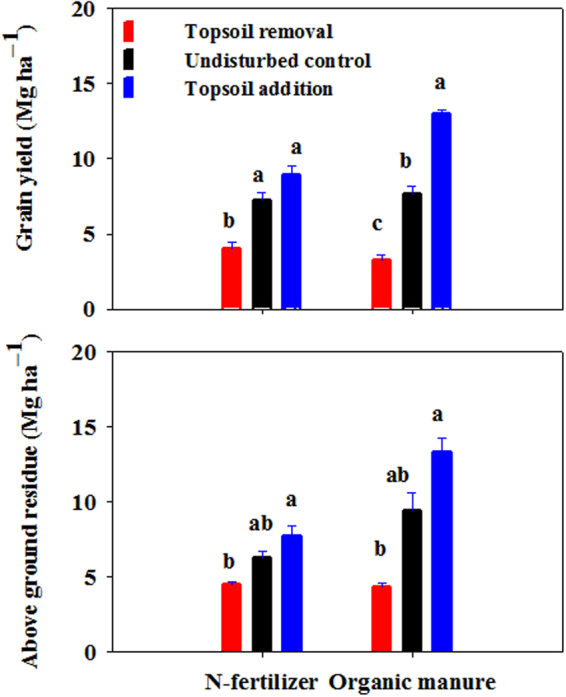
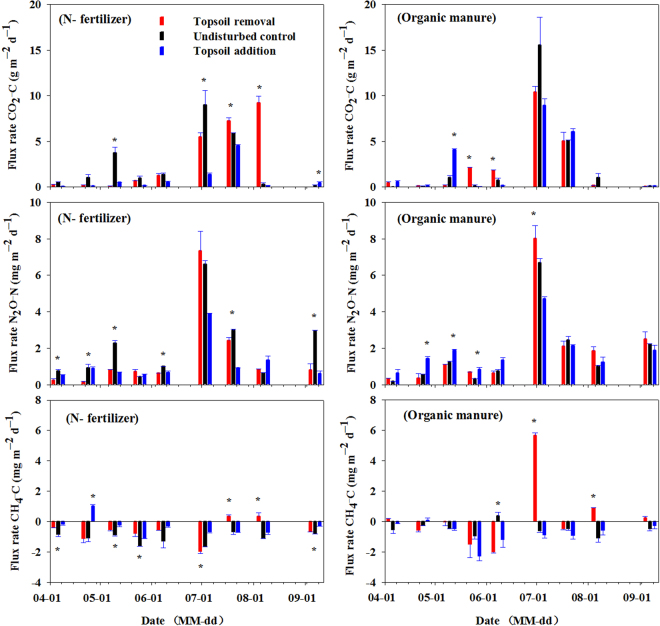
Erosion-induced topsoil loss is a threat to sustainable productivity. Topsoil removal from, or added to, the existing surface is an efficient technique to simulate on-site soil erosion and deposition. A 15-year simulated erosion was conducted at Waterman Farm of Ohio State University to assess impacts of topsoil depth on greenhouse gas (GHG) emissions and maize yield. Three topsoil treatments were investigated: 20 cm topsoil removal, 20 cm topsoil addition, and undisturbed control. Results show that the average global warming potential (GWP) (Mg CO Eq ha growing season) from the topsoil removal plot (18.07) exhibited roughly the same value as that from the undisturbed control plot (18.11), but declined evidently from the topsoil addition plot (10.58). Maize yield decreased by 51% at the topsoil removal plot, while increased by 47% at the topsoil addition plot, when compared with the undisturbed control (7.45 Mg ha). The average GWP of erosion-deposition process was 21% lower than that of the undisturbed control, but that greenhouse gas intensity (GHGI) was 22% higher due to lower yields from the topsoil removal plot. Organic manure application enhanced GWP by 15%, and promoted maize yield by 18%, but brought a small reduction GHGI (3%) against the N-fertilizer application.
土壤侵蚀导致表土流失,对可持续生产力构成威胁。从现有地表去除或添加表土是模拟现场土壤侵蚀和沉积的有效技术。俄亥俄州立大学沃特曼农场进行了为期 15 年的模拟侵蚀,以评估表土深度对温室气体 (GHG) 排放和玉米产量的影响。研究了三种表土处理:去除 20 厘米表土、添加 20 厘米表土和未扰动对照。结果表明,表土去除区(18.07 Mg CO Eq ha 生长季)的平均全球变暖潜势(GWP)与未扰动对照区(18.11 Mg CO Eq ha 生长季)大致相同,但明显低于表土添加区(10.58 Mg CO Eq ha 生长季)。与未扰动对照相比,表土去除区的玉米产量下降了 51%,而表土添加区的玉米产量增加了 47%(7.45 Mg ha)。侵蚀-沉积过程的平均 GWP 比未扰动对照低 21%,但由于表土去除区的产量较低,温室气体强度(GHGI)高出 22%。施用有机肥可使 GWP 增加 15%,使玉米产量增加 18%,但与氮肥施用相比,GHGI 略有降低(3%)。