Department of Public Health, East Carolina University, Greenville, North Carolina.
Rory Meyers College of Nursing, New York University, New York, New York.
Prev Chronic Dis. 2018 Jan 11;15:E06. doi: 10.5888/pcd15.170338.
The primary objectives of this study were 1) to examine trends of self-reported cognitive impairment among 5 major racial/ethnic groups during 1997-2015 in the United States and 2) to examine differences in the trends across these groups.
Data were from the National Health Interview Survey (NHIS). The sample consisted of 155,682 people aged 60 or older. Respondents were asked to report whether any family member was "limited in any way because of difficulty remembering or because of experiencing periods of confusion." Race/ethnicity categories were non-Hispanic white, non-Hispanic black, Native American, Hispanic, and Asian. We applied hierarchical age-period-cohort cross-classified random-effects models for the trend analysis. All analyses accounted for the complex survey design of NHIS.
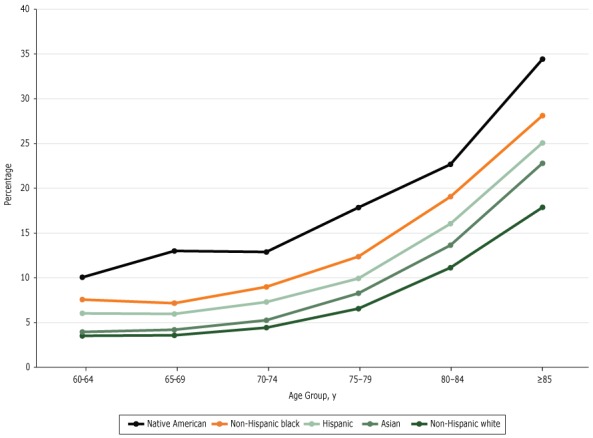
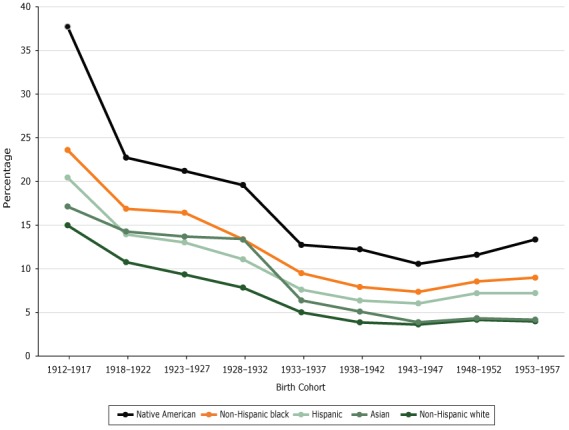
The overall rate of self-reported cognitive impairment increased from 5.7% in 1997 to 6.7% in 2015 (P for trend <.001). Among non-Hispanic white respondents, the rate increased from 5.2% in 1997 to 6.1% in 2015 (slope = 0.14, P for trend <.001). We observed no significant trend in rate of cognitive impairment in other groups. After we controlled for covariates, we found that Asian (B = 0.31), non-Hispanic black (B = 0.37), Hispanic (B = 0.25), and Native American (B = 0.87) respondents were more likely than non-Hispanic white respondents to report cognitive impairment (P <.001 for all).
We found an increased rate of self-reported cognitive impairment in older adults of 5 major racial/ethnic groups from 1997 through 2015 in the United States. However, the rate of self-reported cognitive impairment was low, which may suggest underreporting. There is a need to further promote awareness of the disease among individuals, family members, and health care providers.
本研究的主要目的是:1)在 1997 年至 2015 年间,在美国的 5 个主要种族/族裔群体中,调查自我报告的认知障碍趋势;2)研究这些群体的趋势差异。
数据来自全国健康访谈调查(NHIS)。样本包括 155682 名年龄在 60 岁及以上的人。受访者被要求报告是否有任何家庭成员“由于记忆力问题或经历过一段时间的困惑而受到任何限制。”种族/族裔类别是非西班牙裔白人、非西班牙裔黑人、美国原住民、西班牙裔和亚洲人。我们应用分层年龄-时期-队列交叉随机效应模型进行趋势分析。所有分析均考虑了 NHIS 的复杂调查设计。
自我报告的认知障碍总体发生率从 1997 年的 5.7%上升到 2015 年的 6.7%(趋势 P<.001)。在非西班牙裔白人受访者中,该比率从 1997 年的 5.2%上升到 2015 年的 6.1%(斜率=0.14,趋势 P<.001)。我们没有发现其他群体认知障碍发生率的显著趋势。在控制了协变量后,我们发现亚洲人(B=0.31)、非西班牙裔黑人(B=0.37)、西班牙裔(B=0.25)和美国原住民(B=0.87)受访者比非西班牙裔白人受访者更有可能报告认知障碍(P<.001)。
我们发现,在 1997 年至 2015 年期间,美国 5 个主要种族/族裔群体的老年人群体中自我报告的认知障碍发生率有所增加。然而,自我报告的认知障碍发生率较低,这可能表明报告不足。需要进一步提高个人、家庭成员和医疗保健提供者对该疾病的认识。