Tian Haifeng, Wu Mingquan, Wang Li, Niu Zheng
The State Key Laboratory of Remote Sensing Science, Jointly Sponsored by Institute of Remote Sensing and Digital Earth of Chinese Academy of Sciences and Beijing Normal University, P.O. Box 9718, Datun Road, Chaoyang, Beijing 100101, China.
College of Resource and Environment, University of Chinese Academy of Sciences, Yuquan Road 19, Shijingshan, Beijing 100049, China.
Sensors (Basel). 2018 Jan 11;18(1):185. doi: 10.3390/s18010185.
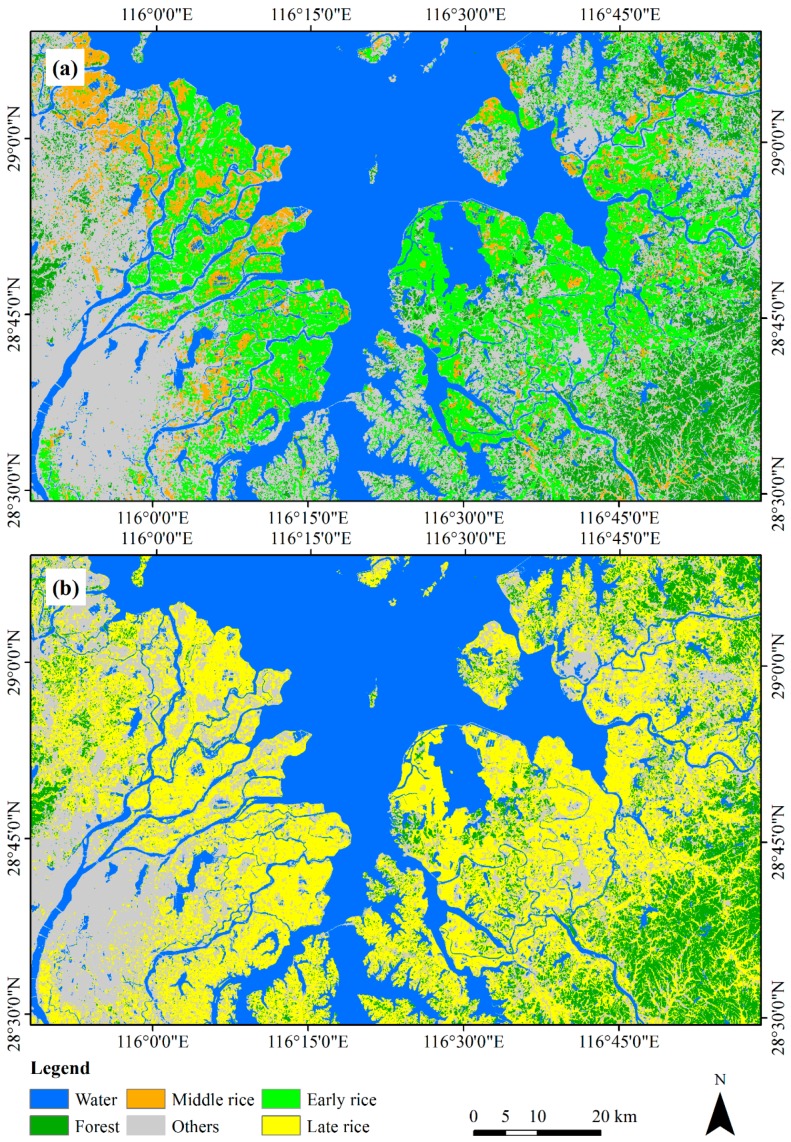
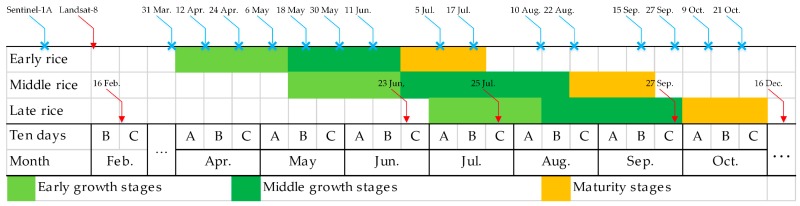
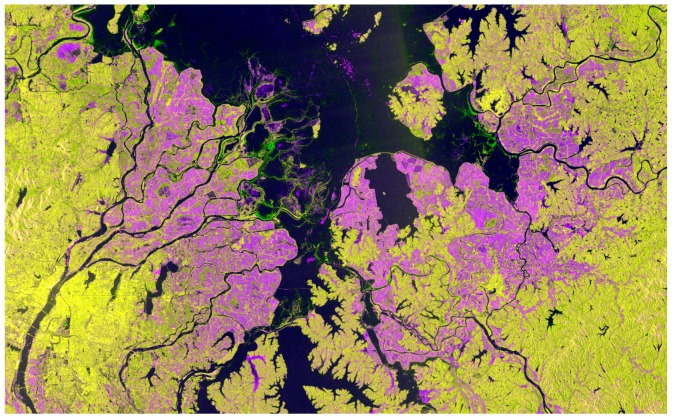
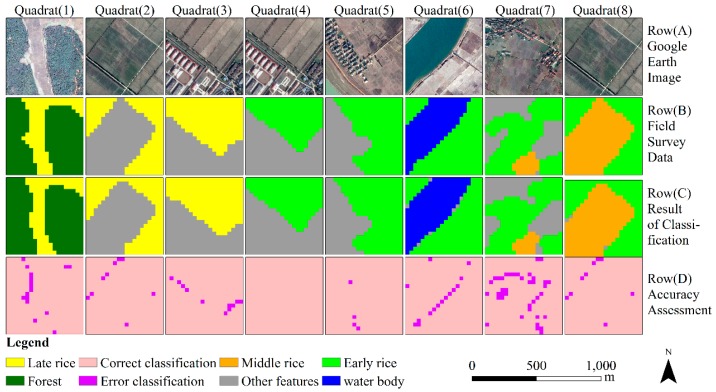
Areas and spatial distribution information of paddy rice are important for managing food security, water use, and climate change. However, there are many difficulties in mapping paddy rice, especially mapping multi-season paddy rice in rainy regions, including differences in phenology, the influence of weather, and farmland fragmentation. To resolve these problems, a novel multi-season paddy rice mapping approach based on Sentinel-1A and Landsat-8 data is proposed. First, Sentinel-1A data were enhanced based on the fact that the backscattering coefficient of paddy rice varies according to its growth stage. Second, cropland information was enhanced based on the fact that the NDVI of cropland in winter is lower than that in the growing season. Then, paddy rice and cropland areas were extracted using a K-Means unsupervised classifier with enhanced images. Third, to further improve the paddy rice classification accuracy, cropland information was utilized to optimize distribution of paddy rice by the fact that paddy rice must be planted in cropland. Classification accuracy was validated based on ground-data from 25 field survey quadrats measuring 600 m × 600 m. The results show that: multi-season paddy rice planting areas effectively was extracted by the method and adjusted early rice area of 1630.84 km², adjusted middle rice area of 556.21 km², and adjusted late rice area of 3138.37 km². The overall accuracy was 98.10%, with a kappa coefficient of 0.94.
水稻的面积和空间分布信息对于管理粮食安全、水资源利用和气候变化至关重要。然而,绘制水稻分布图存在许多困难,尤其是在多雨地区绘制多季水稻分布图,包括物候差异、天气影响和农田碎片化等问题。为了解决这些问题,提出了一种基于哨兵 - 1A 和陆地卫星 - 8 数据的新型多季水稻制图方法。首先,基于水稻后向散射系数随生长阶段变化的事实对哨兵 - 1A 数据进行增强。其次,基于冬季农田的归一化植被指数低于生长季节这一事实增强农田信息。然后,使用 K - 均值无监督分类器对增强后的图像提取水稻和农田面积。第三,为进一步提高水稻分类精度,利用农田信息,基于水稻必须种植在农田这一事实优化水稻分布。基于来自 25 个 600 m×600 m 实地调查样方的地面数据验证分类精度。结果表明:该方法有效提取了多季水稻种植面积,早稻面积调整为 1630.84 km²,中稻面积调整为 556.21 km²,晚稻面积调整为 3138.37 km²。总体精度为 98.10%,kappa 系数为 0.94。