Seyfart Tom, Friedrich Nele, Kische Hanna, Bülow Robin, Wallaschofski Henri, Völzke Henry, Nauck Matthias, Keevil Brian G, Haring Robin
Institute of Clinical Chemistry and Laboratory Medicine, University Medicine Greifswald, Greifswald, Germany.
Institute of Diagnostic Radiology and Neuroradiology, University Medicine Greifswald, Greifswald, Germany.
PLoS One. 2018 Jan 11;13(1):e0189042. doi: 10.1371/journal.pone.0189042. eCollection 2018.
The aim of this study was to evaluate the association of sex hormones with anthropometry in a large population-based cohort, with liquid chromatography-mass spectrometry (LCMS)-based sex hormone measurements and imaging markers.
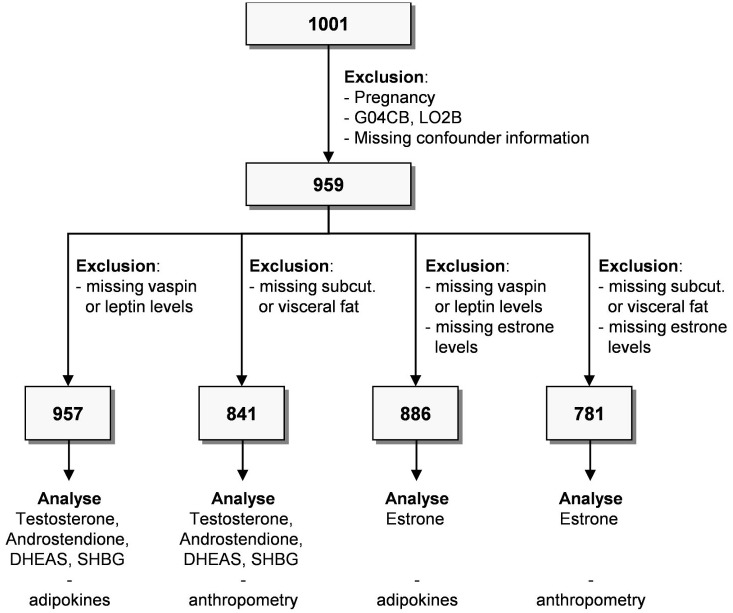
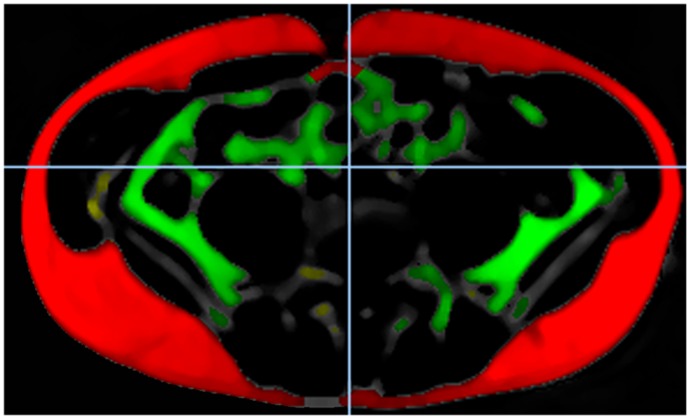
STUDY DESIGN/MAIN OUTCOME MEASURES: Cross-sectional data from 957 men and women from the population-based Study of Health in Pomerania (SHIP) were used. Associations of a comprehensive panel of LCMS-measured sex hormones with anthropometric parameters, laboratory, and imaging markers were analyzed in multivariable regression models for the full sample and stratified by sex. Sex hormone measures included total testosterone (TT), free testosterone (fT), estrone and estradiol, androstenedione (ASD), dehydroepiandrosterone sulfate (DHEAS), and sex hormone-binding globulin (SHBG). Domains of anthropometry included physical measures (body-mass-index (BMI), waist circumference, waist-to-height-ratio, waist-to-hip-ratio, and hip circumference), laboratory measures of adipokines (leptin and vaspin), and magnet resonance imaging-based measures (visceral and subcutaneous adipose tissue).
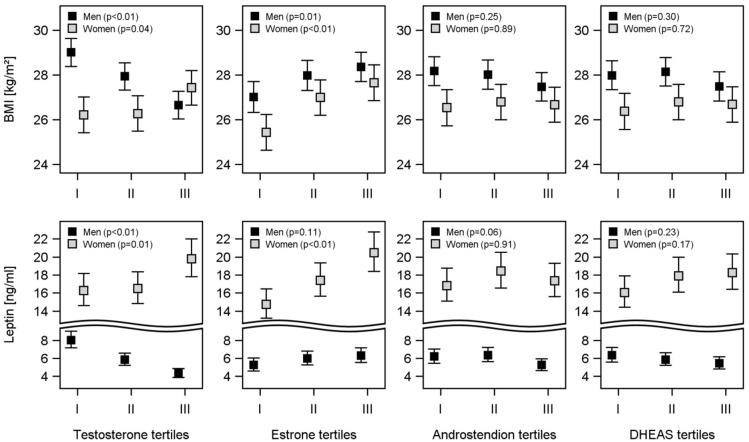
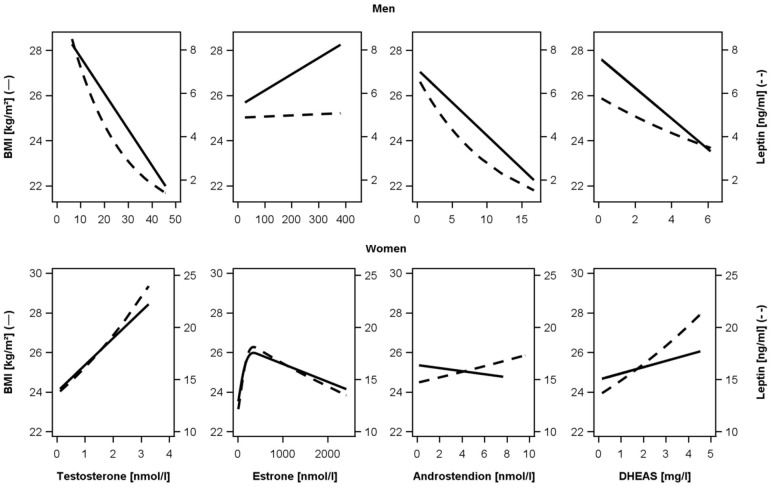
In men, inverse associations between all considered anthropometric parameters with TT were found: BMI (β-coefficient, standard error (SE): -0.159, 0.037), waist-circumference (β-coefficient, SE: -0.892, 0.292), subcutaneous adipose tissue (β-coefficient, SE: -0.156, 0.023), and leptin (β-coefficient, SE: -0.046, 0.009). In women TT (β-coefficient, SE: 1.356, 0.615) and estrone (β-coefficient, SE: 0.014, 0.005) were positively associated with BMI. In analyses of variance, BMI and leptin were inversely associated with TT, ASD, and DHEAS in men, but positively associated with estrone. In women, BMI and leptin were positively associated with all sex hormones.
The present population-based study confirmed and extended previously reported sex-specific associations between sex hormones and various anthropometric markers of overweight and obesity.
本研究旨在通过基于液相色谱 - 质谱(LCMS)的性激素测量和成像标记,评估在一个基于人群的大型队列中性激素与人体测量学之间的关联。
研究设计/主要观察指标:使用了来自基于人群的波美拉尼亚健康研究(SHIP)的957名男性和女性的横断面数据。在全样本的多变量回归模型中,并按性别分层,分析了一组通过LCMS测量的综合性激素与人体测量参数、实验室指标及成像标记之间的关联。性激素测量指标包括总睾酮(TT)、游离睾酮(fT)、雌酮和雌二醇、雄烯二酮(ASD)、硫酸脱氢表雄酮(DHEAS)以及性激素结合球蛋白(SHBG)。人体测量学领域包括身体测量指标(体重指数(BMI)、腰围、腰高比、腰臀比和臀围)、脂肪因子的实验室测量指标(瘦素和内脏脂肪素)以及基于磁共振成像的测量指标(内脏和皮下脂肪组织)。
在男性中,发现所有考虑的人体测量参数与TT之间存在负相关:BMI(β系数,标准误(SE):-0.159,0.037)、腰围(β系数,SE:-0.892,0.292)、皮下脂肪组织(β系数,SE:-0.156,0.023)和瘦素(β系数,SE:-0.046,0.009)。在女性中,TT(β系数,SE:1.356,0.615)和雌酮(β系数,SE:0.014,0.005)与BMI呈正相关。在方差分析中,男性的BMI和瘦素与TT、ASD和DHEAS呈负相关,但与雌酮呈正相关。在女性中,BMI和瘦素与所有性激素呈正相关。
本基于人群的研究证实并扩展了先前报道的性激素与超重和肥胖的各种人体测量标记之间的性别特异性关联。