Department of Pathology, The Second People's Hospital of Hefei, Hefei Hospital Affiliated to Anhui Medical University, Hefei, Anhui, China (mainland).
Med Sci Monit. 2023 Aug 27;29:e941394. doi: 10.12659/MSM.941394.
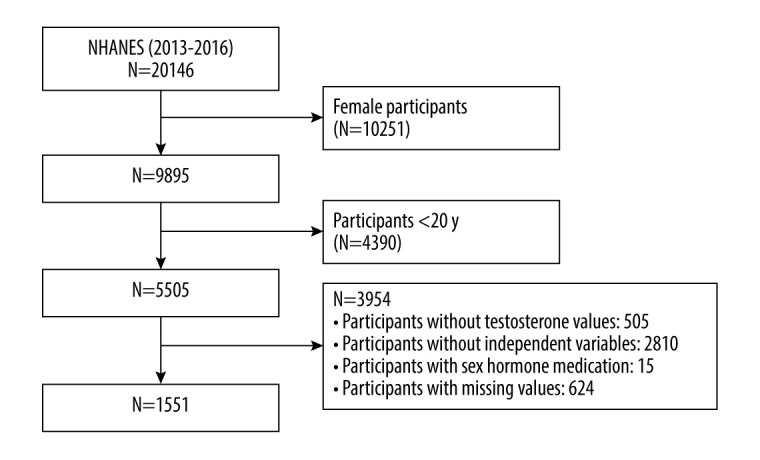
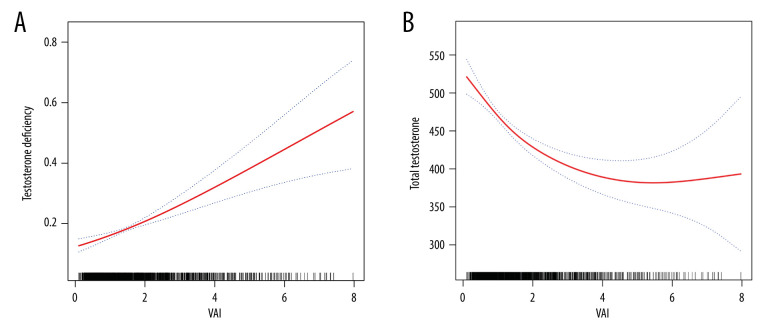
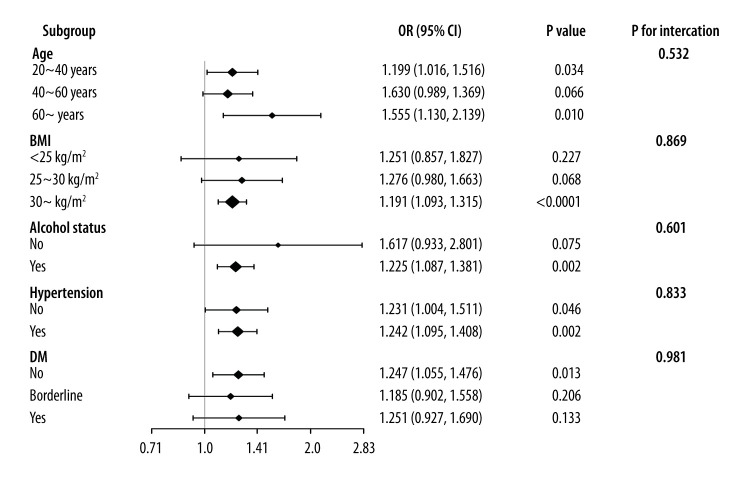
BACKGROUND Testosterone decline and deficiency importantly affect men's health, and may be associated with excessive deposition of visceral adipose tissue. This study was conducted to explore the association between visceral adiposity index (VAI) and testosterone level. MATERIAL AND METHODS A total of 1551 participants from the NHANES 2013-2013 cycle and 2015-2016 cycle were selected for our analyses. The VAI index was calculated based on waist circumference (WC), body mass index (BMI), triglyceride (TG), and high-density lipoprotein cholesterol (HDL-c), and serum testosterone was measured by isotope dilution liquid chromatography tandem mass spectrometry. Multivariable adjusted linear and logistic regression were utilized to investigate the associations between VAI index and testosterone level and testosterone deficiency, respectively. Additionally, subgroup analyses were performed to identify sensitive populations. RESULTS A total of 1551 participants with mean VAI index of 1.95±0.08 were eligible for our analysis. After adjusting for all potential cofounders, men with higher VAI index displayed a lower level of total testosterone level (ß: -11.74, 95% CI: -17.33, -6.15, P<0.0001), and higher risk of testosterone deficiency (OR: 1.24, 95% CI: 1.09, 1.40, P=0.0022). Comparing to VAI quartile 1, quartile 4 showed the most decreased testosterone level (ß: -94.59, 95% CI: -130.04, -59.14, P<0.0001), and highest risk of testosterone deficiency (OR: 5.07, 95% CI: 2.41,10.63, P<0.0001). Subgroup analysis demonstrated that VAI index was strongly related to testosterone level and testosterone deficiency in aged and obese men. CONCLUSIONS Men with higher VAI index displayed lower testosterone levels and higher risk of testosterone deficiency, especially in aged men and obese men.
睾丸酮的下降和缺乏会严重影响男性健康,并且可能与内脏脂肪组织的过度沉积有关。本研究旨在探讨内脏脂肪指数(VAI)与睾丸酮水平之间的关系。
我们对来自 NHANES 2013-2013 周期和 2015-2016 周期的 1551 名参与者进行了分析。VAI 指数是根据腰围(WC)、体重指数(BMI)、甘油三酯(TG)和高密度脂蛋白胆固醇(HDL-c)计算得出的,血清睾丸酮则采用同位素稀释液相色谱串联质谱法测量。利用多变量调整线性和逻辑回归分析分别探讨了 VAI 指数与睾丸酮水平和睾丸酮缺乏之间的关系。此外,还进行了亚组分析以确定敏感人群。
共有 1551 名 VAI 指数平均值为 1.95±0.08 的参与者符合我们的分析要求。在调整了所有潜在混杂因素后,VAI 指数较高的男性总睾丸酮水平较低(ß:-11.74,95%CI:-17.33,-6.15,P<0.0001),且睾丸酮缺乏的风险更高(OR:1.24,95%CI:1.09,1.40,P=0.0022)。与 VAI 四分位 1 相比,四分位 4 显示出最低的睾丸酮水平(ß:-94.59,95%CI:-130.04,-59.14,P<0.0001)和最高的睾丸酮缺乏风险(OR:5.07,95%CI:2.41,10.63,P<0.0001)。亚组分析表明,VAI 指数与年龄较大和肥胖男性的睾丸酮水平和睾丸酮缺乏密切相关。
VAI 指数较高的男性睾丸酮水平较低,睾丸酮缺乏的风险较高,尤其是在年龄较大和肥胖的男性中。