Department of Physiology and Biophysics, Weill Cornell Medicine-Qatar, Education City, PO Box 24144, Doha, Qatar.
Computer Engineering Department, Virginia Tech, Blacksburg, VA 24061, USA.
Hum Mol Genet. 2018 Mar 15;27(6):1106-1121. doi: 10.1093/hmg/ddy006.
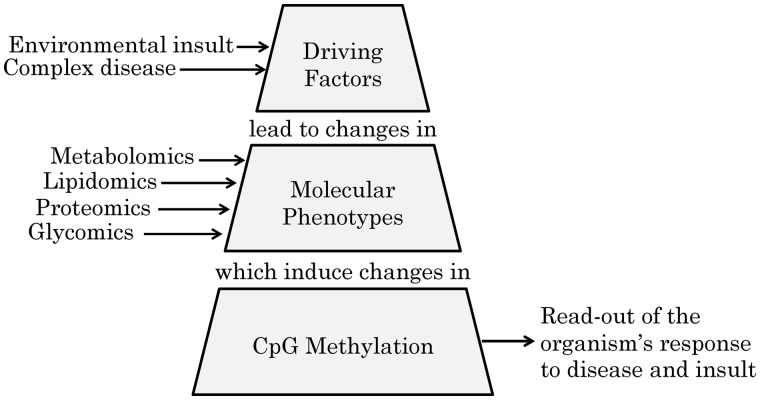
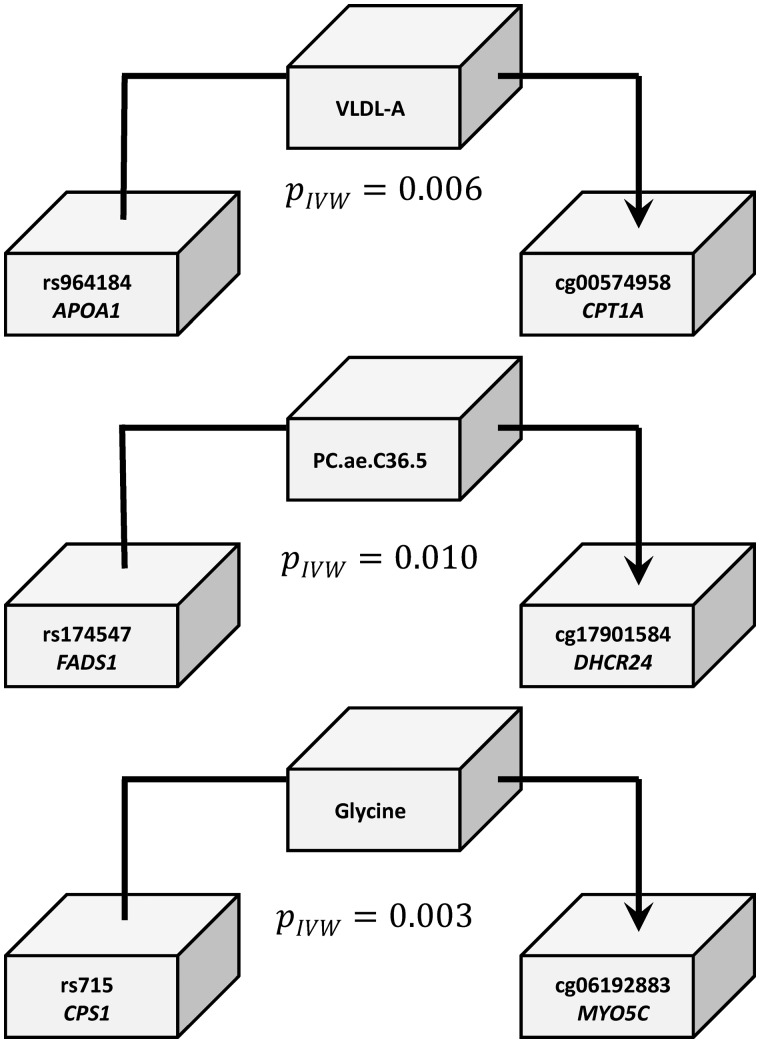
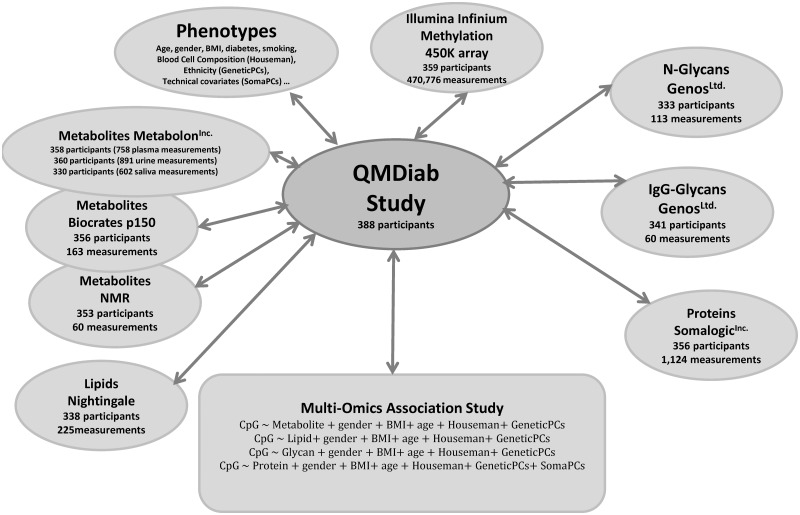
Epigenetic regulation of cellular function provides a mechanism for rapid organismal adaptation to changes in health, lifestyle and environment. Associations of cytosine-guanine di-nucleotide (CpG) methylation with clinical endpoints that overlap with metabolic phenotypes suggest a regulatory role for these CpG sites in the body's response to disease or environmental stress. We previously identified 20 CpG sites in an epigenome-wide association study (EWAS) with metabolomics that were also associated in recent EWASs with diabetes-, obesity-, and smoking-related endpoints. To elucidate the molecular pathways that connect these potentially regulatory CpG sites to the associated disease or lifestyle factors, we conducted a multi-omics association study including 2474 mass-spectrometry-based metabolites in plasma, urine and saliva, 225 NMR-based lipid and metabolite measures in blood, 1124 blood-circulating proteins using aptamer technology, 113 plasma protein N-glycans and 60 IgG-glyans, using 359 samples from the multi-ethnic Qatar Metabolomics Study on Diabetes (QMDiab). We report 138 multi-omics associations at these CpG sites, including diabetes biomarkers at the diabetes-associated TXNIP locus, and smoking-specific metabolites and proteins at multiple smoking-associated loci, including AHRR. Mendelian randomization suggests a causal effect of metabolite levels on methylation of obesity-associated CpG sites, i.e. of glycerophospholipid PC(O-36: 5), glycine and a very low-density lipoprotein (VLDL-A) on the methylation of the obesity-associated CpG loci DHCR24, MYO5C and CPT1A, respectively. Taken together, our study suggests that multi-omics-associated CpG methylation can provide functional read-outs for the underlying regulatory response mechanisms to disease or environmental insults.
细胞功能的表观遗传调控为生物体快速适应健康、生活方式和环境变化提供了一种机制。胞嘧啶-鸟嘌呤二核苷酸 (CpG) 甲基化与代谢表型重叠的临床终点相关联,这表明这些 CpG 位点在机体对疾病或环境应激的反应中具有调节作用。我们之前在一项与代谢组学相关的全基因组关联研究 (EWAS) 中发现了 20 个 CpG 位点,这些 CpG 位点在最近的 EWAS 中也与糖尿病、肥胖和吸烟相关的终点相关联。为了阐明将这些潜在调节性 CpG 位点与相关疾病或生活方式因素联系起来的分子途径,我们进行了一项多组学关联研究,其中包括来自卡塔尔代谢组学糖尿病研究 (QMDiab) 的 359 个样本中的 2474 种基于质谱的血浆、尿液和唾液代谢物,225 种基于 NMR 的血液脂质和代谢物测量,1124 种基于适配体技术的血液循环蛋白,113 种血浆蛋白 N-糖链和 60 种 IgG 糖链。我们在这些 CpG 位点报告了 138 个多组学关联,包括与糖尿病相关的 TXNIP 基因座的糖尿病生物标志物,以及在多个与吸烟相关的基因座(包括 AHRR)中发现的吸烟特异性代谢物和蛋白质。孟德尔随机化表明代谢物水平对肥胖相关 CpG 位点甲基化的因果效应,即甘油磷脂 PC(O-36:5)、甘氨酸和极低密度脂蛋白 (VLDL-A) 对肥胖相关 CpG 位点 DHCR24、MYO5C 和 CPT1A 的甲基化。总之,我们的研究表明,多组学关联的 CpG 甲基化可以为疾病或环境损伤的潜在调节反应机制提供功能读出。