Institute for Computational Biomedicine, Weill Cornell Medicine, New York, NY, USA.
Department of Physiology and Biophysics, Weill Cornell Medicine, New York, NY, USA.
Commun Biol. 2024 Sep 6;7(1):1094. doi: 10.1038/s42003-024-06724-2.
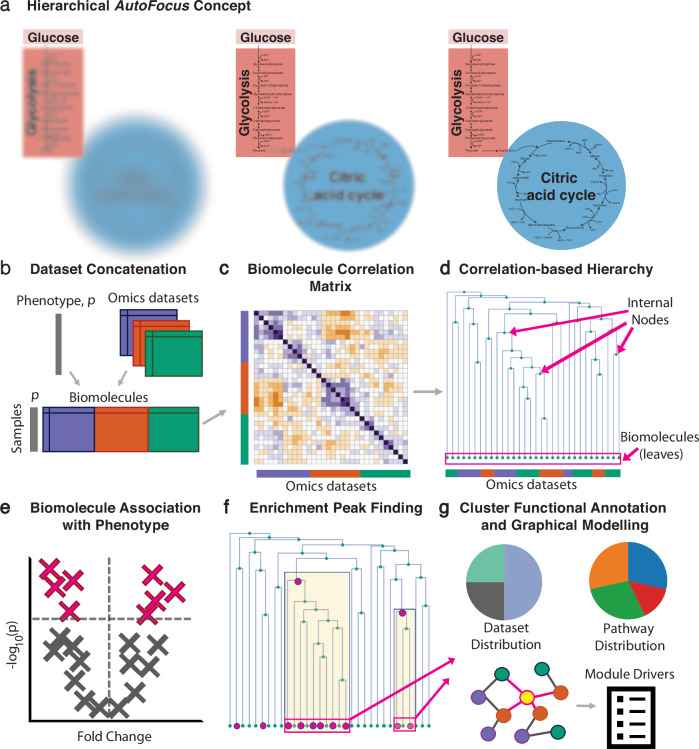
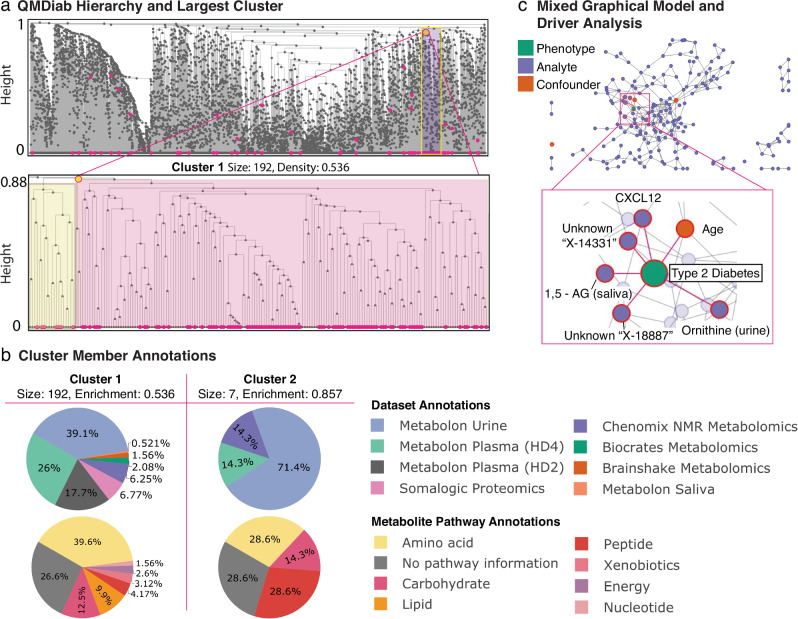
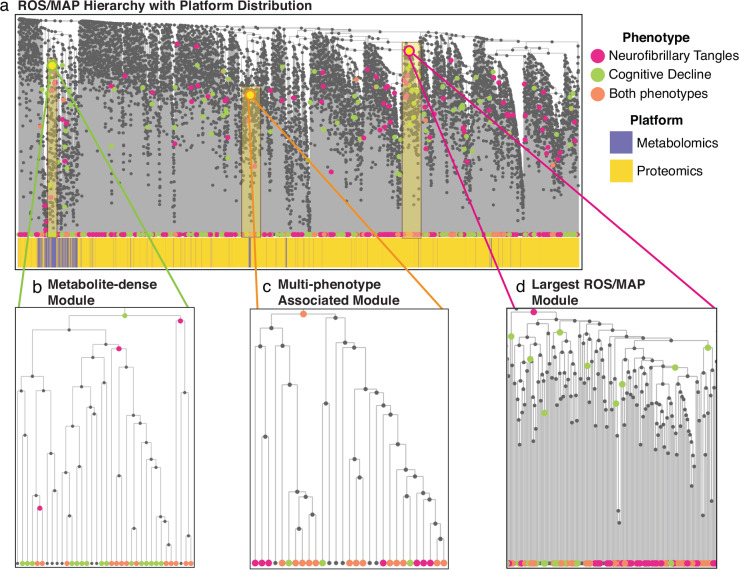
Recent advances in high-throughput measurement technologies have enabled the analysis of molecular perturbations associated with disease phenotypes at the multi-omic level. Such perturbations can range in scale from fluctuations of individual molecules to entire biological pathways. Data-driven clustering algorithms have long been used to group interactions into interpretable functional modules; however, these modules are typically constrained to a fixed size or statistical cutoff. Furthermore, modules are often analyzed independently of their broader biological context. Consequently, such clustering approaches limit the ability to explore functional module associations with disease phenotypes across multiple scales. Here, we introduce AutoFocus, a data-driven method that hierarchically organizes biomolecules and tests for phenotype enrichment at every level within the hierarchy. As a result, the method allows disease-associated modules to emerge at any scale. We evaluated this approach using two datasets: First, we explored associations of biomolecules from the multi-omic QMDiab dataset (n = 388) with the well-characterized type 2 diabetes phenotype. Secondly, we utilized the ROS/MAP Alzheimer's disease dataset (n = 500), consisting of high-throughput measurements of brain tissue to explore modules associated with multiple Alzheimer's Disease-related phenotypes. Our method identifies modules that are multi-omic, span multiple pathways, and vary in size. We provide an interactive tool to explore this hierarchy at different levels and probe enriched modules, empowering users to examine the full hierarchy, delve into biomolecular drivers of disease phenotype within a module, and incorporate functional annotations.
近年来,高通量测量技术的进步使得能够在多组学水平上分析与疾病表型相关的分子扰动。这种扰动的范围可以从单个分子的波动到整个生物途径。数据驱动的聚类算法长期以来一直用于将相互作用分组为可解释的功能模块;然而,这些模块通常受到固定大小或统计截止值的限制。此外,模块通常独立于其更广泛的生物学背景进行分析。因此,这种聚类方法限制了跨多个尺度探索功能模块与疾病表型之间关联的能力。在这里,我们引入了 AutoFocus,这是一种数据驱动的方法,它对生物分子进行层次化组织,并在层次结构中的每个级别上测试表型富集。因此,该方法允许在任何尺度上出现与疾病相关的模块。我们使用两个数据集评估了这种方法:首先,我们探索了来自多组学 QMDiab 数据集(n=388)的生物分子与经过充分研究的 2 型糖尿病表型之间的关联。其次,我们利用 ROS/MAP 阿尔茨海默病数据集(n=500),该数据集包含对脑组织的高通量测量,以探索与多种阿尔茨海默病相关表型相关的模块。我们的方法确定了多组学、跨越多个途径且大小不同的模块。我们提供了一个交互式工具来在不同级别探索这个层次结构,并探测丰富的模块,使用户能够检查整个层次结构,深入研究模块内疾病表型的生物分子驱动因素,并纳入功能注释。