Musoro Zebedee Jammbe, Hamel Jean-Francois, Ediebah Divine Ewane, Cocks Kim, King Madeleine T, Groenvold Mogens, Sprangers Mirjam A G, Brandberg Yvonne, Velikova Galina, Maringwa John, Flechtner Hans-Henning, Bottomley Andrew, Coens Corneel
Quality of life department, European Organisation for Research and Treatment of Cancer, Brussels, Belgium.
Department of Methodology and Biostatistics, University Hospital of Angers UNAM, Angers, France.
BMJ Open. 2018 Jan 10;8(1):e019117. doi: 10.1136/bmjopen-2017-019117.
As patient assessment of health-related quality of life (HRQOL) in cancer clinical trials has increased over the years, so has the need to attach meaningful interpretations to differences in HRQOL scores between groups and changes within groups. Determining what represents a minimally important difference (MID) in HRQOL scores is useful to clinicians, patients and researchers, and can be used as a benchmark for assessing the success of a healthcare intervention. Our objective is to provide an evidence-based protocol to determine MIDs for the European Organisation for Research and Treatment for Cancer Quality of life Questionnaire core 30 (EORTC QLQ-C30). We will mainly focus on MID estimation for group-level comparisons. Responder thresholds for individual-level change will also be estimated.
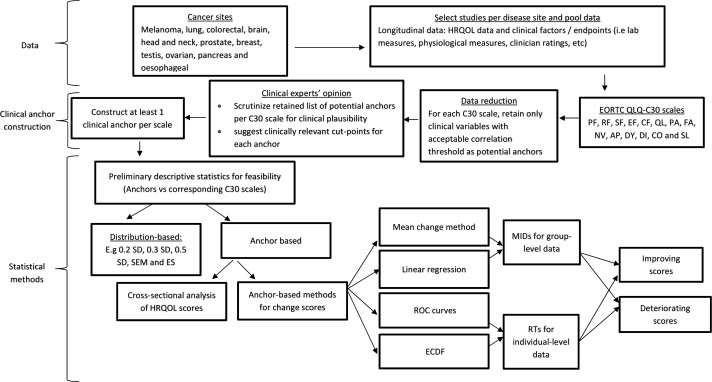
Data will be derived from published phase II and III EORTC trials that used the QLQ-C30 instrument, covering several cancer sites. We will use individual patient data to estimate MIDs for different cancer sites separately. Focus is on anchor-based methods. Anchors will be selected per disease site from available data. A disease-oriented and methodological panel will provide independent guidance on anchor selection. We aim to construct multiple clinical anchors per QLQ-C30 scale and also to compare with several anchor-based methods. The effects of covariates, for example, gender, age, disease stage and so on, will also be investigated. We will examine how our estimated MIDs compare with previously published guidelines, hence further contributing to robust MID guidelines for the EORTC QLQ-C30.
All patient data originate from completed clinical trials with mandatory written informed consent, approved by local ethical committees. Our findings will be presented at scientific conferences, disseminated via peer-reviewed publications and also compiled in a MID 'blue book' which will be made available online on the EORTC Quality of Life Group website as a free guideline document.
多年来,癌症临床试验中患者对健康相关生活质量(HRQOL)的评估有所增加,因此,对组间HRQOL评分差异及组内变化进行有意义的解读的需求也随之增加。确定HRQOL评分中具有最小重要差异(MID)的指标对临床医生、患者和研究人员都很有用,并且可作为评估医疗干预成功与否的基准。我们的目标是提供一个基于证据的方案,以确定欧洲癌症研究与治疗组织生活质量问卷核心30项(EORTC QLQ-C30)的MID。我们将主要关注组间比较的MID估计。还将估计个体水平变化的反应者阈值。
数据将来源于已发表的使用QLQ-C30工具的II期和III期EORTC试验,涵盖多个癌症部位。我们将使用个体患者数据分别估计不同癌症部位的MID。重点是基于锚定的方法。将根据疾病部位从现有数据中选择锚定指标。一个以疾病为导向的方法学小组将为锚定指标的选择提供独立指导。我们的目标是为每个QLQ-C30量表构建多个临床锚定指标,并与几种基于锚定的方法进行比较。还将研究协变量(如性别、年龄、疾病分期等)的影响。我们将研究我们估计的MID与先前发表的指南相比如何,从而进一步为EORTC QLQ-C30的稳健MID指南做出贡献。
所有患者数据均来自已完成的临床试验,这些试验均获得了当地伦理委员会批准的强制性书面知情同意书。我们的研究结果将在科学会议上展示,通过同行评审出版物传播,并汇编成一本MID“蓝皮书”,该蓝皮书将作为免费指南文件在EORTC生活质量小组网站上在线提供。