Froud Robert, Abel Gary
Clinical Trials Unit, Warwick Medical School, University of Warwick, Gibbet Hill Road, Coventry, United Kingdom; Norge Helsehøyskole, Campus Kristiania, Prinsens Gate 7-9, Oslo, Norway.
Cambridge Centre for Health Services Research, University of Cambridge, Robinson Way Cambridge, Cambridgeshire, United Kingdom.
PLoS One. 2014 Dec 4;9(12):e114468. doi: 10.1371/journal.pone.0114468. eCollection 2014.
Receiver Operator Characteristic (ROC) curves are being used to identify Minimally Important Change (MIC) thresholds on scales that measure a change in health status. In quasi-continuous patient reported outcome measures, such as those that measure changes in chronic diseases with variable clinical trajectories, sensitivity and specificity are often valued equally. Notwithstanding methodologists agreeing that these should be valued equally, different approaches have been taken to estimating MIC thresholds using ROC curves.
We aimed to compare the different approaches used with a new approach, exploring the extent to which the methods choose different thresholds, and considering the effect of differences on conclusions in responder analyses.
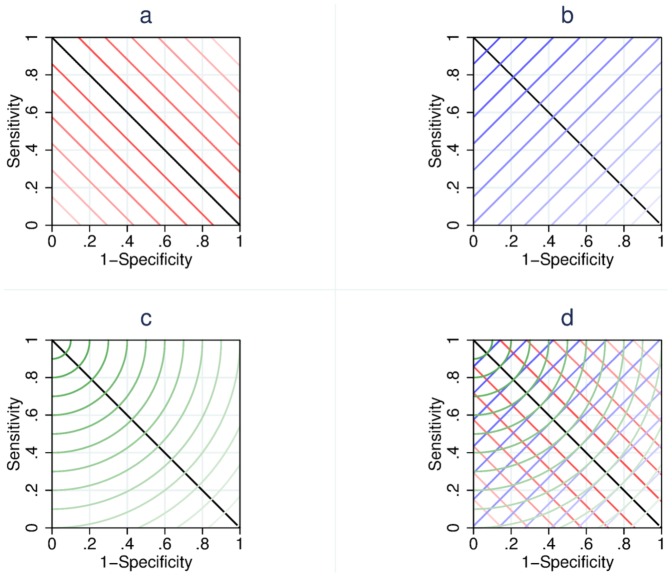
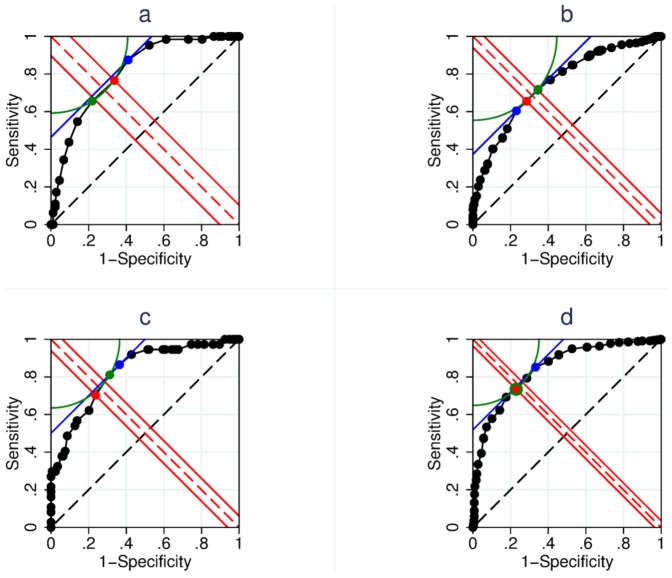
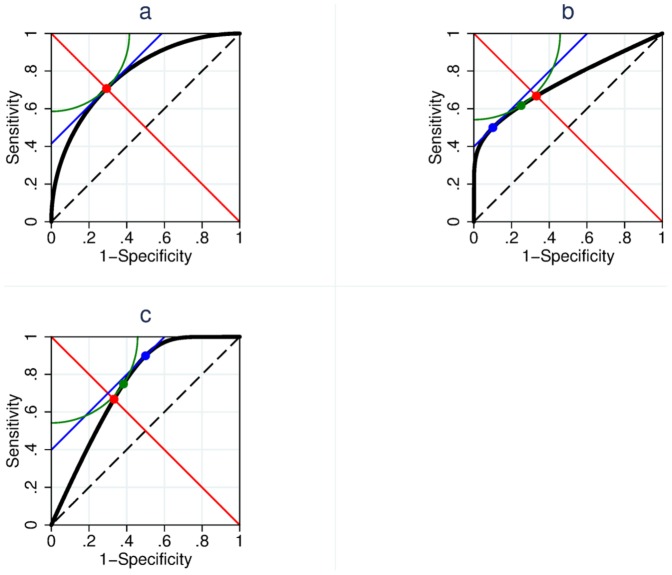
Using graphical methods, hypothetical data, and data from a large randomised controlled trial of manual therapy for low back pain, we compared two existing approaches with a new approach that is based on the addition of the sums of squares of 1-sensitivity and 1-specificity.
There can be divergence in the thresholds chosen by different estimators. The cut-point selected by different estimators is dependent on the relationship between the cut-points in ROC space and the different contours described by the estimators. In particular, asymmetry and the number of possible cut-points affects threshold selection.
Choice of MIC estimator is important. Different methods for choosing cut-points can lead to materially different MIC thresholds and thus affect results of responder analyses and trial conclusions. An estimator based on the smallest sum of squares of 1-sensitivity and 1-specificity is preferable when sensitivity and specificity are valued equally. Unlike other methods currently in use, the cut-point chosen by the sum of squares method always and efficiently chooses the cut-point closest to the top-left corner of ROC space, regardless of the shape of the ROC curve.
受试者工作特征(ROC)曲线正被用于确定衡量健康状况变化的量表上的最小重要变化(MIC)阈值。在准连续的患者报告结局测量中,例如那些测量具有可变临床轨迹的慢性病变化的测量,敏感性和特异性通常被同等重视。尽管方法学家们一致认为这些应该被同等重视,但使用ROC曲线估计MIC阈值时采用了不同的方法。
我们旨在将不同的方法与一种新方法进行比较,探讨这些方法选择不同阈值的程度,并考虑差异对反应者分析结论的影响。
使用图形方法、假设数据以及一项关于腰痛手法治疗的大型随机对照试验的数据,我们将两种现有方法与一种基于1 - 敏感性和1 - 特异性平方和相加的新方法进行了比较。
不同估计器选择的阈值可能存在差异。不同估计器选择的切点取决于ROC空间中切点与估计器所描述的不同轮廓之间的关系。特别是,不对称性和可能的切点数量会影响阈值选择。
MIC估计器的选择很重要。选择切点的不同方法可能导致实质上不同的MIC阈值,从而影响反应者分析的结果和试验结论。当敏感性和特异性被同等重视时,基于1 - 敏感性和1 - 特异性最小平方和的估计器更可取。与目前使用的其他方法不同,平方和方法选择的切点总是且有效地选择最接近ROC空间左上角的切点,而不管ROC曲线的形状如何。