Zhan Yifan, Carrington Emma M, Zhang Yuxia, Heinzel Susanne, Lew Andrew M
The Walter and Eliza Hall Institute of Medical Research, Parkville, VIC, Australia.
Department of Medical Biology, University of Melbourne, Parkville, VIC, Australia.
Front Immunol. 2017 Dec 13;8:1809. doi: 10.3389/fimmu.2017.01809. eCollection 2017.
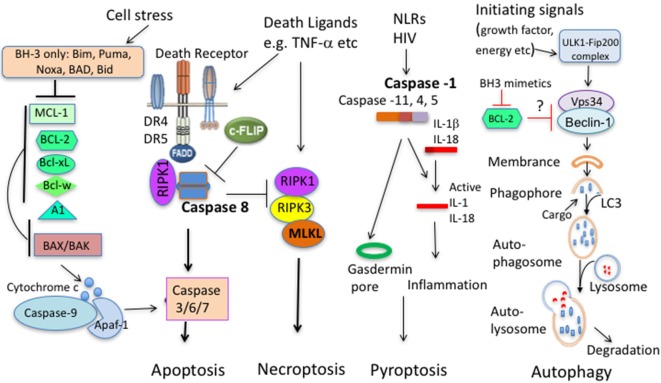
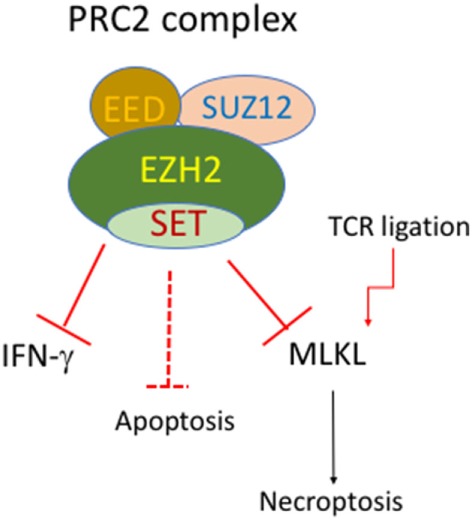
T cells are pivotal in immunity and immunopathology. After activation, T cells undergo a clonal expansion and differentiation followed by a contraction phase, once the pathogen has been cleared. Cell survival and cell death are critical for controlling the numbers of naïve T cells, effector, and memory T cells. While naïve T cell survival has been studied for a long time, more effort has gone into understanding the survival and death of activated T cells. Despite this effort, there is still much to be learnt about T cell survival, as T cells transition from naïve to effector to memory. One key advance is the development of inhibitors that may allow the temporal study of survival mechanisms operating in these distinct cell states. Naïve T cells were highly reliant on BCL-2 and sensitive to BCL-2 inhibition. Activated T cells are remarkably different in their regulation of apoptosis by pro- and antiapoptotic members of the BCL-2 family, rendering them differentially sensitive to antagonists blocking the function of one or more members of this family. Recent progress in understanding other programmed cell death mechanisms, especially necroptosis, suggests a unique role for alternative pathways in regulating death of activated T cells. Furthermore, we highlight a mechanism of epigenetic regulation of cell survival unique to activated T cells. Together, we present an update of our current understanding of the survival requirement of activated T cells.
T细胞在免疫和免疫病理学中起着关键作用。激活后,T细胞经历克隆扩增和分化,一旦病原体被清除,随后进入收缩期。细胞存活和细胞死亡对于控制初始T细胞、效应T细胞和记忆T细胞的数量至关重要。虽然对初始T细胞存活的研究由来已久,但人们更多地致力于了解活化T细胞的存活和死亡。尽管付出了这些努力,但随着T细胞从初始状态转变为效应状态再到记忆状态,关于T细胞存活仍有许多有待了解之处。一个关键进展是开发了抑制剂,这可能有助于对在这些不同细胞状态下运行的存活机制进行时间研究。初始T细胞高度依赖BCL-2且对BCL-2抑制敏感。活化T细胞在BCL-2家族的促凋亡和抗凋亡成员对细胞凋亡的调节方面有显著差异,这使得它们对阻断该家族一个或多个成员功能的拮抗剂有不同的敏感性。在理解其他程序性细胞死亡机制,尤其是坏死性凋亡方面的最新进展表明,替代途径在调节活化T细胞死亡中具有独特作用。此外,我们强调了活化T细胞特有的细胞存活表观遗传调控机制。我们共同展示了目前对活化T细胞存活需求的最新理解。