Lopez Benjamin, Bahuaud Mathilde, Fieschi Claire, Mehlal Souad, Jeljeli Mohamed, Rogeau Stéphanie, Brabant Séverine, Deleplancque Anne-Sophie, Dubucquoi Sylvain, Poizot Sandrine, Terriou Louis, Launay David, Batteux Frédéric, Labalette Myriam, Lefèvre Guillaume
CHU Lille, Institut d'Immunologie, Lille, France.
Univ. Lille, U995 - LIRIC - Lille Inflammation Research International Center, Lille, France.
Front Immunol. 2017 Dec 20;8:1862. doi: 10.3389/fimmu.2017.01862. eCollection 2017.
An overall response assay [OVA, based on a 23-valent pneumococcal polysaccharide vaccine (PPV23)] is widely used to screen for anti-pneumococcal antibodies. Given the heterogeneity of response from one polysaccharide (PS) to another, a World Health Organization-standardized serotype-specific enzyme-linked immunosorbent assay (SSA) is considered to be the only reliable method for testing anti-PS antibody responses in individuals with suspected primary immunodeficiencies (PIDs).
To evaluate the OVA relative to the reference SSA.
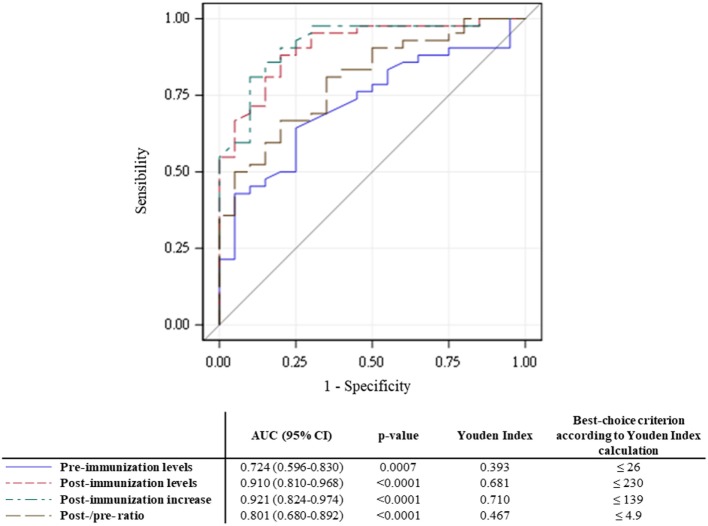
Serum samples of adult patients referred for a suspected PID were collected before and then 4-8 weeks after immunization with PPV23. The anti-pneumococcal response was systematically assessed with an SSA (7-16 serotypes) and interpreted according to the American Academy of Asthma, Allergy and Immunology's current guidelines. We used receiver operating characteristic curves and agreement indices to assess the OVA's diagnostic value in a first cohort. In order to validate these findings, a second (validation) cohort was then prospectively included.
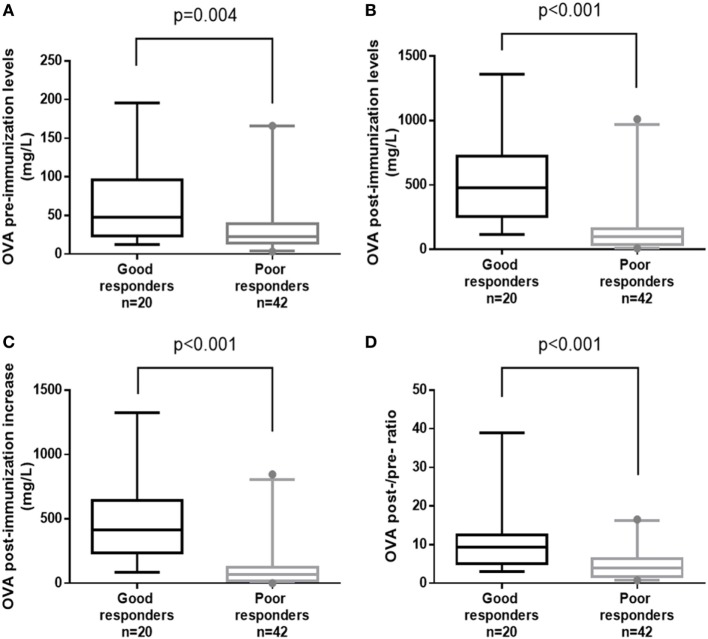
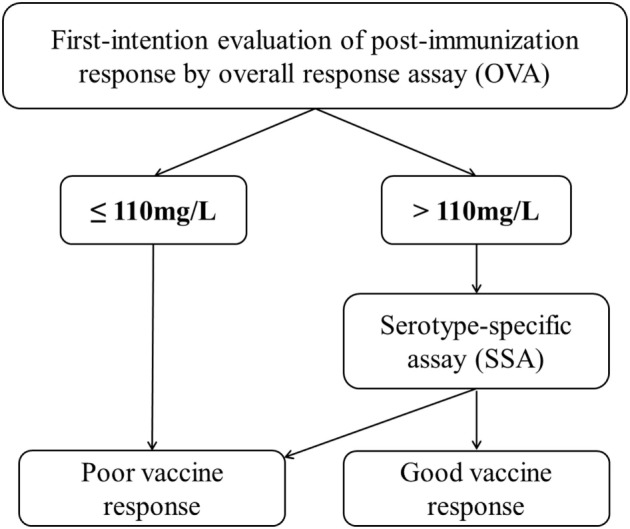
Sixty-two adult patients were included, and 42 (67.7%) were defined as poor responders according to the SSA. Only the post-immunization titer in the OVA was able to correctly identify poor responders; a titer below 110 mg/L gave a positive predictive value of 100% [identifying 24 (57.1%) of the 42 poor responders], and similar levels of diagnostic performance were observed in the validation cohort. The pre-vaccination antibody titer, the post/pre-vaccination antibody titer ratio and a post-vaccination titer above 110 mg/L in the OVA were not predictive of the response in the SSA.
A post-vaccination antibody titer below 110 mg/L in the OVA was constantly associated with a poor PPV23 response using the SSA. In all other cases, SSA is the only reliable method for assessing diagnostic vaccination with PPV23.
一种总体反应检测方法[基于23价肺炎球菌多糖疫苗(PPV23)的OVA]被广泛用于筛查抗肺炎球菌抗体。鉴于不同多糖(PS)之间反应的异质性,世界卫生组织标准化的血清型特异性酶联免疫吸附测定(SSA)被认为是检测疑似原发性免疫缺陷(PID)个体抗PS抗体反应的唯一可靠方法。
相对于参考SSA评估OVA。
收集因疑似PID转诊的成年患者血清样本,在接种PPV23前及接种后4 - 8周采集。用SSA(7 - 16种血清型)系统评估抗肺炎球菌反应,并根据美国哮喘、过敏和免疫学会的现行指南进行解读。我们使用受试者操作特征曲线和一致性指数评估OVA在第一个队列中的诊断价值。为了验证这些发现,随后前瞻性纳入了第二个(验证)队列。
纳入62例成年患者,根据SSA,42例(67.7%)被定义为低反应者。只有OVA中接种后的滴度能够正确识别低反应者;滴度低于110mg/L时,阳性预测值为100%[识别出42例低反应者中的24例(57.1%)],在验证队列中观察到类似水平的诊断性能。OVA中接种前抗体滴度、接种前/后抗体滴度比值以及接种后滴度高于110mg/L均不能预测SSA中的反应。
OVA中接种后抗体滴度低于110mg/L与使用SSA时PPV23反应不佳始终相关。在所有其他情况下,SSA是评估PPV23诊断性接种的唯一可靠方法。