Teng Changcai, Du Dezhi, Xiao Lu, Yu Qinglan, Shang Guoxia, Zhao Zhigang
State Key Laboratory of Plateau Ecology and Agriculture of Qinghai University; Key Laboratory of Qinghai Province for Spring Rapeseed Genetic Improvement, Spring Rapeseed Research and Development Center of Qinghai Province, National Key Laboratory Breeding Base-Key Laboratory of Qinghai Province for Plateau Crop Germplasm Innovation and Utilization, Institute of Spring Rapeseed, Academy of Agriculture and Forestry Sciences, Qinghai University, Xining, China.
Front Plant Sci. 2017 Dec 13;8:2086. doi: 10.3389/fpls.2017.02086. eCollection 2017.
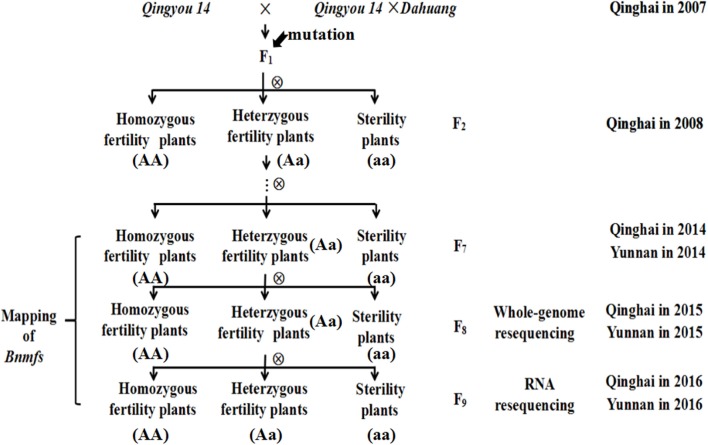
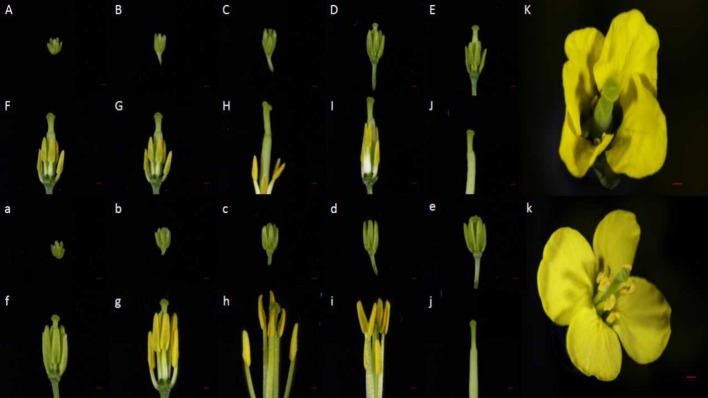
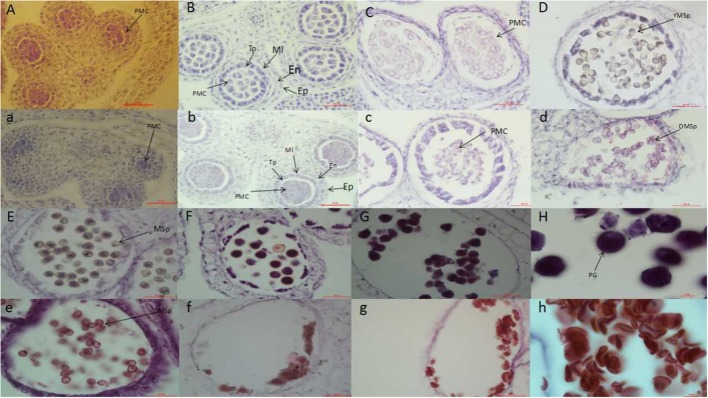
In oilseed crops, carpel and stamen development play vital roles in pollination and rapeseed yield, but the genetic mechanisms underlying carpel and stamen development remain unclear. Herein, a male- and female-sterile mutant was obtained in offspring of a ( cv. Qingyou 14) × (Qingyou 14 × landrace Dahuang) cross. Subsequently, F-F populations were generated through selfing of the heterozygote plants among the progeny of each generation. The male- and female-sterility exhibited stable inheritance in successive generations and was controlled by a recessive gene. The mutant kept the same chromosome number (2 = 38) as parent but showed abnormal meiosis for male and female. One candidate gene for the sterility was identified by simple sequence repeat (SSR) and insertion deletion length polymorphism (InDel) markers in F-F plants, and whole-genome resequencing with F pools and RNA sequencing with F pools. Whole-genome resequencing found three candidate intervals (35.40-35.68, 35.74-35.75, and 45.34-46.45 Mb) on chromosome C3 in and candidate region for was narrowed to approximately 1.11-Mb (45.34-46.45 M) by combining SSR and InDel marker analyses with whole-genome resequencing. From transcriptome profiling in 0-2 mm buds, all of the genes in the candidate interval were detected, and only two genes with significant differences (BnaC03g56670D and BnaC03g56870D) were revealed. BnaC03g56870D was a candidate gene that shared homology with the gene of . Quantitative reverse transcription (qRT)-PCR analysis showed that primarily functioned in flower buds. Thus, sequencing and expression analyses provided evidence that BnaC03g56870D was the candidate gene for male and female sterility in the mutant.
在油料作物中,心皮和雄蕊的发育在授粉和油菜籽产量方面起着至关重要的作用,但其发育的遗传机制仍不清楚。在此,通过(品种青油14)×(青油14×地方品种大黄)杂交的后代中获得了一个雄性和雌性不育突变体。随后,通过每代子代中杂合子植株的自交产生了F1-F2群体。雄性和雌性不育在连续世代中表现出稳定的遗传,并且由一个隐性基因控制。该突变体与亲本保持相同的染色体数(2n = 38),但雄性和雌性减数分裂异常。通过F1-F2植株中的简单序列重复(SSR)和插入缺失长度多态性(InDel)标记,以及F2池的全基因组重测序和F2池的RNA测序,鉴定了一个不育候选基因。全基因组重测序在C3染色体上发现了三个候选区间(35.40-35.68、35.74-35.75和45.34-46.45 Mb),通过将SSR和InDel标记分析与全基因组重测序相结合,将候选区域缩小到约1.11 Mb(45.34-46.45 Mb)。通过对0-2 mm花蕾的转录组分析,检测到候选区间内的所有基因,仅发现两个有显著差异的基因(BnaC03g56670D和BnaC03g56870D)。BnaC03g56870D是一个与拟南芥的MS1基因具有同源性的候选基因。定量逆转录(qRT)-PCR分析表明,BnaC03g56870D主要在花芽中发挥作用。因此,测序和表达分析提供了证据,表明BnaC03g56870D是该突变体中雄性和雌性不育的候选基因。