State Key Laboratory of Virology, College of Chemistry and Molecule Sciences, Wuhan University, Wuhan, 430072, China.
Department of Environmental Microbiology, UFZ - Helmholtz Centre for Environmental Research, Permoserstrasse 15, 04318, Leipzig, Germany.
Microb Biotechnol. 2018 Nov;11(6):1112-1120. doi: 10.1111/1751-7915.13042. Epub 2018 Jan 12.
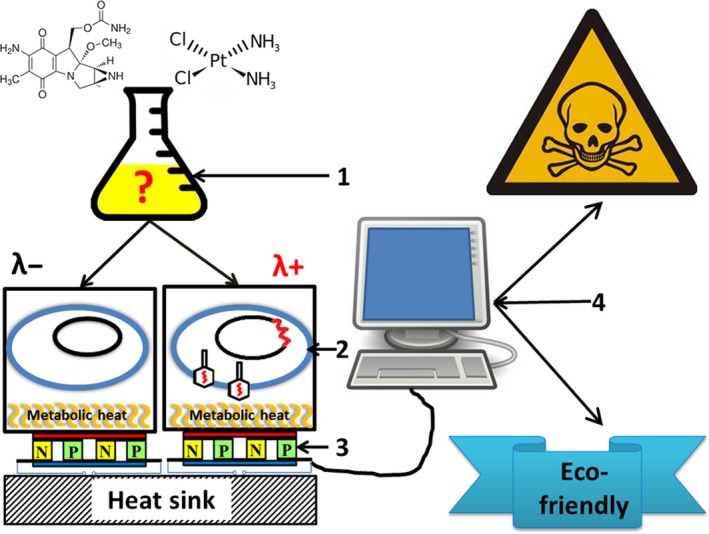
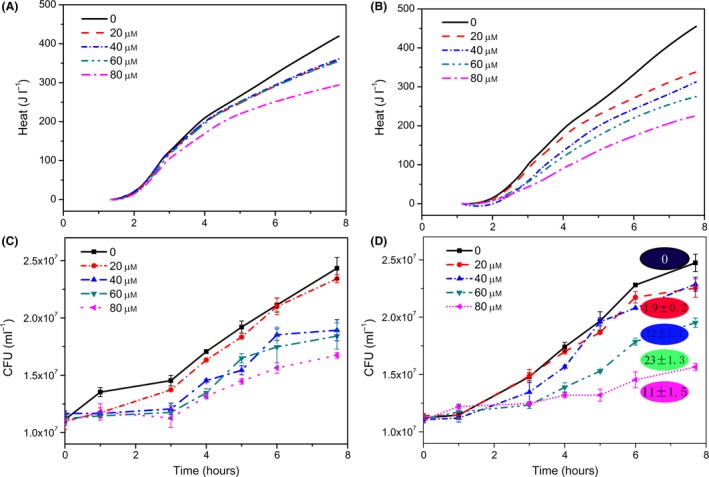
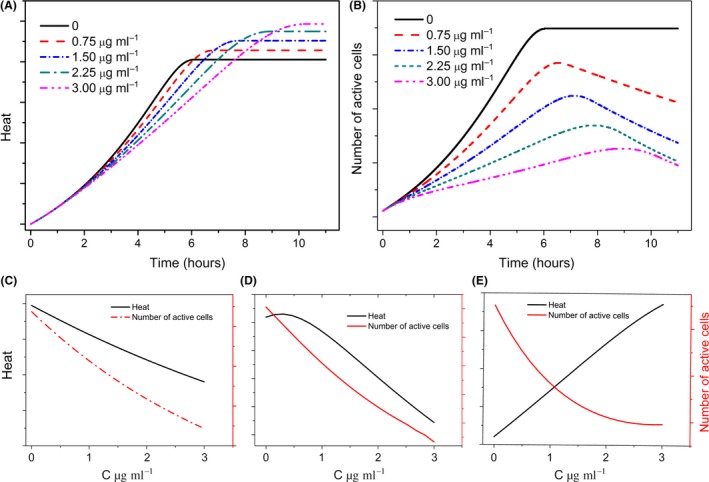
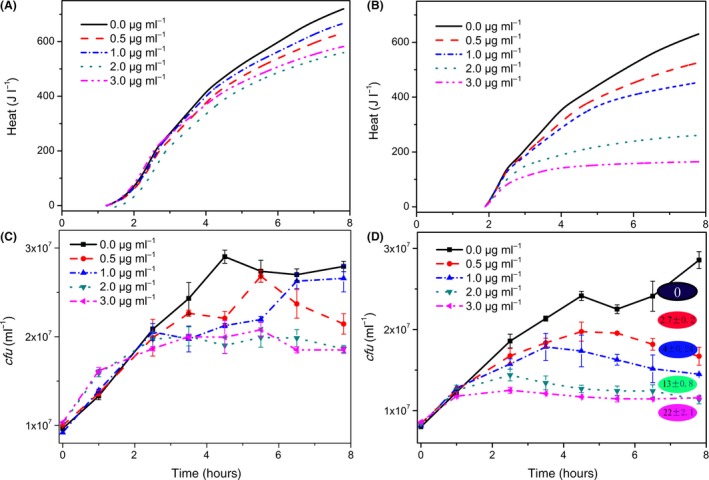
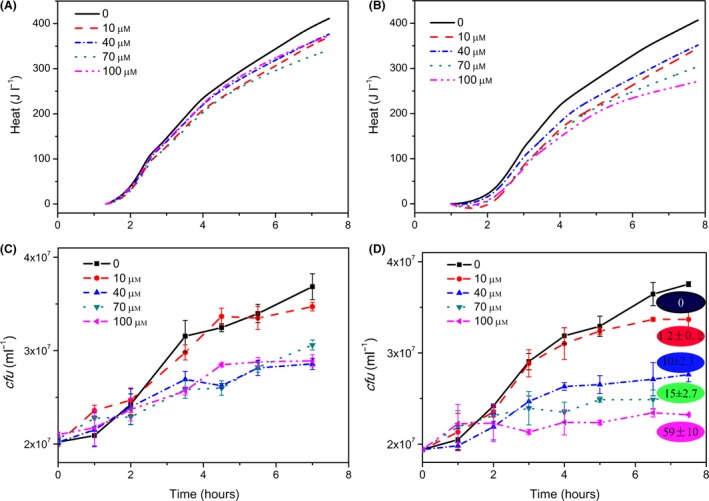
Bacteriophages, that is viruses that infect bacteria, either lyse bacteria directly or integrate their genome into the bacterial genome as so-called prophages, where they remain at a silent state. Both phages and bacteria are able to survive in this state. However, prophages can be reactivated with the introduction of chemicals, followed by the release of a high number of phage particles, which could infect other bacteria, thus harming ecosystems by a viral bloom. The basics for a fast, automatable analytical method for the detection of prophage-activating chemicals are developed and successfully tested here. The method exploits the differences in metabolic heat produced by Escherichia coli with (λ+) and without the lambda prophages (λ-). Since the metabolic heat primarily reflects opposing effects (i.e. the reduction of heat-producing cells by lysis and enhanced heat production to deliver the energetic costs for the synthesis of phages), a systematic analysis of the influence of the different conditions (experimentally and in silico) was performed and revealed anoxic conditions to be best suited. The main advantages of the suggested monitoring method are not only the possibility of obtaining fast results (after only few hours), but also the option for automation, the low workload (requires only few minutes) and the suitability of using commercially available instruments. The future challenge following this proof of principle is the development of thermal transducers which allow for the electronic subtraction of the λ+ from the λ- signal.
噬菌体,即感染细菌的病毒,要么直接裂解细菌,要么将其基因组整合到细菌基因组中成为所谓的原噬菌体,在这种情况下它们处于沉默状态。噬菌体和细菌都能够在这种状态下存活。然而,原噬菌体可以通过引入化学物质被重新激活,随后释放大量噬菌体颗粒,这些颗粒可以感染其他细菌,从而通过病毒爆发对生态系统造成伤害。在这里,开发并成功测试了一种用于检测原噬菌体激活化学物质的快速、自动化分析方法的基础。该方法利用产热大肠杆菌(带有 λ+噬菌体)和不带有 λ 噬菌体(λ-)的代谢产热差异。由于代谢产热主要反映了相反的效果(即裂解导致产热细胞减少,而增强产热以提供噬菌体合成的能量成本),因此对不同条件(实验和计算机模拟)的影响进行了系统分析,结果表明缺氧条件最适合。所提出的监测方法的主要优点不仅在于能够快速获得结果(仅需数小时),还在于能够实现自动化、工作量低(仅需几分钟)以及适合使用市售仪器。在这一原理验证之后,未来的挑战是开发热传感器,使其能够从 λ-信号中电子减去 λ+信号。