URGI, INRA, Université Paris-Saclay, 78026, Versailles, France.
Queensland Alliance for Agriculture and Food Innovation, The University of Queensland, GPO Box 267, Brisbane, Queensland, 4001, Australia.
Sci Rep. 2018 Jan 12;8(1):572. doi: 10.1038/s41598-017-16399-x.
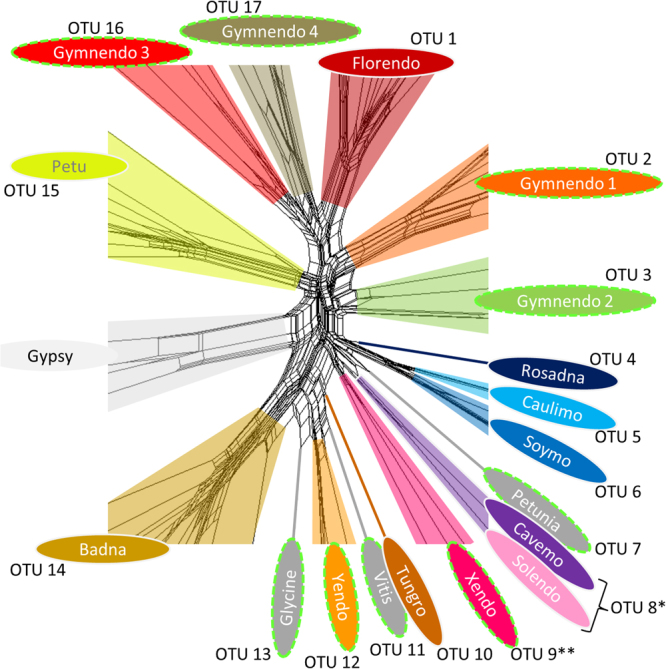
Endogenous viral elements (EVEs) are viral sequences that are integrated in the nuclear genomes of their hosts and are signatures of viral infections that may have occurred millions of years ago. The study of EVEs, coined paleovirology, provides important insights into virus evolution. The Caulimoviridae is the most common group of EVEs in plants, although their presence has often been overlooked in plant genome studies. We have refined methods for the identification of caulimovirid EVEs and interrogated the genomes of a broad diversity of plant taxa, from algae to advanced flowering plants. Evidence is provided that almost every vascular plant (tracheophyte), including the most primitive taxa (clubmosses, ferns and gymnosperms) contains caulimovirid EVEs, many of which represent previously unrecognized evolutionary branches. In angiosperms, EVEs from at least one and as many as five different caulimovirid genera were frequently detected, and florendoviruses were the most widely distributed, followed by petuviruses. From the analysis of the distribution of different caulimovirid genera within different plant species, we propose a working evolutionary scenario in which this family of viruses emerged at latest during Devonian era (approx. 320 million years ago) followed by vertical transmission and by several cross-division host swaps.
内源性病毒元件 (EVEs) 是整合在宿主核基因组中的病毒序列,是数百万年前可能发生的病毒感染的标志。对 EVEs 的研究,即古病毒学,为病毒进化提供了重要的见解。Caulimoviridae 是植物中最常见的 EVEs 群体,尽管它们在植物基因组研究中经常被忽视。我们已经改进了鉴定 caulimovirid EVEs 的方法,并研究了广泛多样性的植物类群的基因组,从藻类到高级开花植物。有证据表明,几乎每一种维管植物(导管植物),包括最原始的类群(石松类、蕨类和裸子植物),都含有 caulimovirid EVEs,其中许多代表以前未被识别的进化分支。在被子植物中,经常检测到至少一个和多达五个不同 caulimovirid 属的 EVEs,而 florendoviruses 的分布最广,其次是 petuviruses。从不同植物物种中不同 caulimovirid 属的分布分析中,我们提出了一个工作进化方案,即这种病毒家族最迟在泥盆纪(约 3.2 亿年前)出现,随后是垂直传播和多次跨分裂宿主交换。