Knyazev Denis G, Kuttner Roland, Zimmermann Mirjam, Sobakinskaya Ekaterina, Pohl Peter
Johannes Kepler University Linz, Institute of Biophysics, Linz, Austria.
Johannes Kepler University Linz, Institute of Theoretical Physics, Linz, Austria.
J Membr Biol. 2018 Jun;251(3):329-343. doi: 10.1007/s00232-017-0012-9. Epub 2018 Jan 12.
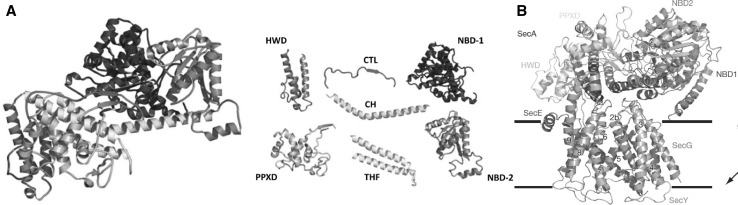
This review focusses on the energetics of protein translocation via the Sec translocation machinery. First we complement structural data about SecYEG's conformational rearrangements by insight obtained from functional assays. These include measurements of SecYEG permeability that allow assessment of channel gating by ligand binding and membrane voltage. Second we will discuss the power stroke and Brownian ratcheting models of substrate translocation and the role that the two models assign to the putative driving forces: (i) ATP (SecA) and GTP (ribosome) hydrolysis, (ii) interaction with accessory proteins, (iii) membrane partitioning and folding, (iv) proton motive force (PMF), and (v) entropic contributions. Our analysis underlines how important energized membranes are for unravelling the translocation mechanism in future experiments.
本综述聚焦于通过Sec转运机制进行蛋白质转运的能量学。首先,我们通过功能测定获得的见解来补充关于SecYEG构象重排的结构数据。这些测定包括SecYEG通透性的测量,从而能够通过配体结合和膜电位来评估通道门控。其次,我们将讨论底物转运的动力冲程和布朗棘轮模型,以及这两个模型赋予假定驱动力的作用:(i)ATP(SecA)和GTP(核糖体)水解,(ii)与辅助蛋白的相互作用,(iii)膜分配和折叠,(iv)质子动力势(PMF),以及(v)熵贡献。我们的分析强调了在未来实验中,充满能量的膜对于阐明转运机制是多么重要。