de-Madaria Enrique, Molero Xavier, Bonjoch Laia, Casas Josefina, Cárdenas-Jaén Karina, Montenegro Andrea, Closa Daniel
Pancreatic Unit, Department of Gastroenterology, Hospital General Universitario de Alicante, Instituto de Investigación Sanitaria y Biomédica de Alicante (ISABIAL - Fundación FISABIO), Alicante, Spain.
Exocrine Pancreatic Diseases Research Group, Hospital Universitari Vall d'Hebron, Institut de Recerca (VHIR), Universitat Autònoma de Barcelona, CIBEREHD, Barcelona, Spain.
Ann Intensive Care. 2018 Jan 9;8(1):1. doi: 10.1186/s13613-017-0346-6.
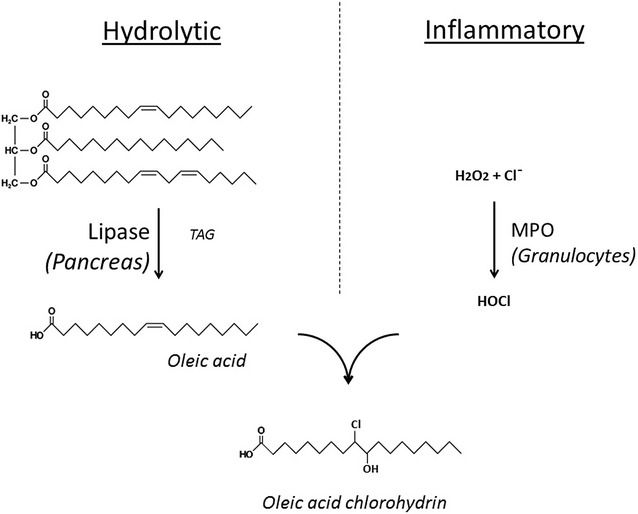
The early prediction of the severity of acute pancreatitis still represents a challenge for clinicians. Experimental studies have revealed the generation of specific halogenated lipids, in particular oleic acid chlorohydrin, in the early stages of acute pancreatitis. We hypothesized that the levels of circulating oleic acid chlorohydrin might be a useful early prognostic biomarker in acute pancreatitis in humans.
In a prospective, multicenter cohort study, plasma samples collected within 24 h after presentation in the emergency room from 59 patients with acute pancreatitis and from 9 healthy subjects were assessed for oleic acid chlorohydrin levels.
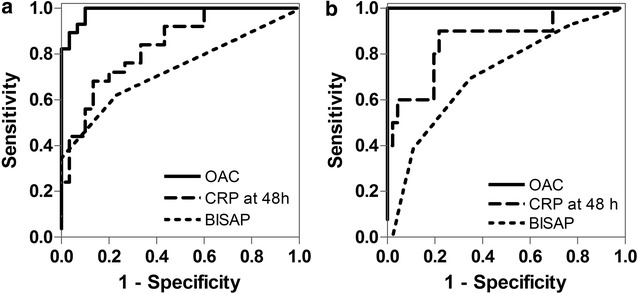
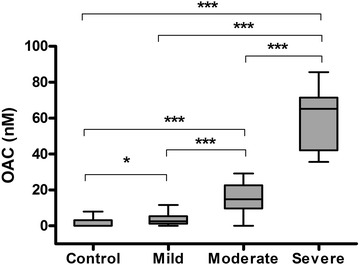
Pancreatitis was mild in 30 patients, moderately severe in 16 and severe in 13. Oleic acid chlorohydrin levels within 24 h after presentation were significantly higher in patients that later progressed to moderate and severe acute pancreatitis. Using 7.49 nM as the cutoff point, oleic acid chlorohydrin distinguished mild from moderately severe-to-severe pancreatitis with high sensitivity/specificity (96.6/90.0%) and positive/negative predictive values (90.3/96.4%). Using 32.40 nM as the cutoff value sensitivity, specificity, positive and negative predictive values were all 100% for severe acute pancreatitis. It was found to be a better prognostic marker than BISAP score, hematocrit at 48 h, SIRS at admission, persistent SIRS or C-reactive protein at 48 h.
Oleic acid chlorohydrin concentration in plasma is elevated in patients with acute pancreatitis on admission and correlates with a high degree with the final severity of the disease, indicating that it has potential to serve as an early prognostic marker for acute pancreatitis severity.
急性胰腺炎严重程度的早期预测对临床医生而言仍是一项挑战。实验研究已揭示在急性胰腺炎早期会生成特定的卤化脂质,尤其是油酸氯醇。我们推测循环中油酸氯醇的水平可能是人类急性胰腺炎有用的早期预后生物标志物。
在一项前瞻性、多中心队列研究中,对59例急性胰腺炎患者和9例健康受试者在急诊室就诊后24小时内采集的血浆样本进行油酸氯醇水平评估。
30例患者胰腺炎为轻度,16例为中度严重,13例为重度。就诊后24小时内,后来进展为中度和重度急性胰腺炎的患者油酸氯醇水平显著更高。以7.49 nM作为临界值,油酸氯醇区分轻度与中度严重至重度胰腺炎的灵敏度/特异度较高(96.6/90.0%),阳性/阴性预测值也较高(90.3/96.4%)。以32.40 nM作为临界值,对重度急性胰腺炎的灵敏度、特异度、阳性和阴性预测值均为100%。结果发现它是比BISAP评分、48小时血细胞比容、入院时全身炎症反应综合征、持续性全身炎症反应综合征或48小时C反应蛋白更好的预后标志物。
急性胰腺炎患者入院时血浆中油酸氯醇浓度升高,且与疾病最终严重程度高度相关,表明它有潜力作为急性胰腺炎严重程度的早期预后标志物。