School of Biosciences, College of Health and Life Sciences, Aston University, Aston Triangle, Birmingham, United Kingdom.
Front Endocrinol (Lausanne). 2020 Dec 21;11:602771. doi: 10.3389/fendo.2020.602771. eCollection 2020.
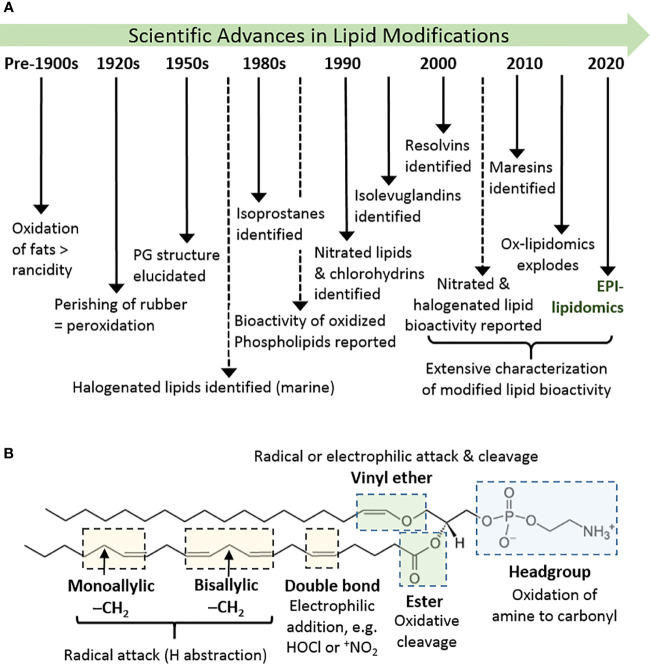
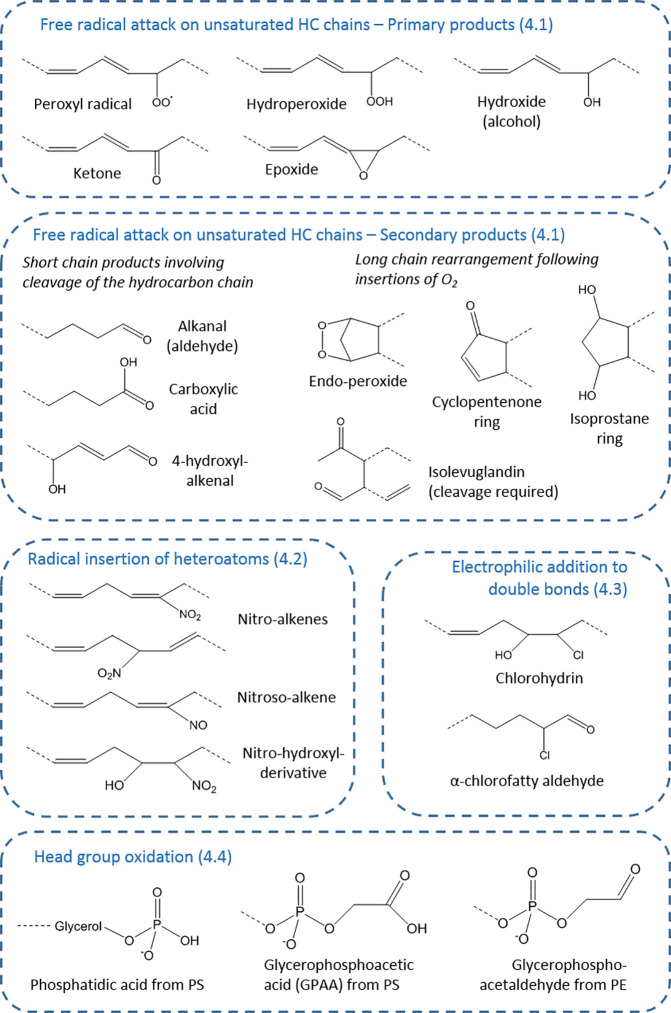
While often regarded as a subset of metabolomics, lipidomics can better be considered as a field in its own right. While the total number of lipid species in biology may not exceed the number of metabolites, they can be modified chemically and biochemically leading to an enormous diversity of derivatives, many of which retain the lipophilic properties of lipids and thus expand the lipidome greatly. Oxidative modification by radical oxygen species, either enzymatically or chemically, is one of the major mechanisms involved, although attack by non-radical oxidants also occurs. The modified lipids typically contain more oxygens in the form of hydroxyl, epoxide, carbonyl and carboxylic acid groups, and nitration, nitrosylation, halogenation or sulfation can also occur. This article provides a succinct overview of the types of species formed, the reactive compounds involved and the specific molecular sites that they react with, and the biochemical or chemical mechanisms involved. In many cases, these modifications reduce the stability of the lipid, and breakdown products are formed, which themselves have interesting properties such as the ability to react with other biomolecules. Publications on the biological effects of modified lipids are growing rapidly, supporting the concept that some of these biomolecules have potential signaling and regulatory effects. The question therefore arises whether modified lipids represent an "epilipidome", analogous to the epigenetic modifications that can control gene expression.
尽管脂质组学通常被认为是代谢组学的一个分支,但它可以被更好地视为一个独立的领域。虽然生物学中脂质种类的总数可能不会超过代谢物的数量,但它们可以在化学和生物化学上发生修饰,从而导致大量的衍生物,其中许多保留了脂质的亲脂性,从而大大扩展了脂质组。自由基氧物质的氧化修饰,无论是酶促还是化学修饰,都是涉及的主要机制之一,尽管非自由基氧化剂的攻击也会发生。修饰后的脂质通常含有更多的氧,形式为羟基、环氧化物、羰基和羧酸基团,还可能发生硝化、亚硝化、卤化或硫酸化。本文简要概述了形成的物种类型、涉及的反应性化合物以及它们与之反应的特定分子部位,以及涉及的生化或化学机制。在许多情况下,这些修饰会降低脂质的稳定性,并形成分解产物,这些产物本身具有有趣的性质,例如与其他生物分子反应的能力。关于修饰脂质的生物学效应的出版物正在迅速增加,这支持了这样一种观点,即这些生物分子中的一些具有潜在的信号转导和调节作用。因此,出现了这样一个问题,即修饰后的脂质是否代表了一种“外脂质组”,类似于可以控制基因表达的表观遗传修饰。