Schröder F F, Verdonschot N J J, Ten Haken B, Peters A, Vochteloo A J H, Pakvis D F M, Huis In't Veld R
Centre for Orthopaedic Surgery OCON, Hengelo, The Netherlands.
MIRA Institute for Biomedical Technology and Technical Medicine, University of Twente, Enschede, the Netherlands.
J Exp Orthop. 2018 Jan 12;5(1):4. doi: 10.1186/s40634-017-0116-2.
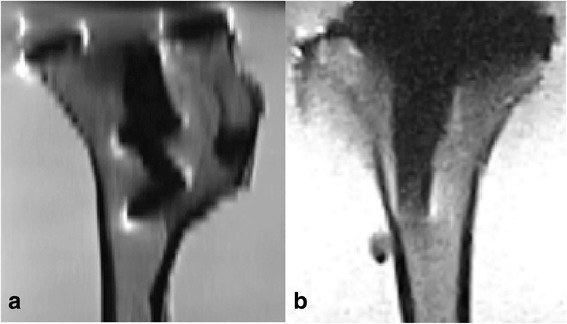
Roentgen stereophotogrammetric analysis (RSA) is used to measure early prosthetic migration and to predict future implant failure. RSA has several disadvantages, such as the need for perioperatively inserted tantalum markers. Therefore, this study evaluates low-field MRI as an alternative to RSA. The use of traditional MRI with prostheses induces disturbing metal artifacts which are reduced by low-field MRI. The purpose of this study is to assess the feasibility to use low-field (0.25 Tesla) MRI for measuring the precision of zero motion. This was assessed by calculating the virtual prosthetic motion of a zero-motion prosthetic reconstruction in multiple scanning sessions. Furthermore, the effects of different registration methods on these virtual motions were tested.
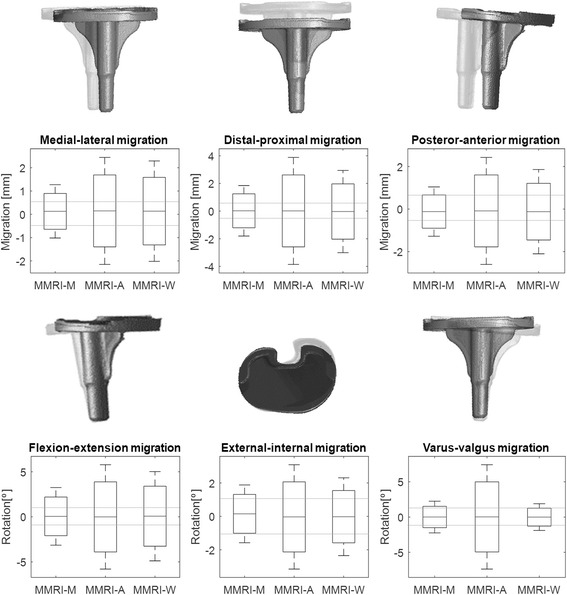
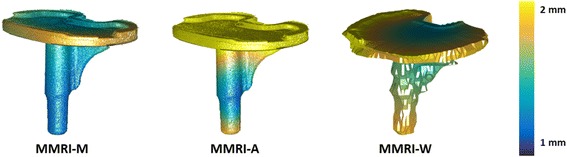
The precision of zero motion for low-field MRI was between 0.584 mm and 1.974 mm for translation and 0.884° and 3.774° for rotation. The manual registration method seemed most accurate, with μ ≤ 0.13 mm (σ ≤ 0.931 mm) for translation and μ ≤ 0.15° (σ ≤ 1.63°) for rotation.
Low-field MRI is not yet as precise as today's golden standard (marker based RSA) as reported in the literature. However, low-field MRI is feasible of measuring the relative position of bone and implant with comparable precision as obtained with marker-free RSA techniques. Of the three registration methods tested, manual registration was most accurate. Before starting clinical validation further research is necessary and should focus on improving scan sequences and registration algorithms.
X线立体摄影测量分析(RSA)用于测量早期假体移位并预测未来植入物失败。RSA有几个缺点,比如需要在围手术期插入钽标记物。因此,本研究评估低场磁共振成像(MRI)作为RSA的替代方法。传统MRI用于假体时会产生干扰性金属伪影,而低场MRI可减少这种伪影。本研究的目的是评估使用低场(0.25特斯拉)MRI测量零运动精度的可行性。这通过计算多次扫描过程中零运动假体重建的虚拟假体运动来评估。此外,还测试了不同配准方法对这些虚拟运动的影响。
低场MRI零运动的平移精度在0.584毫米至1.974毫米之间,旋转精度在0.884°至3.774°之间。手动配准方法似乎最准确,平移时μ≤0.13毫米(σ≤0.931毫米),旋转时μ≤0.15°(σ≤1.63°)。
如文献报道,低场MRI尚未达到当今的金标准(基于标记物的RSA)那样精确。然而,低场MRI能够以与无标记RSA技术相当的精度测量骨骼和植入物的相对位置。在所测试的三种配准方法中,手动配准最准确。在开始临床验证之前,有必要进一步开展研究,且应侧重于改进扫描序列和配准算法。