Mirmiran Parvin, Moghadam Sajjad Khalili, Bahadoran Zahra, Ghasemi Asghar, Azizi Fereidoun
Nutrition and Endocrine Research, Shahid Beheshti University of Medical Sciences, Tehran 19839-63113, Iran.
Student Research Committee, Shahid Beheshti University of Medical Sciences, Tehran 19839-63113, Iran.
Prev Nutr Food Sci. 2017 Dec;22(4):263-270. doi: 10.3746/pnf.2017.22.4.263. Epub 2017 Dec 31.
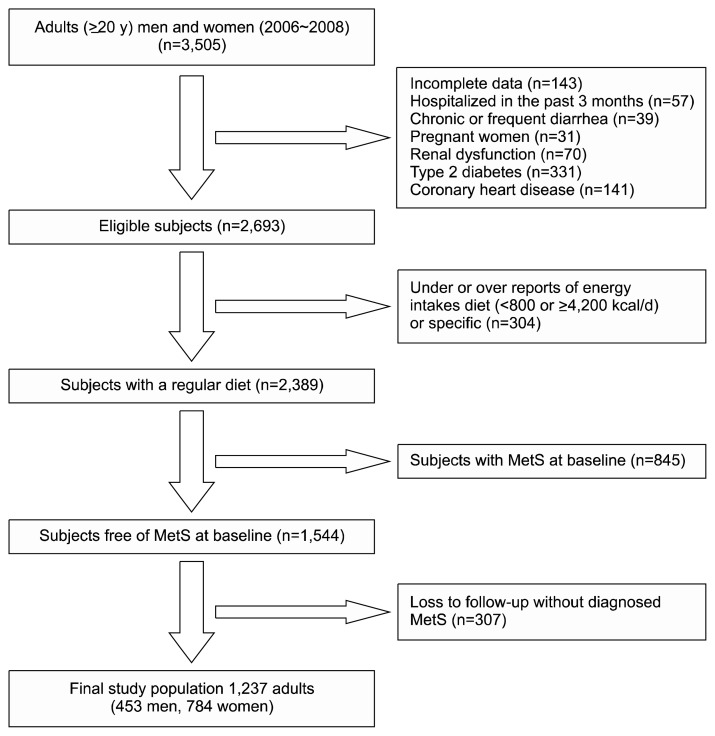
This study was conducted to investigate whether regular dietary intake of L-arginine could affect the occurrence of metabolic syndrome (MetS). Eligible adult men and women (n=1,237), who participated in the Tehran Lipid and Glucose Study, were followed for a median of 6.3 years. Dietary intakes of L-arginine and serum nitrate and nitrite (NOx) concentration were assessed at baseline (20062008), and demographics, anthropometrics, and biochemical variables were evaluated at baseline and follow-up examinations. The occurrence of MetS was assessed in relation to total L-arginine, intakes of L-arginine from animal and plant sources, with adjustment of potential confounding variables. Participants who had higher intake of L-arginine also had higher serum NOx at baseline (35.0 vs. 30.5 μmol/L, <0.05). After 6 years of follow-up, higher intakes of L-arginine from animal sources were accompanied with increased risk of MetS [odd ratios (OR)=1.49, 95% confidence interval (95% CI)=1.022.18]. Compared to the lowest, the highest intakes of L-arginine from plant sources were related to significantly reduced risk of MetS (OR=0.58, 95% CI=0.32~0.99). In conclusion, our findings suggest a potentially protective effect of plant derived L-arginine intakes against development of MetS and its phenotypes; moreover, higher intakes of L-arginine from animal sources could be a dietary risk factor for development of metabolic disorders.
本研究旨在调查定期饮食摄入L-精氨酸是否会影响代谢综合征(MetS)的发生。参与德黑兰脂质与葡萄糖研究的符合条件的成年男性和女性(n = 1237),随访时间中位数为6.3年。在基线期(20062008年)评估L-精氨酸的饮食摄入量以及血清硝酸盐和亚硝酸盐(NOx)浓度,并在基线期和随访检查时评估人口统计学、人体测量学和生化变量。根据总L-精氨酸、动物和植物来源的L-精氨酸摄入量,并对潜在混杂变量进行调整,评估MetS的发生情况。L-精氨酸摄入量较高的参与者在基线时血清NOx也较高(35.0对30.5 μmol/L,<0.05)。经过6年的随访,动物来源的L-精氨酸摄入量较高与MetS风险增加相关[比值比(OR)=1.49,95%置信区间(95%CI)=1.022.18]。与最低摄入量相比,植物来源的L-精氨酸最高摄入量与MetS风险显著降低相关(OR = 0.58,95%CI = 0.32~0.99)。总之,我们的研究结果表明,植物来源的L-精氨酸摄入量对MetS及其表型的发展具有潜在的保护作用;此外,动物来源的L-精氨酸较高摄入量可能是代谢紊乱发展的饮食风险因素。