Williams Mark D, Sawchuk Craig N, Shippee Nathan D, Somers Kristin J, Berg Summer L, Mitchell Jay D, Mattson Angela B, Katzelnick David J
Department of Psychiatry and Psychology, Mayo Clinic, Rochester, Minnesota, USA.
Division of Health Policy and Management, University of Minnesota School of Public Health, Minneapolis, Minnesota, USA.
BMJ Open Qual. 2018 Jan 9;7(1):e000066. doi: 10.1136/bmjoq-2017-000066. eCollection 2018.
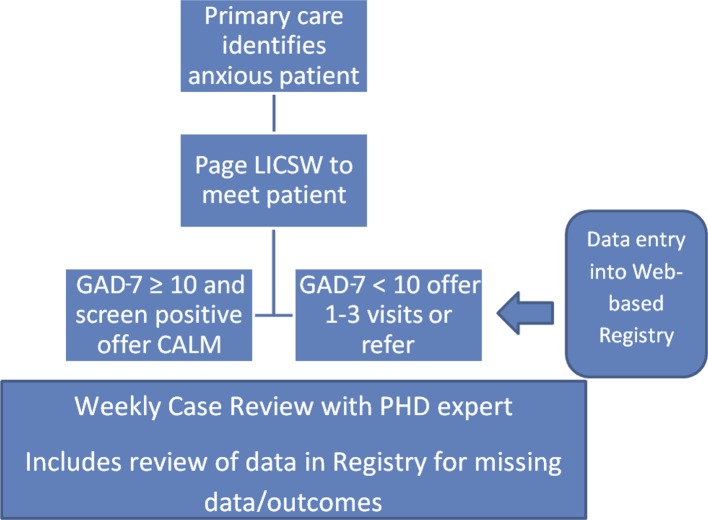
Primary care patients frequently present with anxiety with prevalence ratios up to 30%. Brief cognitive-behavioural therapy (CBT) has been shown in meta-analytic studies to have a strong effect size in the treatment of anxiety. However, in surveys of anxious primary care patients, nearly 80% indicated that they had not received CBT. In 2010, a model of CBT (Coordinated Anxiety Learning and Management (CALM)) adapted to primary care for adult anxiety was published based on results of a randomised controlled trial. This project aimed to integrate an adaptation of CALM into one primary care practice, using results from the published research as a benchmark with the secondary intent to spread a successful model to other practices. A quality improvement approach was used to translate the CALM model of CBT for anxiety into one primary care clinic. Plan-Do-Study-Act steps are highlighted as important steps towards our goal of comparing our outcomes with benchmarks from original research. Patients with anxiety as measured by a score of 10 or higher on the Generalized Anxiety Disorder 7 item scale (GAD-7) were offered CBT as delivered by licensed social workers with support by a PhD psychologist. Outcomes were tracked and entered into an electronic registry, which became a critical tool upon which to adapt and improve our delivery of psychotherapy to our patient population. Challenges and adaptations to the model are discussed. Our 6-month response rates on the GAD-7 were 51%, which was comparable with that of the original research (57%). Quality improvement methods were critical in discovering which adaptations were needed before spread. Among these, embedding a process of measurement and data entry and ongoing feedback to patients and therapists using this data are critical step towards sustaining and improving the delivery of CBT in primary care.
基层医疗患者中焦虑症的发病率较高,患病率可达30%。荟萃分析研究表明,简短认知行为疗法(CBT)在治疗焦虑症方面具有显著的效果。然而,在对焦虑症基层医疗患者的调查中,近80%的患者表示未接受过CBT治疗。2010年,基于一项随机对照试验的结果,发表了一种适用于成人焦虑症基层医疗的CBT模式(协调焦虑学习与管理(CALM))。本项目旨在将CALM的一种改编形式整合到一个基层医疗实践中,以已发表研究的结果为基准,并将成功模式推广到其他实践作为次要目标。采用质量改进方法将用于治疗焦虑症的CALM模式的CBT转化到一家基层医疗诊所。计划-执行-研究-行动步骤被视为朝着将我们的结果与原始研究基准进行比较这一目标迈出的重要步骤。对于在广泛性焦虑障碍7项量表(GAD-7)上得分10分或更高的焦虑症患者,由持牌社会工作者在一名心理学博士的支持下提供CBT治疗。对结果进行跟踪并录入电子登记系统