Department of Comparative Medicine, Stanford University School of Medicine, Stanford, CA, USA.
The Ohio State University (OSU) College of Veterinary Medicine, Columbus, OH, USA.
J Int AIDS Soc. 2018 Jan;21(1). doi: 10.1002/jia2.25063.
HIV affects more women than any other life-threatening infectious agent, and most infections are sexually transmitted. HIV must breach the female genital tract mucosal barrier to establish systemic infection, and clinical studies indicate virus more easily evades this barrier in women using depot-medroxyprogesterone acetate (DMPA) and other injectable progestins for contraception. Identifying a potential mechanism for this association, we learned DMPA promotes susceptibility of wild-type mice to genital herpes simplex virus type 2 (HSV-2) infection by reducing genital tissue expression of the cell-cell adhesion molecule desmoglein-1 (DSG-1) and increasing genital mucosal permeability. Conversely, DMPA-mediated increases in genital mucosal permeability and HSV-2 susceptibility were eliminated in mice concomitantly administered exogenous oestrogen (E). To confirm and extend these findings, herein we used humanized mice to define effects of systemic DMPA and intravaginal (ivag) E administration on susceptibility to genital infection with cell-associated HIV-1.
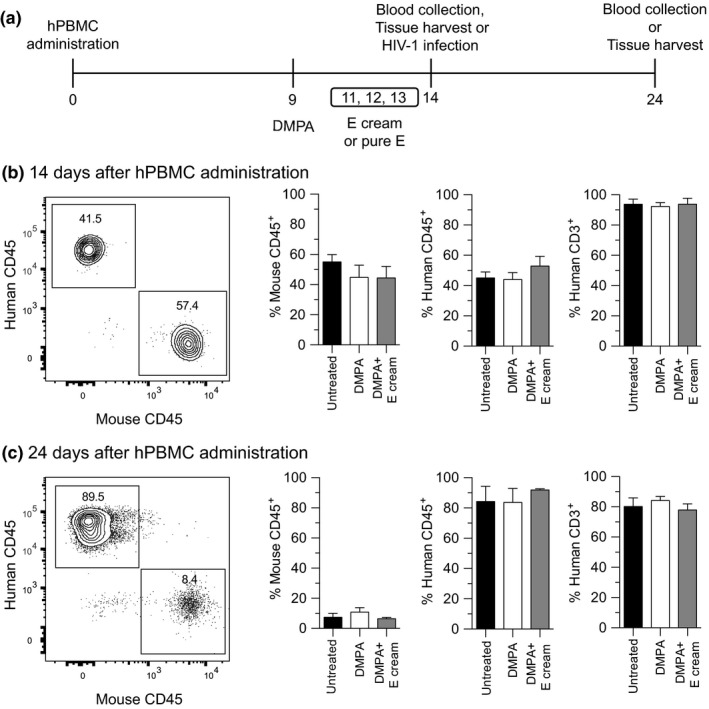
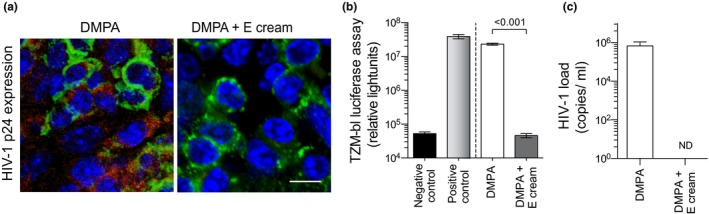
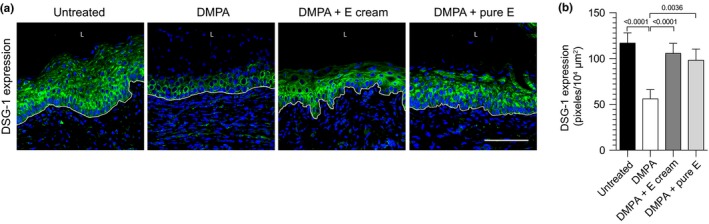
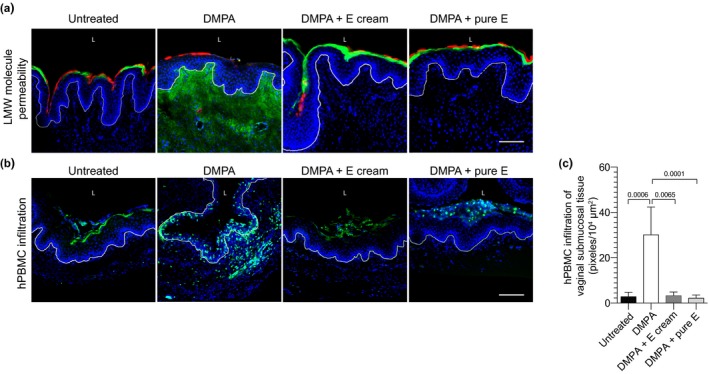
Effects of DMPA or an intravaginal (ivag) E cream on engraftment of NOD-scid-IL-2Rgc (NSG) mice with human peripheral blood mononuclear cells (hPBMCs) were defined with flow cytometry. Confocal microscopy was used to evaluate effects of DMPA, DMPA and E cream, or DMPA and the pharmacologically active component of the cream on vaginal tissue DSG-1 expression and genital mucosal permeability to low molecular weight (LMW) molecules and hPBMCs. In other studies, hPBMC-engrafted NSG mice (hPBMC-NSG) received DMPA or DMPA and ivag E cream before genital inoculation with 10 HIV-1-infected hPBMCs. Mice were euthanized 10 days after infection, and plasma HIV-1 load quantified by qRT-PCR and splenocytes used to detect HIV-1 p24 antigen via immunohistochemistry and infectious virus via TZM-bl luciferase assay.
Whereas hPBMC engraftment was unaffected by DMPA or E treatment, mice administered DMPA and E (cream or the pharmacologically active cream component) displayed greater vaginal tissue expression of DSG-1 protein and decreased vaginal mucosal permeability to LMW molecules and hPBMCs versus DMPA-treated mice. DMPA-treated hPBMC-NSG mice were also uniformly susceptible to genital transmission of cell-associated HIV-1, while no animal concomitantly administered DMPA and E cream acquired systemic HIV-1 infection.
Exogenous E administration reduces susceptibility of DMPA-treated humanized mice to genital HIV-1 infection.
艾滋病毒影响的女性比任何其他危及生命的传染病,而且大多数感染是性传播。艾滋病毒必须突破女性生殖道黏膜屏障,建立全身感染,临床研究表明,病毒更容易逃避这种障碍,在妇女使用长效醋酸甲羟孕酮(DMPA )和其他注射孕激素避孕。确定这种关联的潜在机制,我们了解到 DMPA 通过降低生殖器组织细胞间黏附分子桥粒芯糖蛋白-1(DSG-1 )的表达和增加生殖器黏膜通透性,增加了野生型小鼠对生殖器单纯疱疹病毒 2 (HSV-2 )感染的易感性。相反,在同时给予外源性雌激素(E )的小鼠中,DMPA 介导的生殖器黏膜通透性增加和 HSV-2 易感性增加被消除。为了证实并扩展这些发现,本文使用人源化小鼠来定义全身 DMPA 和阴道内(ivag )E 给药对与细胞相关的 HIV-1 生殖器感染易感性的影响。
用流式细胞术定义 DMPA 或阴道内(ivag )E 乳膏对 NOD-scid-IL-2Rgc (NSG )小鼠植入人外周血单核细胞(hPBMCs )的影响。用共聚焦显微镜评估 DMPA 、DMPA 和 E 乳膏或 DMPA 和乳膏的药理活性成分对阴道组织 DSG-1 表达和生殖器黏膜对低分子量(LMW )分子和 hPBMCs 的通透性的影响。在其他研究中,植入 hPBMC 的 NSG 小鼠(hPBMC-NSG )在与 10 个感染了 HIV-1 的 hPBMC 进行生殖器接种前接受 DMPA 或 DMPA 和阴道内 E 乳膏。感染后 10 天处死小鼠,用 qRT-PCR 定量血浆 HIV-1 载量,用免疫组化法检测脾细胞中的 HIV-1 p24 抗原,用 TZM-bl 荧光素酶测定法检测感染性病毒。
尽管 hPBMC 植入不受 DMPA 或 E 处理的影响,但与 DMPA 处理的小鼠相比,给予 DMPA 和 E (乳膏或药理活性乳膏成分)的小鼠显示出更高的阴道组织 DSG-1 蛋白表达和更低的阴道黏膜对 LMW 分子和 hPBMCs 的通透性。同时给予 DMPA 和 E 乳膏的 hPBMC-NSG 小鼠也普遍容易发生与细胞相关的 HIV-1 的生殖器传播,而没有动物同时接受 DMPA 和 E 乳膏治疗而获得全身 HIV-1 感染。
外源性 E 处理可降低 DMPA 处理的人源化小鼠对生殖器 HIV-1 感染的易感性。