Division of Surgery, Department of Clinical Sciences, Karolinska Institutet at Danderyd Hospital, 182 88, Stockholm, Sweden.
Division of Surgery, Department of Clinical Science, Intervention and Technology (CLINTEC), Karolinska Institutet at Karolinska University Hospital, 171 77, Stockholm, Sweden.
BMC Cancer. 2018 Jan 15;18(1):78. doi: 10.1186/s12885-017-3925-x.
Colorectal cancer (CRC) is a leading cause of cancer-associated deaths with liver metastases developing in 25-30% of those affected. Previous data suggest a survival difference between right- and left-sided liver metastatic CRC, even though left-sided cancer has a higher incidence of liver metastases. The aim of the study was to describe the liver metastatic patterns and survival as a function of the characteristics of the primary tumour and different combinations of metastatic disease.
A retrospective population-based study was performed on a cohort of patients diagnosed with CRC in the region of Stockholm, Sweden during 2008. Patients were identified through the Swedish National Quality Registry for Colorectal Cancer Treatment (SCRCR) and additional information on intra- and extra-hepatic metastatic pattern and treatment were retrieved from electronic patient records. Patients were followed for 5 years or until death. Factors influencing overall survival (OS) were investigated by means of Cox regression. OS was compared using Kaplan-Meier estimations and the log-rank test.
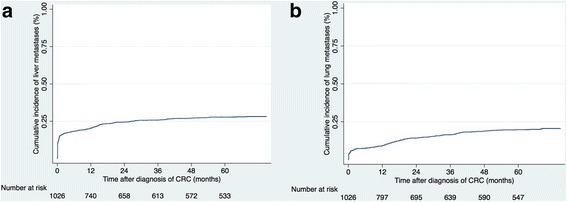
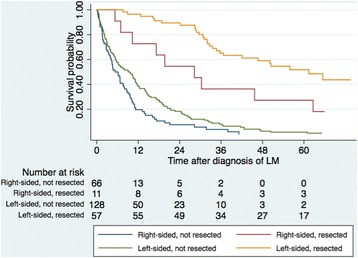
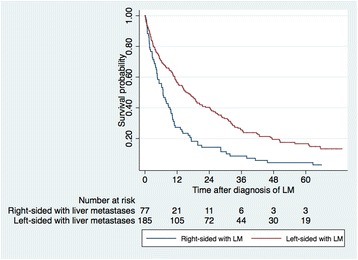
Liver metastases were diagnosed in 272/1026 (26.5%) patients within five years of diagnosis of the primary. Liver and lung metastases were more often diagnosed in left-sided colon cancer compared to right-sided cancer (28.4% versus 22.1%, p = 0.029 and 19.7% versus 13.2%, p = 0.010, respectively) but the extent of liver metastases were more extensive for right-sided cancer as compared to left-sided (p = 0.001). Liver metastatic left-sided cancer, including rectal cancer, was associated with a 44% decreased mortality risk compared to right-sided cancer (HR = 0.56, 95% CI: 0.39-0.79) with a 5-year OS of 16.6% versus 4.3% (p < 0.001). In liver metastatic CRC, the presence of lung metastases did not significantly influence OS as assessed by multivariate analysis (HR = 1.11, 95% CI: 0.80-1.53).
The worse survival in liver metastatic right-sided colon cancer could possibly be explained by the higher number of metastases, as well as more extensive segmental involvement compared with left-sided colon and rectal cancer, even though the latter had a higher incidence of liver metastases. Detailed population-based data on the metastatic pattern of CRC and survival could assist in more structured and individualized guidelines for follow-up of patients with CRC.
结直肠癌(CRC)是癌症相关死亡的主要原因,其中 25-30%的患者会发生肝转移。先前的数据表明,右侧和左侧肝转移性 CRC 之间存在生存差异,尽管左侧癌症的肝转移发生率更高。本研究的目的是描述原发性肿瘤特征以及不同肝转移疾病组合对肝转移模式和生存的影响。
对 2008 年在瑞典斯德哥尔摩地区诊断为 CRC 的患者队列进行了一项回顾性基于人群的研究。通过瑞典国家结直肠癌治疗质量登记处(SCRCR)识别患者,并且从电子患者记录中检索了关于肝内和肝外转移模式和治疗的附加信息。对患者进行了 5 年或直至死亡的随访。使用 Cox 回归分析了影响总生存期(OS)的因素。使用 Kaplan-Meier 估计和对数秩检验比较了 OS。
在诊断原发性疾病的五年内,272/1026(26.5%)患者被诊断为肝转移。与右侧结肠癌相比,左侧结肠癌更常诊断为肝和肺转移(28.4%比 22.1%,p=0.029 和 19.7%比 13.2%,p=0.010),但右侧结肠癌的肝转移范围更广(p=0.001)。与右侧结肠癌相比,包括直肠癌在内的左侧肝转移性左结肠癌的死亡率降低了 44%(HR=0.56,95%CI:0.39-0.79),5 年 OS 为 16.6%比 4.3%(p<0.001)。在肝转移性 CRC 中,通过多变量分析评估,肺转移的存在并未显著影响 OS(HR=1.11,95%CI:0.80-1.53)。
右侧结肠癌肝转移的生存率较差可能是由于与左侧结肠癌和直肠癌相比,转移灶数量更多,以及更广泛的节段性受累所致,尽管后者的肝转移发生率更高。关于 CRC 转移模式和生存的详细基于人群的数据可以帮助制定更具结构性和个体化的 CRC 患者随访指南。