National Engineering Research Center for Breeding Swine Industry, Guangdong Provincial Key Lab of Agro-Animal Genomics and Molecular Breeding, College of Animal Science, South China Agricultural University, Guangzhou 510642, China.
Department of Human Nutrition, Food and Animal Sciences, College of Tropical Agriculture and Human Resources, University of Hawaii at Manoa, 1955 East-West Road, AgSci. 415J, Honolulu, HI 96822, USA.
Int J Mol Sci. 2018 Jan 16;19(1):271. doi: 10.3390/ijms19010271.
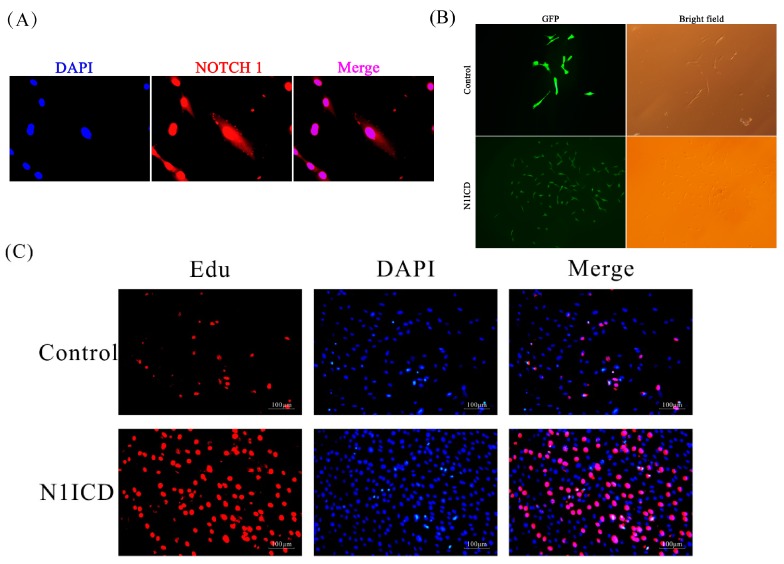
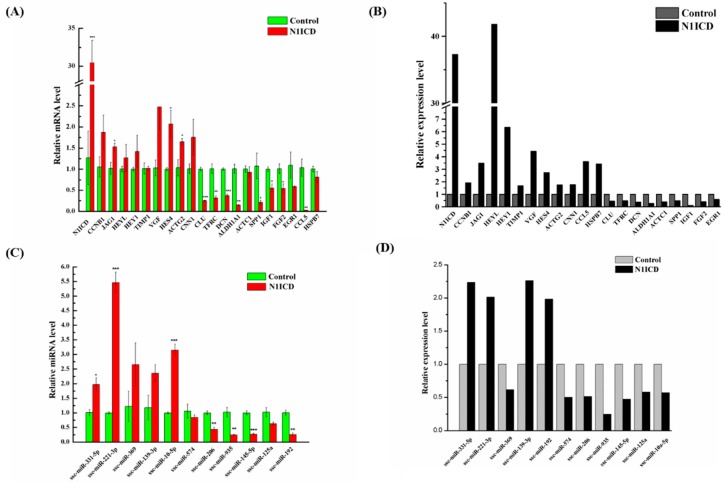
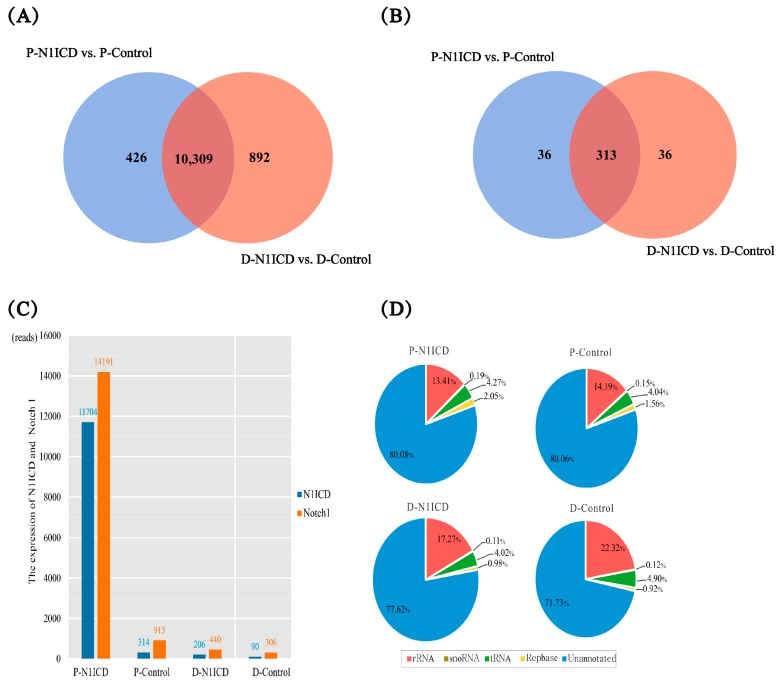
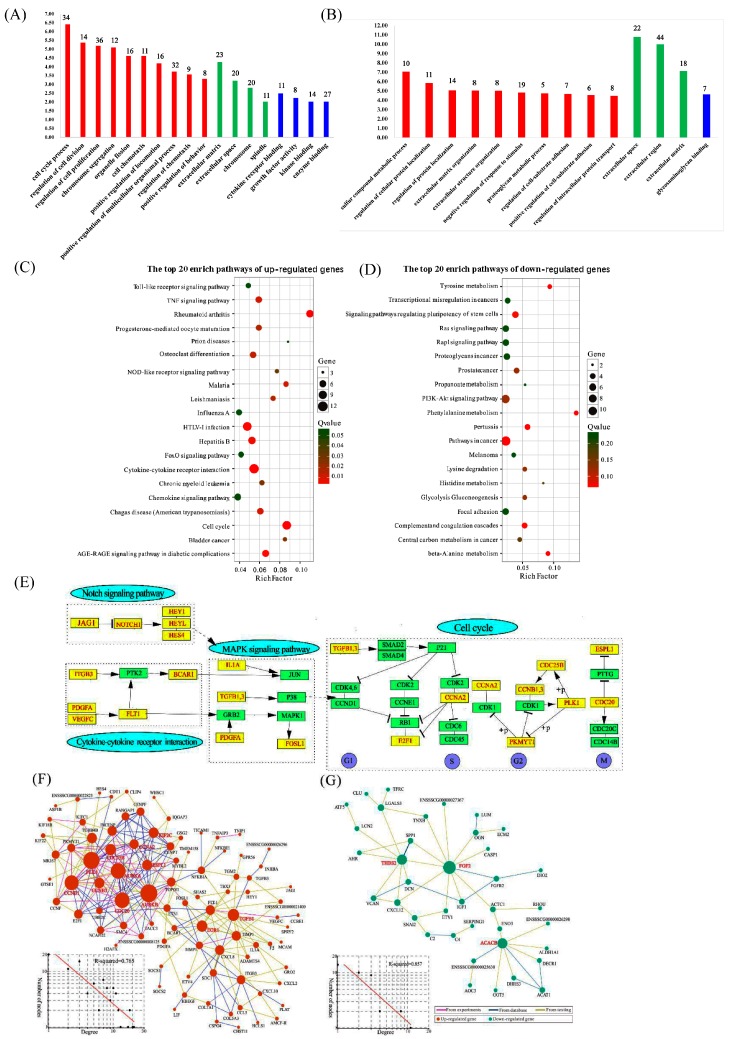
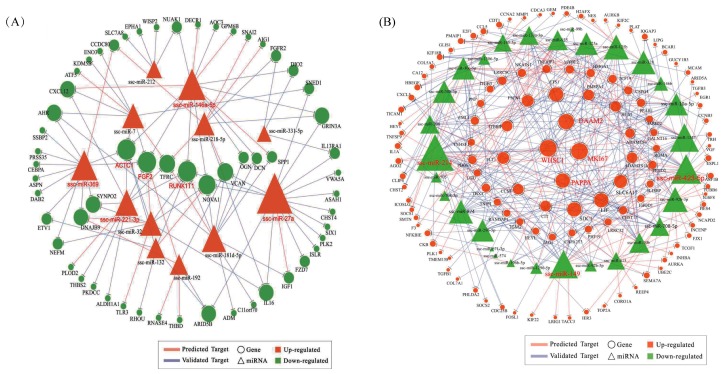
Notch signaling as a conserved cell fate regulator is involved in the regulation of cell quiescence, proliferation, differentiation and postnatal tissue regeneration. However, how Notch signaling regulates porcine satellite cells (PSCs) has not been elucidated. We stably transfected Notch1 intracellular domain (N1ICD) into PSCs to analyze the gene expression profile and miRNA-seq. The analysis of the gene expression profile identified 295 differentially-expressed genes (DEGs) in proliferating-N1ICD PSCs (P-N1ICD) and nine DEGs on differentiating-N1ICD PSCs (D-N1ICD), compared with that in control groups (P-Control and D-Control, respectively). Analyzing the underlying function of DEGs showed that most of the upregulated DEGs enriched in P-N1ICD PSCs are related to the cell cycle. Forty-four and 12 known differentially-expressed miRNAs (DEMs) were identified in the P-N1ICD PSCs and D-N1ICD PSCs group, respectively. Furthermore, we constructed the gene-miRNA network of the DEGs and DEMs. In P-N1ICD PSCs, miR-125a, miR-125b, miR-10a-5p, ssc-miR-214, miR-423 and miR-149 are downregulated hub miRNAs, whose corresponding hub genes are marker of proliferation Ki-67 (MKI67) and nuclear receptor binding SET domain protein 2 (WHSC1). By contrast, miR-27a, miR-146a-5p and miR-221-3p are upregulated hub miRNAs, whose hub genes are RUNX1 translocation partner 1 (RUNX1T1) and fibroblast growth factor 2 (FGF2). All the hub miRNAs and genes are associated with cell proliferation. Quantitative RT-PCR results are consistent with the gene expression profile and miRNA-seq results. The results of our study provide valuable information for understanding the molecular mechanisms underlying Notch signaling in PSCs and skeletal muscle development.
Notch 信号作为一种保守的细胞命运调控因子,参与细胞静止、增殖、分化和出生后组织再生的调控。然而, Notch 信号如何调节猪卫星细胞(PSCs)尚不清楚。我们将 Notch1 细胞内结构域(N1ICD)稳定转染到 PSCs 中,以分析基因表达谱和 miRNA-seq。基因表达谱分析表明,在增殖-N1ICD PSCs(P-N1ICD)和分化-N1ICD PSCs(D-N1ICD)中,有 295 个差异表达基因(DEGs)与对照组(P-Control 和 D-Control)相比有所不同。分析 DEGs 的潜在功能表明,在 P-N1ICD PSCs 中上调的 DEGs 主要富集在细胞周期中。在 P-N1ICD PSCs 和 D-N1ICD PSCs 组中分别鉴定出 44 个和 12 个已知的差异表达 miRNA(DEM)。此外,我们构建了 DEGs 和 DEMs 的基因-miRNA 网络。在 P-N1ICD PSCs 中,miR-125a、miR-125b、miR-10a-5p、ssc-miR-214、miR-423 和 miR-149 是下调的 hub miRNAs,其对应的 hub 基因是增殖标志物 Ki-67(MKI67)和核受体结合 SET 域蛋白 2(WHSC1)。相反,miR-27a、miR-146a-5p 和 miR-221-3p 是上调的 hub miRNAs,其 hub 基因是 RUNX1 易位伙伴 1(RUNX1T1)和成纤维细胞生长因子 2(FGF2)。所有 hub miRNAs 和基因都与细胞增殖有关。定量 RT-PCR 结果与基因表达谱和 miRNA-seq 结果一致。我们的研究结果为了解 Notch 信号在 PSCs 和骨骼肌发育中的分子机制提供了有价值的信息。