Schreiber Peter W, Bischoff-Ferrari Heike A, Boggian Katia, Bonani Marco, van Delden Christian, Enriquez Natalia, Fehr Thomas, Garzoni Christian, Hirsch Hans H, Hirzel Cédric, Manuel Oriol, Meylan Pascal, Saleh Lanja, Weisser Maja, Mueller Nicolas J
University Hospital Zurich and University Zurich, Division of Infectious Diseases and Hospital Epidemiology, Zurich, Switzerland.
University Hospital Zurich and University of Zurich, Department of Geriatrics and Aging Research, Zurich, Switzerland.
PLoS One. 2018 Jan 16;13(1):e0191167. doi: 10.1371/journal.pone.0191167. eCollection 2018.
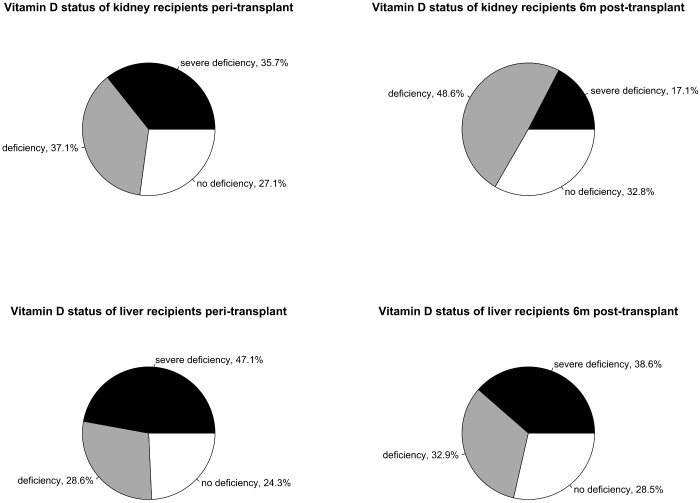
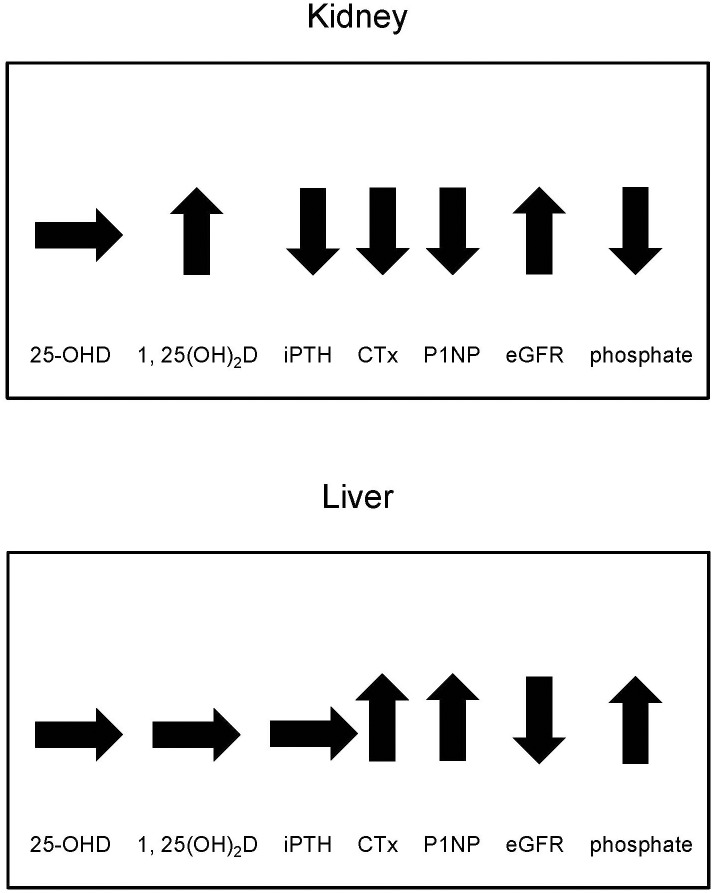
Bone disease contributes to relevant morbidity after solid organ transplantation. Vitamin D has a crucial role for bone metabolism. Activation of vitamin D depends on the endocrine function of both, liver and kidney. Our study assessed key markers of bone metabolism at time of transplantation and 6 months after transplantation among 70 kidney and 70 liver recipients. In 70 kidney recipients 25-OH vitamin D levels did not differ significantly between peri-transplant (median 32.5nmol/l) and 6 months post-transplant (median 41.9nmol/l; P = 0.272). Six months post-transplant median 1, 25-(OH)2 vitamin D levels increased by >300% (from 9.1 to 36.5ng/l; P<0.001) and median intact parathyroid hormone levels decreased by 68.4% (from 208.7 to 66.0 ng/l; P<0.001). Median β-Crosslaps (CTx) and total procollagen type 1 amino-terminal propeptide (P1NP) decreased by 65.1% (from 1.32 to 0.46ng/ml; P<0.001) and 60.6% (from 158.2 to 62.3ng/ml; P<0.001), respectively. Kidney recipients with incident fractures had significantly lower levels of 1, 25-(OH)2 vitamin D at time of transplantation and of intact parathyroid hormone 6 months post-transplant. Among 70 liver recipients, 25-OH vitamin D, 1, 25-(OH)2 vitamin D and intact parathyroid hormone levels were not significantly altered between peri-transplant and 6 months post-transplant. Contrary to kidney recipients, median CTx increased by 60.0% (from 0.45 to 0.72 ng/ml; P = 0.002) and P1NP by 49.3% (from 84.0 to 125.4ng/ml; P = 0.001) in the longitudinal course. Assessed biomarkers didn't differ between liver recipients with and without fractures. To conclude, the assessed panel of biomarkers proved highly dynamic after liver as well as kidney transplantation in the early post-transplant period. After kidney transplantation a significant gain in 1, 25-(OH)2 vitamin D combined with a decline in iPTH, CTx and P1NP, whereas after liver transplantation an increase in CTx and P1NP were characteristic.
骨病是实体器官移植后相关发病的原因之一。维生素D对骨代谢起着关键作用。维生素D的活化依赖于肝脏和肾脏的内分泌功能。我们的研究评估了70例肾移植受者和70例肝移植受者在移植时及移植后6个月的骨代谢关键标志物。在70例肾移植受者中,移植前后25-羟基维生素D水平无显著差异(移植时中位数为32.5nmol/l,移植后6个月中位数为41.9nmol/l;P = 0.272)。移植后6个月,1,25-二羟基维生素D水平中位数增加超过300%(从9.1ng/l增至36.5ng/l;P<0.001),完整甲状旁腺激素水平中位数下降68.4%(从208.7ng/l降至66.0ng/l;P<0.001)。β-交联C端肽(CTx)和I型前胶原N端前肽(P1NP)中位数分别下降65.1%(从1.32ng/ml降至0.46ng/ml;P<0.001)和60.6%(从158.2ng/ml降至62.3ng/ml;P<0.001)。发生骨折的肾移植受者在移植时1,25-二羟基维生素D水平及移植后6个月的完整甲状旁腺激素水平显著较低。在70例肝移植受者中,移植前后25-羟基维生素D、1,25-二羟基维生素D和完整甲状旁腺激素水平无显著变化。与肾移植受者相反,纵向观察中CTx中位数增加60.0%(从0.45ng/ml增至0.72ng/ml;P = 0.002),P1NP增加49.3%(从84.0ng/ml增至125.4ng/ml;P = 0.001)。有骨折和无骨折的肝移植受者评估的生物标志物无差异。总之,在移植后早期,经评估的生物标志物组在肝移植和肾移植后均显示出高度动态变化。肾移植后1,25-二羟基维生素D显著增加,同时iPTH、CTx和P1NP下降,而肝移植后CTx和P1NP增加是其特征。