Department of Biochemistry, The James Cook University Hospital, Middlesbrough TS4 3BW, UK.
J Transl Med. 2013 Aug 29;11:201. doi: 10.1186/1479-5876-11-201.
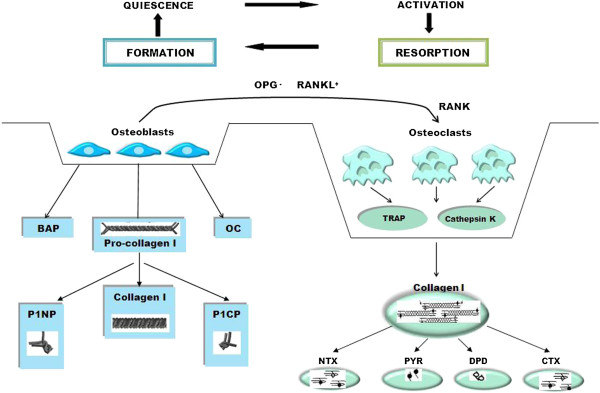
Osteoporosis is characterised by low bone mass and structural deterioration of bone tissue, resulting in increased fragility and susceptibility to fracture. Osteoporotic fractures are a significant cause of morbidity and mortality. Direct medical costs from such fractures in the UK are currently estimated at over two billion pounds per year, resulting in a substantial healthcare burden that is expected to rise exponentially due to increasing life expectancy. Currently bone mineral density is the WHO standard for diagnosis of osteoporosis, but poor sensitivity means that potential fractures will be missed if it is used alone. During the past decade considerable progress has been made in the identification and characterisation of specific biomarkers to aid the management of metabolic bone disease. Technological developments have greatly enhanced assay performance producing reliable, rapid, non-invasive cost effective assays with improved sensitivity and specificity. We now have a greater understanding of the need to regulate pre-analytical sample collection to minimise the effects of biological variation. However, bone turnover markers (BTMs) still have limited clinical utility. It is not routinely recommended to use BTMs to select those at risk of fractures, but baseline measurements of resorption markers are useful before commencement of anti-resorptive treatment and can be checked 3-6 months later to monitor response and adherence to treatment. Similarly, formation markers can be used to monitor bone forming agents. BTMs may also be useful when monitoring patients during treatment holidays and aid in the decision as to when therapy should be recommenced. Recent recommendations by the Bone Marker Standards Working Group propose to standardise research and include a specific marker of bone resorption (CTX) and bone formation (P1NP) in all future studies. It is hoped that improved research in turn will lead to optimised markers for the clinical management of osteoporosis and other bone diseases.
骨质疏松症的特征是骨量低和骨组织结构恶化,导致脆性增加和易骨折。骨质疏松性骨折是发病率和死亡率的一个重要原因。目前,英国此类骨折的直接医疗费用估计超过 20 亿英镑,这导致了巨大的医疗负担,预计随着预期寿命的延长,这种负担将呈指数级增长。目前,骨密度是世界卫生组织诊断骨质疏松症的标准,但由于其敏感性差,如果单独使用,可能会错过潜在的骨折。在过去的十年中,在识别和表征特定生物标志物以帮助管理代谢性骨病方面取得了相当大的进展。技术的发展极大地提高了分析性能,产生了可靠、快速、非侵入性、具有成本效益的分析方法,其敏感性和特异性得到了提高。我们现在更了解需要调节分析前样本采集,以最大限度地减少生物变异性的影响。然而,骨转换标志物(BTM)的临床应用仍然有限。目前不建议常规使用 BTM 来选择骨折风险高的患者,但在开始抗吸收治疗之前,对吸收标志物进行基线测量是有用的,并且可以在 3-6 个月后进行检查,以监测反应和治疗依从性。同样,形成标志物可用于监测骨形成剂。BTM 也可用于监测治疗期间的患者,并有助于决定何时重新开始治疗。骨标志物标准工作组最近的建议建议标准化研究,并在所有未来的研究中包含特定的骨吸收标志物(CTX)和骨形成标志物(P1NP)。希望这反过来能提高研究水平,为骨质疏松症和其他骨病的临床管理优化标志物。