Department of Paediatrics, University of Oxford, Oxford, UK.
Department of Veterinary Medicine, University of Cambridge, Cambridge, UK.
Retrovirology. 2018 Jan 16;15(1):7. doi: 10.1186/s12977-018-0390-9.
The factors determining differential HIV disease outcome among individuals expressing protective HLA alleles such as HLA-B27:05 and HLA-B57:01 remain unknown. We here analyse two HIV-infected subjects expressing both HLA-B27:05 and HLA-B57:01. One subject maintained low-to-undetectable viral loads for more than a decade of follow up. The other progressed to AIDS in < 3 years.
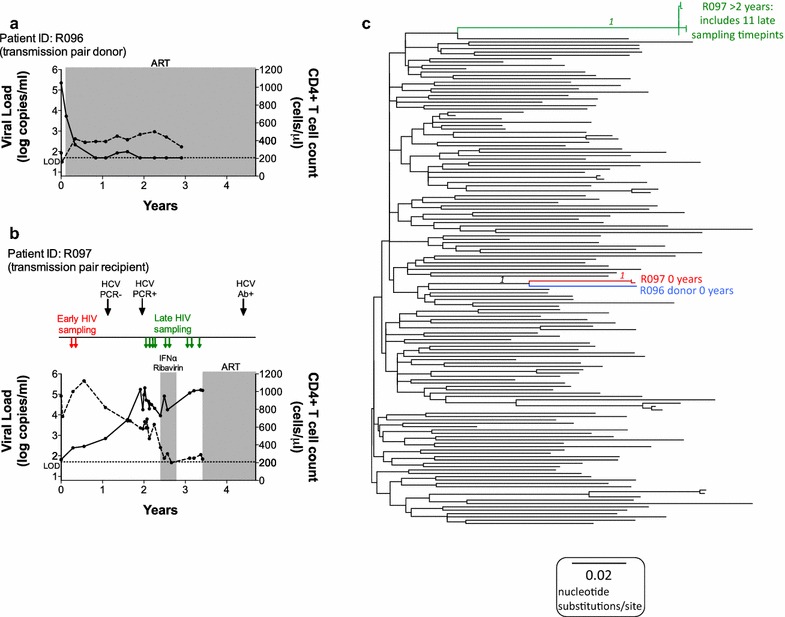
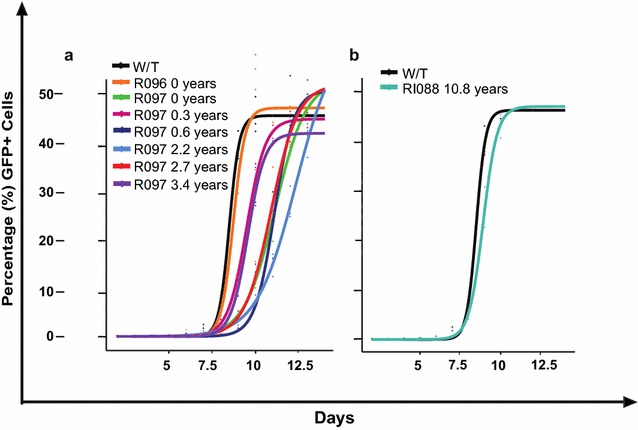
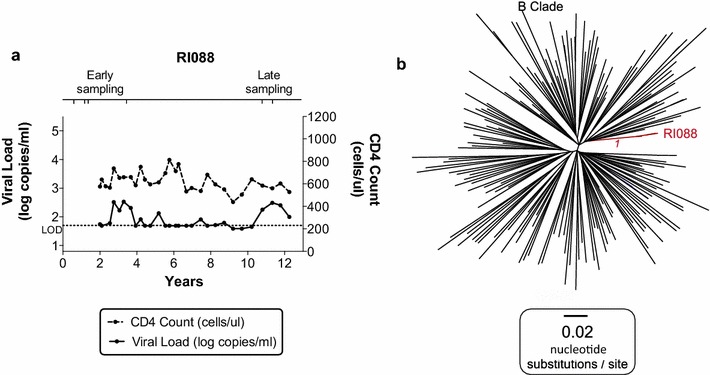
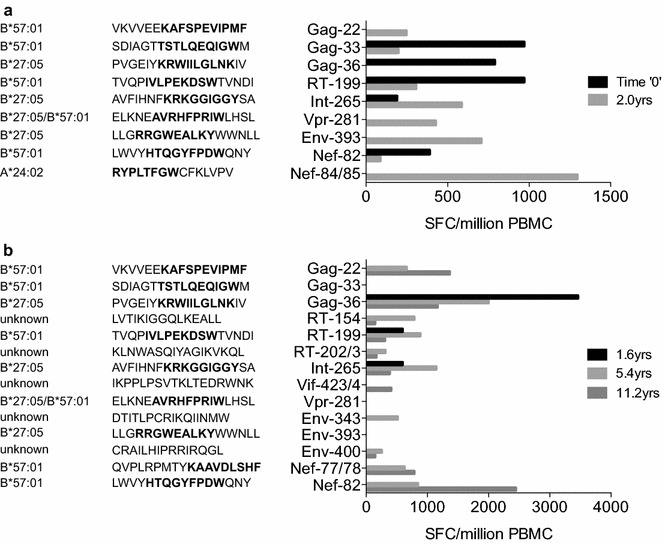
The rapid progressor was the recipient within a known transmission pair, enabling virus sequences to be tracked from transmission. Progression was associated with a 12% Gag sequence change and 26% Nef sequence change at the amino acid level within 2 years. Although next generation sequencing from early timepoints indicated that multiple CD8+ cytotoxic T lymphocyte (CTL) escape mutants were being selected prior to superinfection, < 4% of the amino acid changes arising from superinfection could be ascribed to CTL escape. Analysis of an HLA-B27:05/B57:01 non-progressor, in contrast, demonstrated minimal virus sequence diversification (1.1% Gag amino acid sequence change over 10 years), and dominant HIV-specific CTL responses previously shown to be effective in control of viraemia were maintained. Clonal sequencing demonstrated that escape variants were generated within the non-progressor, but in many cases were not selected. In the rapid progressor, progression occurred despite substantial reductions in viral replicative capacity (VRC), and non-progression in the elite controller despite relatively high VRC.
These data are consistent with previous studies demonstrating rapid progression in association with superinfection and that rapid disease progression can occur despite the relatively the low VRC that is typically observed in the setting of multiple CTL escape mutants.
具有保护型 HLA 等位基因(如 HLA-B27:05 和 HLA-B57:01)的个体之间 HIV 疾病结果存在差异,其决定因素尚不清楚。我们在此分析了两位同时表达 HLA-B27:05 和 HLA-B57:01 的 HIV 感染者。其中一位患者在超过十年的随访中病毒载量保持在低水平或无法检测到。另一位则在不到三年的时间内进展为艾滋病。
快速进展者是已知传播链中的受者,因此能够追踪到从传播开始的病毒序列。在 2 年内,快速进展者的 gag 序列发生了 12%的变化,Nef 序列发生了 26%的变化。尽管下一代测序技术表明,在超级感染之前,已经有多种 CD8+细胞毒性 T 淋巴细胞(CTL)逃逸突变体被选择,但超级感染产生的氨基酸变化中,只有<4%可以归因于 CTL 逃逸。相比之下,对一位 HLA-B27:05/B57:01 非进展者的分析显示,病毒序列的多样化程度较低(10 年内 gag 氨基酸序列变化<1.1%),并维持了先前被证明对控制病毒血症有效的 HIV 特异性 CTL 反应。克隆测序表明,非进展者体内也产生了逃逸变异体,但在许多情况下未被选择。在快速进展者中,尽管病毒复制能力(VRC)显著降低,仍出现了进展,而在精英控制者中,尽管 VRC 相对较高,仍未出现进展。
这些数据与之前的研究一致,表明超级感染与快速进展相关,并且尽管通常在存在多种 CTL 逃逸突变体的情况下观察到相对较低的 VRC,但仍可能发生快速疾病进展。