Centre for Immunity, Infection and Evolution, School of Biological Sciences, University of Edinburgh, Edinburgh EH9 3FL, United Kingdom.
Institute of Immunology and Infection Research, School of Biological Sciences, University of Edinburgh, Edinburgh EH9 3FL, United Kingdom.
Proc Natl Acad Sci U S A. 2018 Jan 30;115(5):1063-1068. doi: 10.1073/pnas.1712879115. Epub 2018 Jan 16.
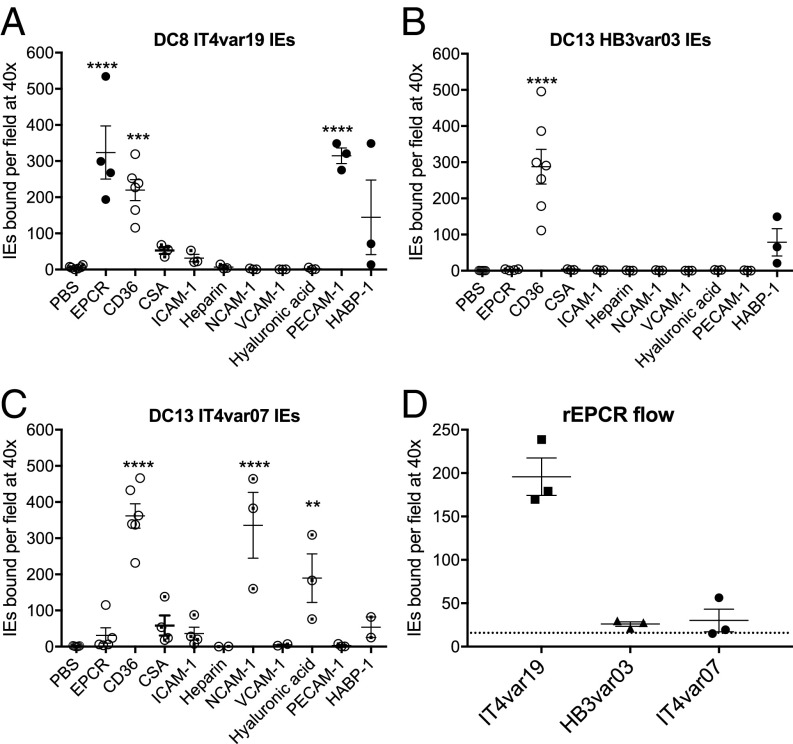
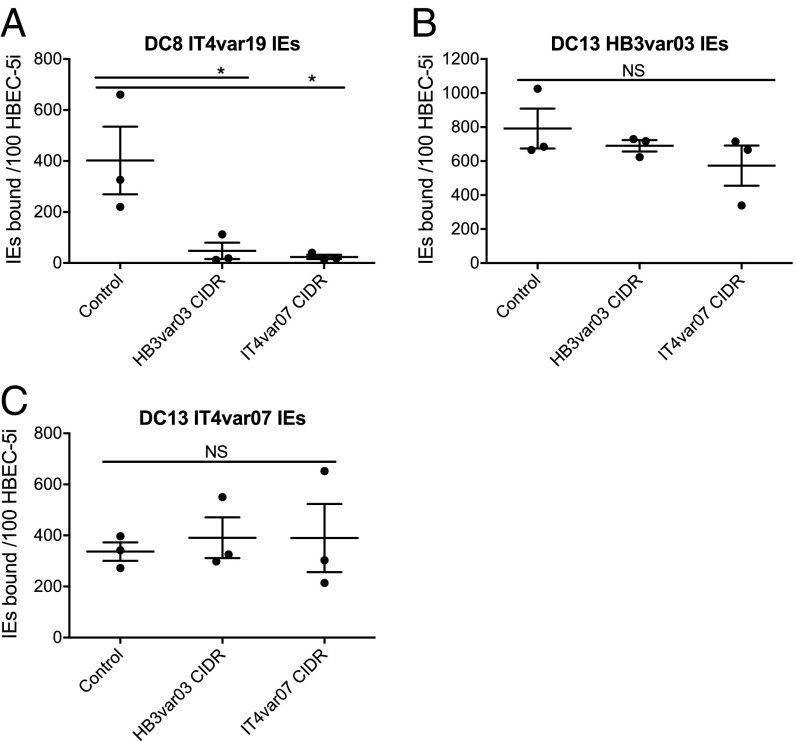
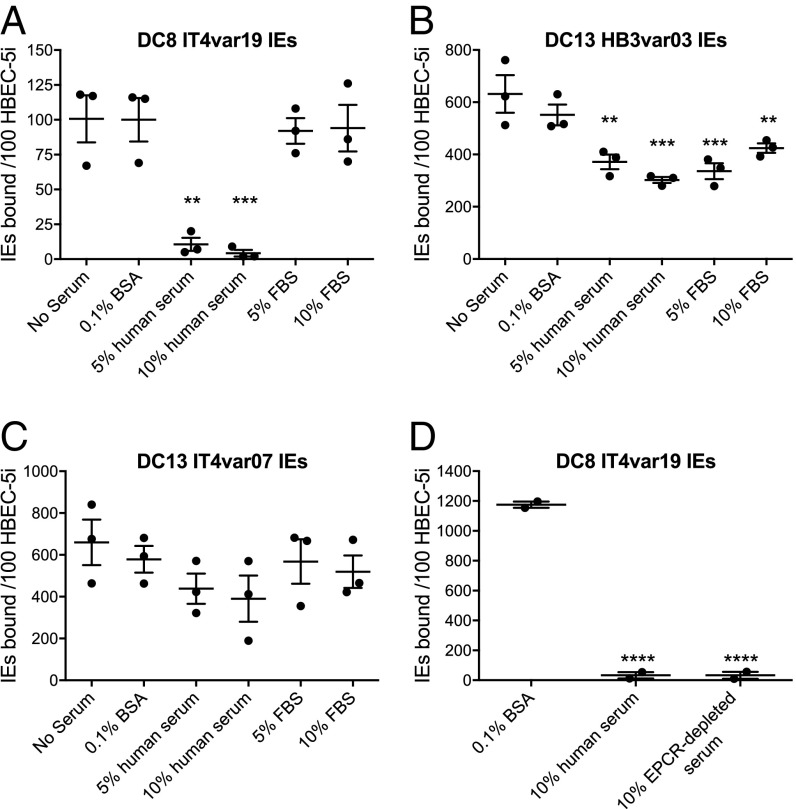
Recent advances have identified a new paradigm for cerebral malaria pathogenesis in which endothelial protein C receptor (EPCR) is a major host receptor for sequestration of -infected erythrocytes (IEs) in the brain and other vital organs. The parasite adhesins that bind EPCR are members of the IE variant surface antigen family erythrocyte membrane protein 1 (PfEMP1) containing specific adhesion domains called domain cassette (DC) 8 and DC13. The binding interaction site between PfEMP1 and EPCR has been mapped by biophysical and crystallography studies using recombinant proteins. However, studies examining the interaction of native PfEMP1 on the IE surface with EPCR are few. We aimed to study binding to EPCR by IEs expressing DC8 and DC13 PfEMP1 variants whose recombinant proteins have been used in key prior functional and structural studies. IE binding to EPCR immobilized on plastic and on human brain endothelial cells was examined in static and flow adhesion assays. Unexpectedly, we found that IEs expressing the DC13 PfEMP1 variant HB3var03 or IT4var07 did not bind to EPCR on plastic and the binding of these variants to brain endothelial cells was not dependent on EPCR. IEs expressing the DC8 variant IT4var19 did bind to EPCR, but this interaction was inhibited if normal human serum or plasma was present, raising the possibility that IE-EPCR interaction may be prevented by plasma components under physiological conditions. These data highlight a discrepancy in EPCR-binding activity between PfEMP1 recombinant proteins and IEs, and indicate the critical need for further research to understand the pathophysiological significance of the PfEMP1-EPCR interaction.
最近的研究进展为脑型疟疾的发病机制提出了一个新的范例,即内皮蛋白 C 受体 (EPCR) 是 - 感染的红细胞 (IEs) 在大脑和其他重要器官中被隔离的主要宿主受体。与 EPCR 结合的寄生虫黏附素是 IEs 变体表面抗原家族的成员,红细胞膜蛋白 1 (PfEMP1) 包含称为结构域盒 (DC) 8 和 DC13 的特定黏附结构域。PfEMP1 与 EPCR 之间的结合相互作用位点已通过使用重组蛋白的生物物理和晶体学研究进行了映射。然而,研究 IE 表面上天然 PfEMP1 与 EPCR 相互作用的研究很少。我们旨在通过表达 DC8 和 DC13 PfEMP1 变体的 IEs 来研究与 EPCR 的结合,其重组蛋白已用于先前的关键功能和结构研究。在静态和流动黏附测定中检查了 IE 对固定在塑料上和人脑内皮细胞上的 EPCR 的结合。出乎意料的是,我们发现表达 DC13 PfEMP1 变体 HB3var03 或 IT4var07 的 IEs 不会与塑料上的 EPCR 结合,并且这些变体与脑内皮细胞的结合不依赖于 EPCR。表达 DC8 变体 IT4var19 的 IEs 确实与 EPCR 结合,但如果存在正常的人血清或血浆,这种相互作用会受到抑制,这提示 IE-EPCR 相互作用可能会被生理条件下的血浆成分所阻止。这些数据突出了 PfEMP1 重组蛋白和 IEs 之间在 EPCR 结合活性上的差异,并表明需要进一步研究以了解 PfEMP1-EPCR 相互作用的病理生理意义。