Sousa Diana Z, Visser Michael, van Gelder Antonie H, Boeren Sjef, Pieterse Mervin M, Pinkse Martijn W H, Verhaert Peter D E M, Vogt Carsten, Franke Steffi, Kümmel Steffen, Stams Alfons J M
Laboratory of Microbiology, Wageningen University & Research, Stippeneng 4, 6708 WE, Wageningen, The Netherlands.
Laboratory of Biochemistry, Wageningen University & Research, Stippeneng 4, 6708 WE, Wageningen, The Netherlands.
Nat Commun. 2018 Jan 16;9(1):239. doi: 10.1038/s41467-017-02518-9.
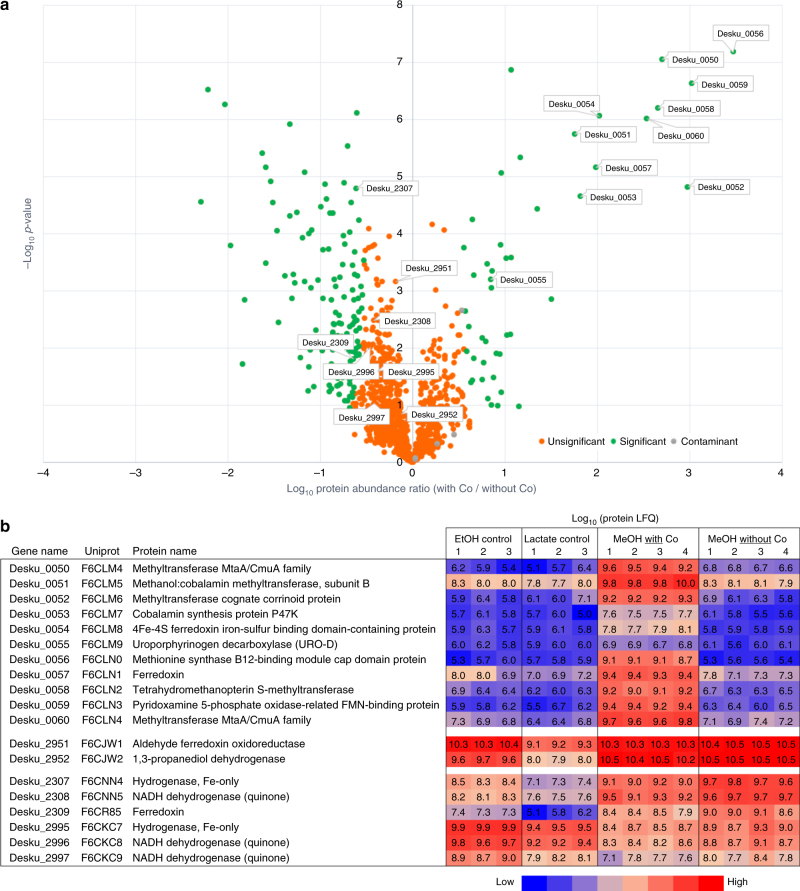
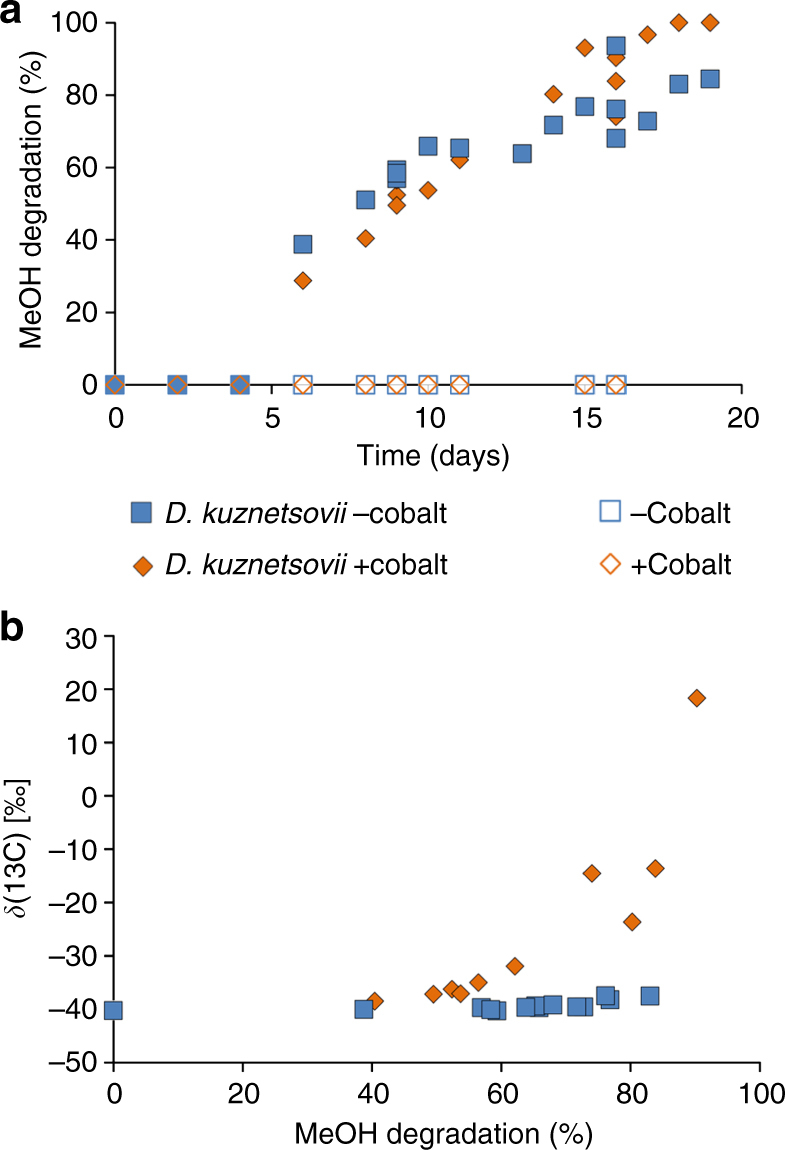
Methanol is generally metabolized through a pathway initiated by a cobalamine-containing methanol methyltransferase by anaerobic methylotrophs (such as methanogens and acetogens), or through oxidation to formaldehyde using a methanol dehydrogenase by aerobes. Methanol is an important substrate in deep-subsurface environments, where thermophilic sulfate-reducing bacteria of the genus Desulfotomaculum have key roles. Here, we study the methanol metabolism of Desulfotomaculum kuznetsovii strain 17, isolated from a 3000-m deep geothermal water reservoir. We use proteomics to analyze cells grown with methanol and sulfate in the presence and absence of cobalt and vitamin B12. The results indicate the presence of two methanol-degrading pathways in D. kuznetsovii, a cobalt-dependent methanol methyltransferase and a cobalt-independent methanol dehydrogenase, which is further confirmed by stable isotope fractionation. This is the first report of a microorganism utilizing two distinct methanol conversion pathways. We hypothesize that this gives D. kuznetsovii a competitive advantage in its natural environment.
甲醇通常通过厌氧甲基营养菌(如产甲烷菌和产乙酸菌)中含钴胺素的甲醇甲基转移酶启动的途径进行代谢,或者需氧菌利用甲醇脱氢酶将其氧化为甲醛进行代谢。甲醇是深层地下环境中的一种重要底物,其中脱硫肠状菌属的嗜热硫酸盐还原菌起着关键作用。在此,我们研究了从3000米深的地热水储层中分离出的库兹涅佐夫脱硫肠状菌菌株17的甲醇代谢。我们使用蛋白质组学分析在有和没有钴及维生素B12的情况下,以甲醇和硫酸盐为培养基生长的细胞。结果表明,库兹涅佐夫脱硫肠状菌存在两条甲醇降解途径,一条是依赖钴的甲醇甲基转移酶途径,另一条是不依赖钴的甲醇脱氢酶途径,这一点通过稳定同位素分馏得到了进一步证实。这是关于一种微生物利用两种不同甲醇转化途径的首次报道。我们推测,这赋予了库兹涅佐夫脱硫肠状菌在其天然环境中的竞争优势。