Averill Kristine M, Mortensen David A, Smithwick Erica A H, Kalisz Susan, McShea William J, Bourg Norman A, Parker John D, Royo Alejandro A, Abrams Marc D, Apsley David K, Blossey Bernd, Boucher Douglas H, Caraher Kai L, DiTommaso Antonio, Johnson Sarah E, Masson Robert, Nuzzo Victoria A
Ecology Intercollege Graduate Degree Program, The Pennsylvania State University, University Park, PA, USA.
Department of Plant Sciences, The Pennsylvania State University, University Park, PA, USA.
AoB Plants. 2017 Dec 7;10(1):plx047. doi: 10.1093/aobpla/plx047. eCollection 2018 Feb.
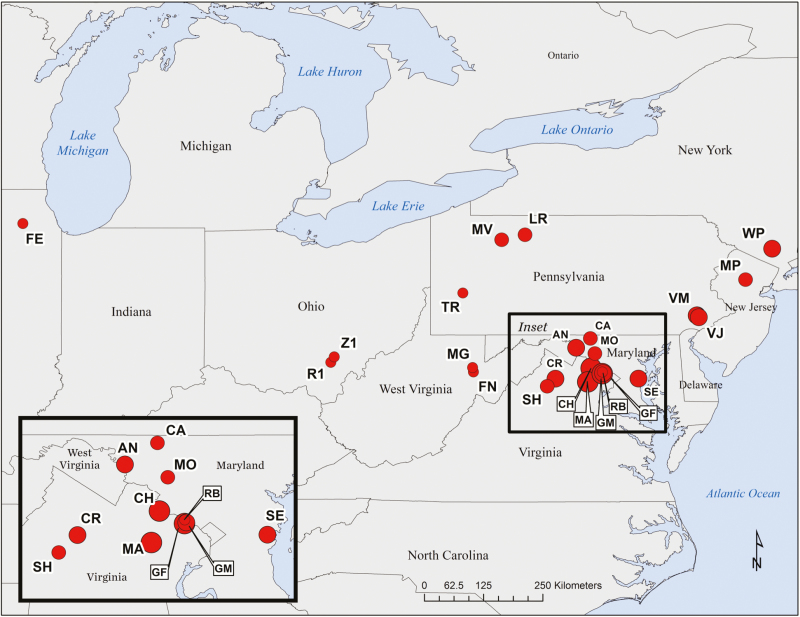
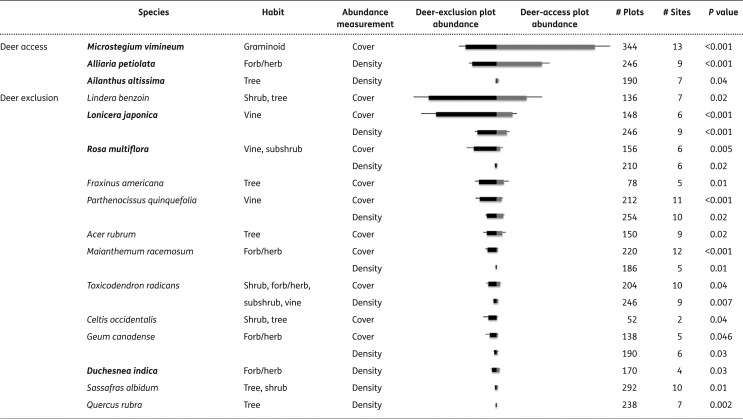
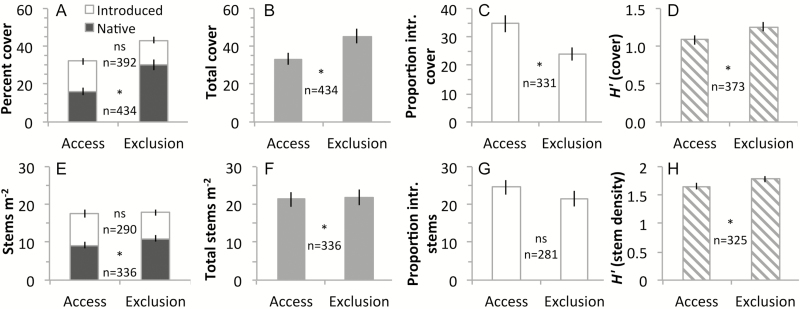
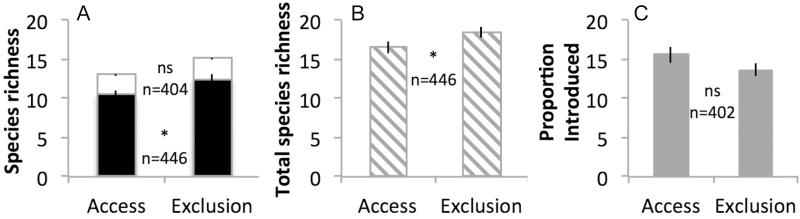
Herbivores can profoundly influence plant species assembly, including plant invasion, and resulting community composition. Population increases of native herbivores, e.g. white-tailed deer (), combined with burgeoning plant invasions raise concerns for native plant diversity and forest regeneration. While individual researchers typically test for the impact of deer on plant invasion at a few sites, the overarching influence of deer on plant invasion across regional scales is unclear. We tested the effects of deer on the abundance and diversity of introduced and native herbaceous and woody plants across 23 white-tailed deer research sites distributed across the east-central and north-eastern USA and representing a wide range of deer densities and invasive plant abundance and identity. Deer access/exclusion or deer population density did not affect introduced plant richness or community-level abundance. Native and total plant species richness, abundance (cover and stem density) and Shannon diversity were lower in deer-access vs. deer-exclusion plots. Among deer-access plots, native species richness, native and total cover, and Shannon diversity (cover) declined as deer density increased. Deer access increased the proportion of introduced species cover (but not of species richness or stem density). As deer density increased, the proportion of introduced species richness, cover and stem density all increased. Because absolute abundance of introduced plants was unaffected by deer, the increase in proportion of introduced plant abundance is likely an indirect effect of deer reducing native cover. Indicator species analysis revealed that deer access favoured three introduced plant species, including and , as well as four native plant species. In contrast, deer exclusion favoured three introduced plant species, including and , and 15 native plant species. Overall, native deer reduced community diversity, lowering native plant richness and abundance, and benefited certain invasive plants, suggesting pervasive impacts of this keystone herbivore on plant community composition and ecosystem services in native forests across broad swathes of the eastern USA.
食草动物会对植物物种组合产生深远影响,包括植物入侵以及由此产生的群落组成。本土食草动物数量的增加,例如白尾鹿(),再加上植物入侵的迅速发展,引发了人们对本土植物多样性和森林再生的担忧。虽然个别研究人员通常会在少数几个地点测试鹿对植物入侵的影响,但鹿在区域尺度上对植物入侵的总体影响尚不清楚。我们在美国中东部和东北部分布的23个白尾鹿研究地点,测试了鹿对引入的和本土的草本及木本植物的丰度和多样性的影响,这些地点代表了广泛的鹿密度以及入侵植物的丰度和种类。鹿的进入/排除或鹿的种群密度并未影响引入植物的丰富度或群落水平的丰度。与鹿排除的样地相比,鹿可进入的样地中本土和总植物物种丰富度、丰度(盖度和茎密度)以及香农多样性较低。在鹿可进入的样地中,随着鹿密度的增加,本土物种丰富度、本土和总盖度以及香农多样性(盖度)下降。鹿的进入增加了引入物种盖度的比例(但不是物种丰富度或茎密度)。随着鹿密度的增加,引入物种丰富度、盖度和茎密度的比例均增加。由于引入植物的绝对丰度不受鹿的影响,引入植物丰度比例的增加可能是鹿减少本土盖度的间接影响。指示物种分析表明,鹿的进入有利于三种引入植物物种,包括 和 ,以及四种本土植物物种。相比之下,鹿的排除有利于三种引入植物物种,包括 和 ,以及15种本土植物物种。总体而言,本土鹿降低了群落多样性,减少了本土植物的丰富度和丰度,并使某些入侵植物受益,这表明这种关键食草动物对美国东部大片原生森林中的植物群落组成和生态系统服务具有广泛影响。