Arribas María, Aguirre Jacobo, Manrubia Susanna, Lázaro Ester
Centro de Astrobiología (CSIC-INTA), Ctra. de Ajalvir km. 4, Torrejón de Ardoz, Madrid 28850, Spain.
Grupo Interdisciplinar de Sistemas Complejos (GISC), Madrid, Spain.
Virus Evol. 2018 Jan 9;4(1):vex043. doi: 10.1093/ve/vex043. eCollection 2018 Jan.
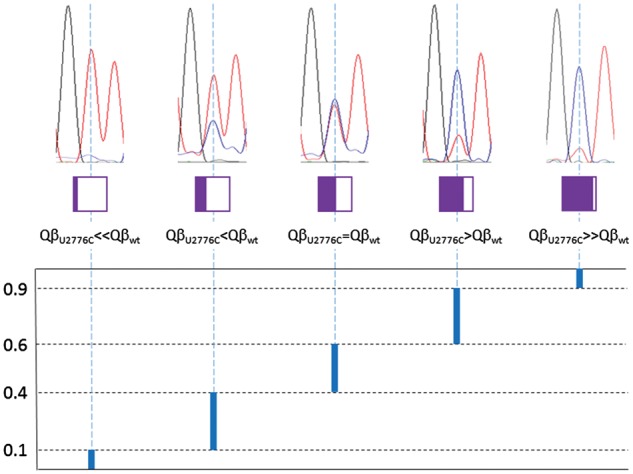
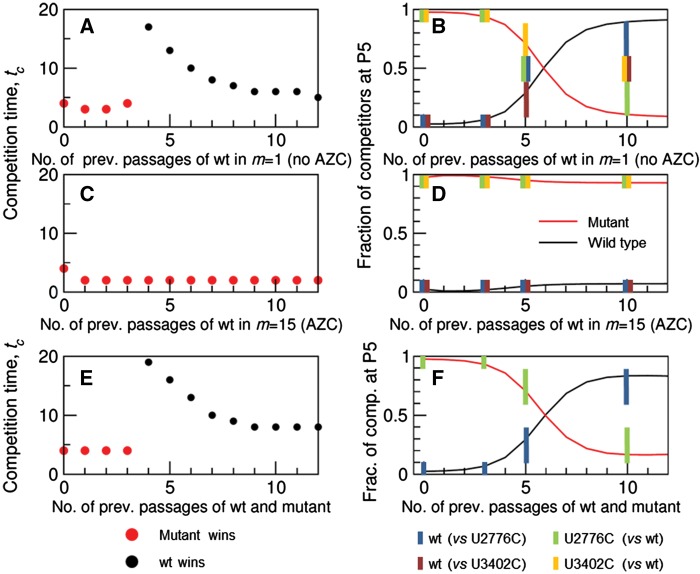
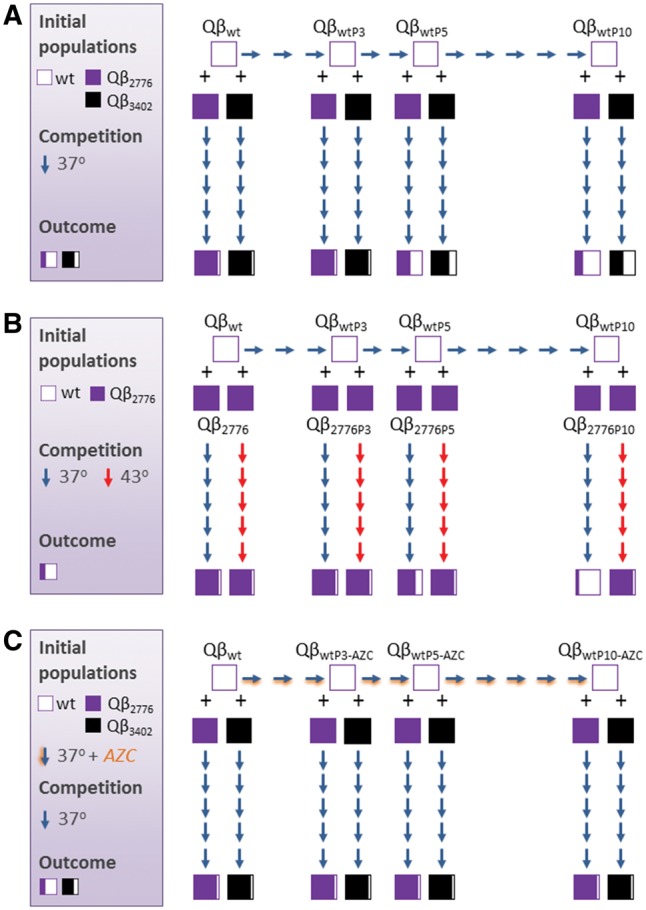
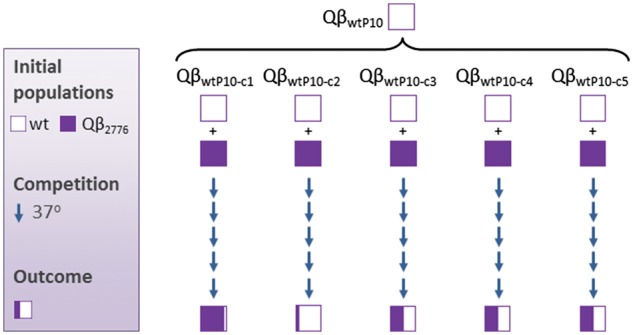
Virus fitness is a complex parameter that results from the interaction of virus-specific characters (e.g. intracellular growth rate, adsorption rate, virion extracellular stability, and tolerance to mutations) with others that depend on the underlying fitness landscape and the internal structure of the whole population. Individual mutants usually have lower fitness values than the complex population from which they come from. When they are propagated and allowed to attain large population sizes for a sufficiently long time, they approach mutation-selection equilibrium with the concomitant fitness gains. The optimization process follows dynamics that vary among viruses, likely due to differences in any of the parameters that determine fitness values. As a consequence, when different mutants spread together, the number of generations experienced by each of them prior to co-propagation may determine its particular fate. In this work we attempt a clarification of the effect of different levels of population diversity in the outcome of competition dynamics. To this end, we analyze the behavior of two mutants of the RNA bacteriophage Qβ that co-propagate with the wild-type virus. When both competitor viruses are clonal, the mutants rapidly outcompete the wild type. However, the outcome in competitions performed with partially optimized virus populations depends on the distance of the competitors to their clonal origin. We also implement a theoretical population dynamics model that describes the evolution of a heterogeneous population of individuals, each characterized by a fitness value, subjected to subsequent cycles of replication and mutation. The experimental results are explained in the framework of our theoretical model under two non-excluding, likely complementary assumptions: (1) The relative advantage of both competitors changes as populations approach mutation-selection equilibrium, as a consequence of differences in their growth rates and (2) one of the competitors is more robust to mutations than the other. The main conclusion is that the nearness of an RNA virus population to mutation-selection equilibrium is a key factor determining the fate of particular mutants arising during replication.
病毒适应性是一个复杂的参数,它源于病毒特异性特征(如细胞内生长速率、吸附速率、病毒粒子细胞外稳定性和对突变的耐受性)与其他依赖于潜在适应性景观和整个群体内部结构的因素之间的相互作用。单个突变体的适应性值通常低于它们所源自的复杂群体。当它们繁殖并在足够长的时间内达到较大的群体规模时,它们会伴随着适应性增加而接近突变 - 选择平衡。优化过程遵循因病毒而异的动态变化,这可能是由于决定适应性值的任何参数存在差异所致。因此,当不同的突变体一起传播时,它们在共同传播之前经历的世代数可能决定其特定命运。在这项工作中,我们试图阐明不同水平的群体多样性对竞争动态结果的影响。为此,我们分析了与野生型病毒共同传播的RNA噬菌体Qβ的两个突变体的行为。当两种竞争病毒都是克隆性的时,突变体迅速超越野生型。然而,用部分优化的病毒群体进行竞争的结果取决于竞争者与其克隆起源的距离。我们还实施了一个理论群体动力学模型,该模型描述了一个异质个体群体的进化,每个个体都具有一个适应性值,并经历随后的复制和突变循环。在两个非排他性、可能互补的假设框架下,我们的理论模型解释了实验结果:(1)由于生长速率的差异,随着群体接近突变 - 选择平衡,两种竞争者的相对优势会发生变化;(2)其中一个竞争者对突变的耐受性比另一个更强。主要结论是RNA病毒群体接近突变 - 选择平衡的程度是决定复制过程中出现的特定突变体命运的关键因素。