Pannala Rahul, Baldwin Bruce, Aluru Vijay, Grys Thomas E, Holmes Jordan, Miller Laurence J, Harrison M Edwyn, Nguyen Cuong C, Tenover Fred C, Persing David, Faigel Douglas O
Division of Gastroenterology and Hepatology, Mayo Clinic, Scottsdale, AZ, USA.
Division of Laboratory Medicine, Mayo Clinic, Scottsdale, AZ, USA.
Endosc Int Open. 2018 Jan;6(1):E58-E63. doi: 10.1055/s-0043-122141. Epub 2018 Jan 12.
BACKGROUND/AIMS: In an investigator-initiated, prospective study, we evaluated the feasibility of a five-gene sequence point-of-care (POC) testing strategy (Xpert CARBA-R Assay, Cepheid Inc., Sunnyvale, CA, USA), compared to reference laboratory PCR (48 - 72 hours turnaround time, two gene sequences), in patients undergoing endoscopic retrograde cholangiopancreatography (ERCP) and in a hospital outbreak investigation.
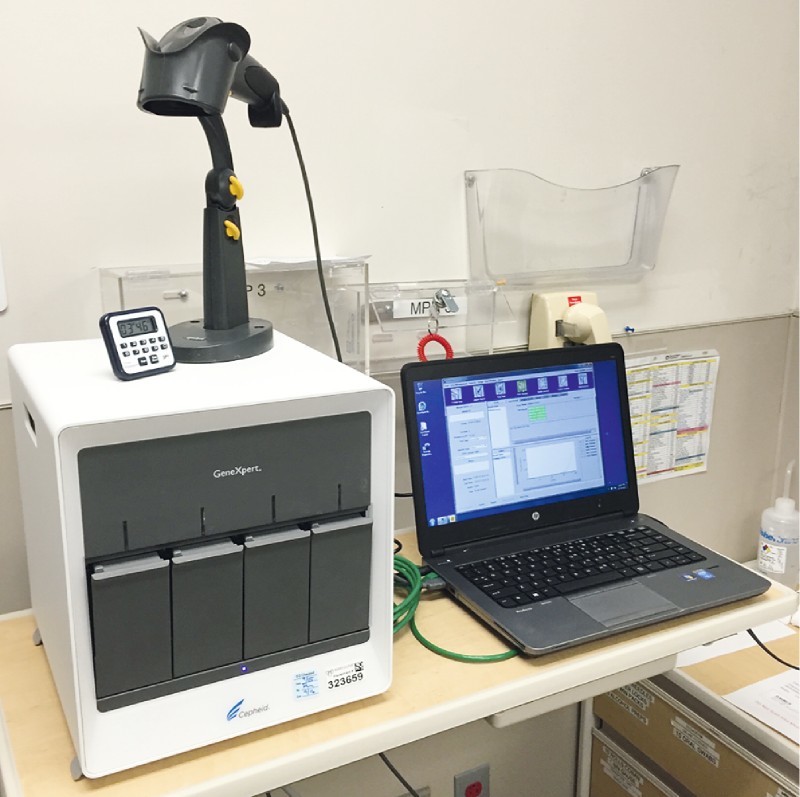
After informed consent, patients undergoing ERCP (September 2015 - April 2016, n = 191) at Mayo Clinic and potential hospital contacts (n = 9) of an index carbapenem-resistant organism (CRO)-positive inpatient were included. Two rectal swabs, one each for reference and POC assays were obtained. The Xpert CARBA-R Assay enables qualitative rapid detection of five beta-lactamase gene sequences associated with carbapenem-non-susceptibility in Gram-negative bacteria. Feasibility parameters (specimen processing and assay run time, ease of use) and percent agreement between the tests were calculated using JMP Pro11 (SAS Corp, Cary, NC, USA).
Mean age was 62 ± 15 years; 108 (54 %) were male. Both tests were successfully performed in all patients. The POC test was rated by endoscopy nurses as easy/very easy to conduct in 193 patients (97 %); median assay run time and median time for specimen collection and processing were 55 minutes (interquartile range IQR: 53 - 55 minutes) and 3 minutes (IQR: 3 - 6 minutes), respectively. In 200/201 (99.5 %) tests, there was agreement between the POC and reference PCR.
The more comprehensive POC CRO testing of patients in the endoscopy suite is feasible and results are available in < 1 hour. This strategy may enable rapid risk stratification of duodenoscope exposure to CRO and potentially improve operational efficiency and decrease costs.
背景/目的:在一项研究者发起的前瞻性研究中,我们评估了一种五基因序列即时检测(POC)策略(Xpert CARBA-R检测法,美国加利福尼亚州桑尼维尔市塞菲德公司)的可行性,该策略与参考实验室PCR(周转时间48 - 72小时,检测两个基因序列)相比,应用于接受内镜逆行胰胆管造影(ERCP)的患者以及医院爆发调查中。
在获得知情同意后,纳入梅奥诊所接受ERCP的患者(2015年9月 - 2016年4月,n = 191)以及一名耐碳青霉烯类生物体(CRO)阳性住院患者的潜在医院接触者(n = 9)。获取两份直肠拭子,一份用于参考检测,一份用于POC检测。Xpert CARBA-R检测法能够定性快速检测革兰氏阴性菌中与碳青霉烯不敏感相关的五个β-内酰胺酶基因序列。使用JMP Pro11(美国北卡罗来纳州卡里市SAS公司)计算可行性参数(样本处理和检测运行时间、易用性)以及检测之间的一致性百分比。
平均年龄为62±15岁;108例(54%)为男性。所有患者的两种检测均成功完成。内镜护士将POC检测评为在193例患者(97%)中易于/非常易于进行;检测运行时间中位数以及样本采集和处理时间中位数分别为55分钟(四分位间距IQR:53 - 55分钟)和3分钟(IQR:3 - 6分钟)。在200/201(99.5%)次检测中,POC检测与参考PCR检测结果一致。
在内镜检查室对患者进行更全面的POC CRO检测是可行的,且结果可在1小时内获得。该策略可能实现对十二指肠镜暴露于CRO的快速风险分层,并有可能提高运营效率和降低成本。