Clarke Sarah B, Deighton Kevin, Newman Caroline, Nicholson Gareth, Gallagher Liam, Boos Christopher J, Mellor Adrian, Woods David R, O'Hara John P
Institute for Sport, Physical Activity & Leisure, Leeds Beckett University, Leeds, United Kingdom.
School of Health and Human Performance, Northern Michigan University, Marquette, Michigan, United States of America.
PLoS One. 2018 Jan 17;13(1):e0190919. doi: 10.1371/journal.pone.0190919. eCollection 2018.
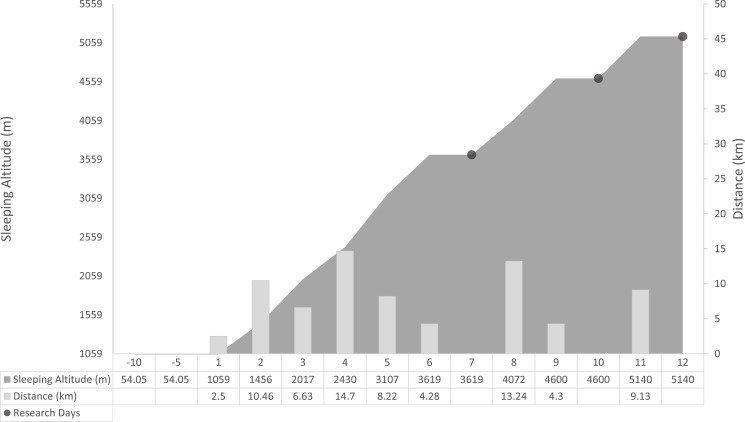
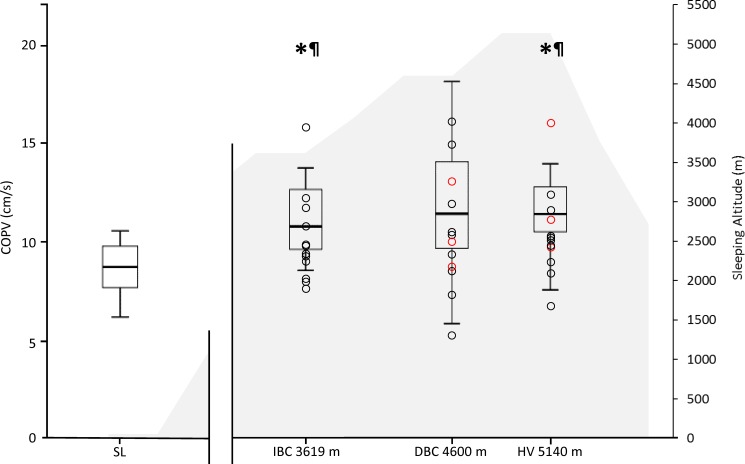
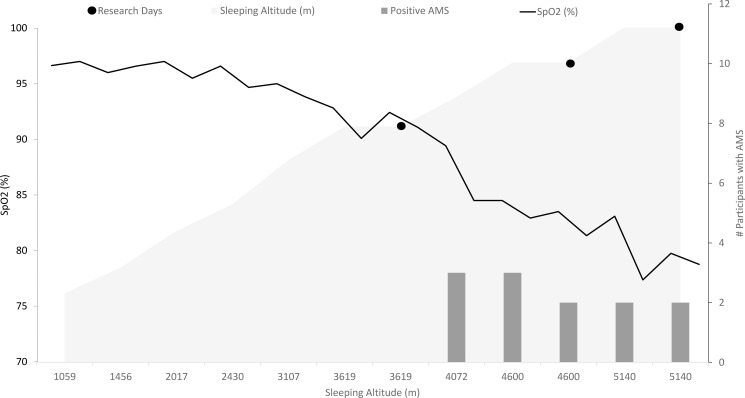
Postural control and joint position sense are essential for safely undertaking leisure and professional activities, particularly at high altitude. We tested whether exposure to a 12-day trek with a gradual ascent to high altitude impairs postural control and joint position sense. This was a repeated measures observational study of 12 military service personnel (28±4 years). Postural control (sway velocity measured by a portable force platform) during standing balance, a Sharpened Romberg Test and knee joint position sense were measured, in England (113m elevation) and at 3 research camps (3619m, 4600m and 5140m) on a 12-day high altitude trek in the Dhaulagiri region of Nepal. Pulse oximetry, and Lake Louise scores were also recorded on the morning and evening of each trek day. Data were compared between altitudes and relationships between pulse oximetry, Lake Louise score, and sway velocity were explored. Total sway velocity during standing balance with eyes open (p = 0.003, d = 1.9) and during Sharpened Romberg test with eyes open (p = 0.007, d = 1.6) was significantly greater at altitudes of 3619m and 5140m when compared with sea level. Anterior-posterior sway velocity during standing balance with eyes open was also significantly greater at altitudes of 3619m and 5140m when compared with sea level (p = 0.001, d = 1.9). Knee joint position sense was not altered at higher altitudes. There were no significant correlations between Lake Louise scores, pulse oximetry and postural sway. Despite a gradual ascent profile, exposure to 3619 m was associated with impairments in postural control without impairment in knee joint position sense. Importantly, these impairments did not worsen at higher altitudes of 4600 m or 5140 m. The present findings should be considered during future trekking expeditions when developing training strategies targeted to manage impairments in postural control that occur with increasing altitude.
姿势控制和关节位置觉对于安全地进行休闲和职业活动至关重要,尤其是在高海拔地区。我们测试了进行一次为期12天、逐渐上升至高海拔的徒步旅行是否会损害姿势控制和关节位置觉。这是一项对12名军事人员(28±4岁)进行的重复测量观察性研究。在英国(海拔113米)以及在尼泊尔道拉吉里地区进行的为期12天的高海拔徒步旅行中的3个研究营地(海拔3619米、4600米和5140米),测量了站立平衡时的姿势控制(通过便携式测力平台测量摆动速度)、改良罗姆伯格试验以及膝关节位置觉。在每个徒步旅行日的早晨和晚上还记录了脉搏血氧饱和度和路易斯湖评分。对不同海拔的数据进行了比较,并探讨了脉搏血氧饱和度、路易斯湖评分和摆动速度之间的关系。与海平面相比,在海拔3619米和5140米时,睁眼站立平衡时的总摆动速度(p = 0.003,d = 1.9)以及睁眼改良罗姆伯格试验时的总摆动速度(p = 0.007,d = 1.6)显著更大。与海平面相比,在海拔3619米和5140米时,睁眼站立平衡时的前后摆动速度也显著更大(p = 0.001,d = 1.9)。在更高海拔时膝关节位置觉未改变。路易斯湖评分、脉搏血氧饱和度和姿势摆动之间无显著相关性。尽管是逐渐上升的过程,但暴露于3619米与姿势控制受损相关,而膝关节位置觉未受损。重要的是,这些损伤在4600米或5140米的更高海拔处并未恶化。在未来的徒步旅行探险中制定针对管理随着海拔升高而出现的姿势控制损伤的训练策略时,应考虑本研究结果。