Wu Juan, Xu Jianhua, Wang Kang, Zhu Qicui, Cai Jingyu, Ren Jiale, Zheng Shuang, Ding Changhai
Department of Rheumatology and Immunology, Arthritis Research Institute, the First Affiliated Hospital of Anhui Medical University, 218 Jixi Street, Hefei, China.
Menzies Institute for Medical Research, University of Tasmania, Private Bag 23, Hobart, TAS, 7000, Australia.
BMC Musculoskelet Disord. 2018 Jan 17;19(1):16. doi: 10.1186/s12891-018-1936-7.
Associations between adipokines and bone mineral density (BMD) in knee osteoarthritis (OA) remain indistinct. The aim of this study was to investigate the cross-sectional associations between serum levels of adipokines and BMD in patients with knee OA.
This study included 164 patients with symptomatic knee OA from the Anhui Osteoarthritis study. Serum levels of leptin, adiponectin, and resistin were measured using an enzyme-linked immunosorbent assay (ELISA). BMD at total body, spine, hip, and femur were measured by dual-energy X-ray absorptiometry (DXA).
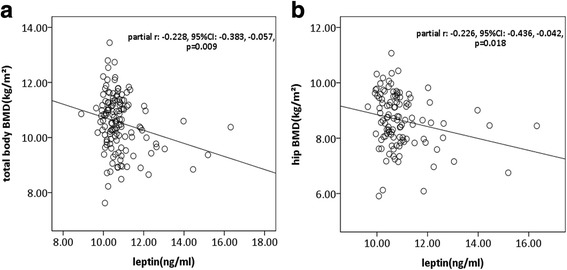
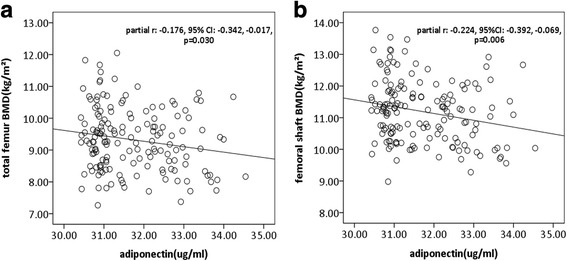
In multivariable analyses, serum levels of leptin were significantly associated with reduced BMD at total body, hip, total femur, femoral neck, and femoral shaft (β = - 0.019, 95% CI -0.034 to - 0.005; β = - 0.018, 95% CI -0.034 to - 0.003; β = - 0.018, 95% CI -0.034 to - 0.002; β = - 0.016, 95% CI -0.032 to 0.000; β = - 0.026, 95% CI -0.046 to - 0.006; respectively). Serum levels of adiponectin were significantly and negatively associated with BMD at total femur and femoral shaft (β = - 0.007, 95% CI -0.013 to 0.000; β = - 0.011, 95% CI -0.018 to - 0.003; respectively). However, no significant associations were found between serum levels of resistin and BMD at any site measured.
Serum levels of leptin and adiponectin were significantly and negatively associated with BMD, suggesting potentially detrimental effects of leptin and adiponectin on BMD in knee OA patients.
在膝关节骨关节炎(OA)中,脂肪因子与骨密度(BMD)之间的关联仍不明确。本研究旨在调查膝关节OA患者血清脂肪因子水平与BMD之间的横断面关联。
本研究纳入了来自安徽骨关节炎研究的164例有症状的膝关节OA患者。采用酶联免疫吸附测定(ELISA)法检测血清瘦素、脂联素和抵抗素水平。通过双能X线吸收法(DXA)测量全身、脊柱、髋部和股骨的骨密度。
在多变量分析中,血清瘦素水平与全身、髋部、全股骨、股骨颈和股骨干骨密度降低显著相关(β = -0.019,95%CI -0.034至-0.005;β = -0.018,95%CI -0.034至-0.003;β = -0.018,95%CI -0.034至-0.002;β = -0.016,95%CI -0.032至0.000;β = -0.026,95%CI -0.046至-0.006;分别)。血清脂联素水平与全股骨和股骨干骨密度显著负相关(β = -0.007,95%CI -0.013至0.000;β = -0.011,95%CI -0.018至-0.003;分别)。然而,在所测量的任何部位,血清抵抗素水平与骨密度之间均未发现显著关联。
血清瘦素和脂联素水平与骨密度显著负相关,提示瘦素和脂联素对膝关节OA患者的骨密度可能有有害影响。