Meng Xianyi, Grötsch Bettina, Luo Yubin, Knaup Karl Xaver, Wiesener Michael Sean, Chen Xiao-Xiang, Jantsch Jonathan, Fillatreau Simon, Schett Georg, Bozec Aline
Department of Internal Medicine 3, Friedrich-Alexander-University Erlangen-Nürnberg (FAU) and Universitätsklinikum Erlangen, 91054, Erlangen, Germany.
Department of Internal Medicine 4, Friedrich-Alexander-University Erlangen-Nürnberg (FAU) and Universitätsklinikum Erlangen, 91054, Erlangen, Germany.
Nat Commun. 2018 Jan 17;9(1):251. doi: 10.1038/s41467-017-02683-x.
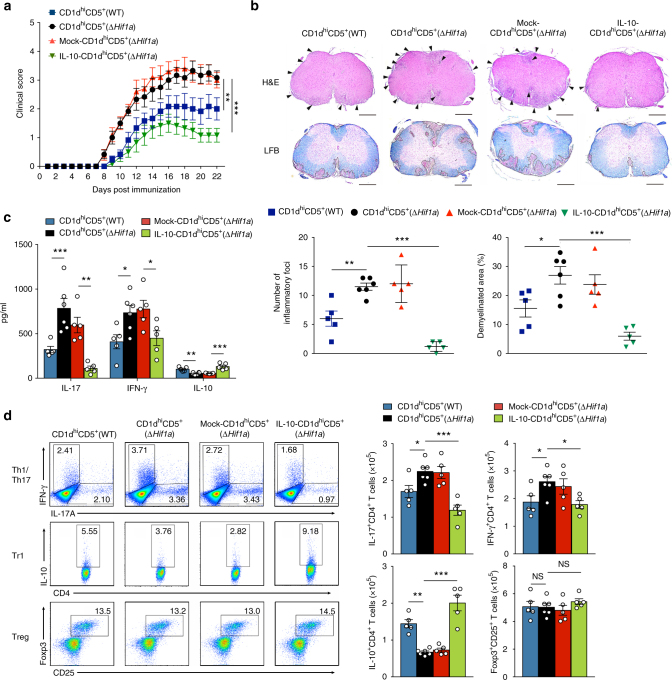
Hypoxia-inducible factors (HIFs) are key elements for controlling immune cell metabolism and functions. While HIFs are known to be involved in T cells and macrophages activation, their functions in B lymphocytes are poorly defined. Here, we show that hypoxia-inducible factor-1α (HIF-1α) contributes to IL-10 production by B cells. HIF-1α regulates IL-10 expression, and HIF-1α-dependent glycolysis facilitates CD1dCD5 B cells expansion. Mice with B cell-specific deletion of Hif1a have reduced number of IL-10-producing B cells, which result in exacerbated collagen-induced arthritis and experimental autoimmune encephalomyelitis. Wild-type CD1dCD5 B cells, but not Hif1a-deficient CD1dCD5 B cells, protect recipient mice from autoimmune disease, while the protective function of Hif1a-deficient CD1dCD5 B cells is restored when their defective IL-10 expression is genetically corrected. Taken together, this study demonstrates the key function of the hypoxia-associated transcription factor HIF-1α in driving IL-10 expression in CD1dCD5 B cells, and in controlling their protective activity in autoimmune disease.
缺氧诱导因子(HIFs)是控制免疫细胞代谢和功能的关键因素。虽然已知HIFs参与T细胞和巨噬细胞的激活,但其在B淋巴细胞中的功能尚不清楚。在此,我们表明缺氧诱导因子-1α(HIF-1α)有助于B细胞产生白细胞介素-10(IL-10)。HIF-1α调节IL-10的表达,且HIF-1α依赖的糖酵解促进CD1dCD5 B细胞的扩增。B细胞特异性缺失Hif1a的小鼠产生IL-10的B细胞数量减少,这导致胶原诱导的关节炎和实验性自身免疫性脑脊髓炎加剧。野生型CD1dCD5 B细胞而非Hif1a缺陷型CD1dCD5 B细胞可保护受体小鼠免受自身免疫性疾病的侵害,而当Hif1a缺陷型CD1dCD5 B细胞有缺陷的IL-10表达通过基因校正恢复时,其保护功能也得以恢复。综上所述,本研究证明了缺氧相关转录因子HIF-1α在驱动CD1dCD5 B细胞中IL-10表达以及控制其在自身免疫性疾病中的保护活性方面的关键作用。