Paganelli Roberto, Petrarca Claudia, Di Gioacchino Mario
1Dipartimento di Medicina e Scienze dell'invecchiamento, Università "G. d'Annunzio" of Chieti-Pescara, Via dei Vestini, 5, 66013 Chieti, Italy.
Ce.S.I.-Me.T., Chieti, Italy.
Clin Mol Allergy. 2018 Jan 10;16:1. doi: 10.1186/s12948-018-0080-0. eCollection 2018.
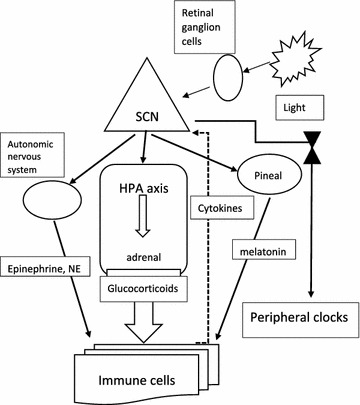
The 2017 Nobel Prize for Physiology or Medicine, awarded for the discoveries made in the past 15 years on the genetic and molecular mechanisms regulating many physiological functions, has renewed the attention to the importance of circadian rhythms. These originate from a central pacemaker in the suprachiasmatic nucleus in the brain, photoentrained via direct connection with melanopsin containing, intrinsically light-sensitive retinal ganglion cells, and it projects to periphery, thus creating an inner circadian rhythm. This regulates several activities, including sleep, feeding times, energy metabolism, endocrine and immune functions. Disturbances of these rhythms, mainly of wake/sleep, hormonal secretion and feeding, cause decrease in quality of life, as well as being involved in development of obesity, metabolic syndrome and neuropsychiatric disorders. Most immunological functions, from leukocyte numbers, activity and cytokine secretion undergo circadian variations, which might affect susceptibility to infections. The intensity of symptoms and disease severity show a 24 h pattern in many immunological and allergic diseases, including rheumatoid arthritis, bronchial asthma, atopic eczema and chronic urticaria. This is accompanied by altered sleep duration and quality, a major determinant of quality of life. Shift work and travel through time zones as well as artificial light pose new health threats by disrupting the circadian rhythms. Finally, the field of chronopharmacology uses these concepts for delivering drugs in synchrony with biological rhythms.
2017年诺贝尔生理学或医学奖授予了过去15年在调控多种生理功能的遗传和分子机制方面的发现,这再次引发了人们对昼夜节律重要性的关注。昼夜节律源自大脑视交叉上核中的一个中央起搏器,它通过与含有黑视蛋白、具有内在光敏性的视网膜神经节细胞直接相连而被光调节,并且投射到外周,从而产生内在的昼夜节律。这调节多种活动,包括睡眠、进食时间、能量代谢、内分泌和免疫功能。这些节律的紊乱,主要是清醒/睡眠、激素分泌和进食方面的紊乱,会导致生活质量下降,还与肥胖、代谢综合征和神经精神疾病的发生有关。大多数免疫功能,从白细胞数量、活性到细胞因子分泌,都会经历昼夜变化,这可能会影响对感染的易感性。在许多免疫和过敏性疾病中,包括类风湿性关节炎、支气管哮喘、特应性皮炎和慢性荨麻疹,症状的强度和疾病的严重程度呈现出24小时的模式。这伴随着睡眠时间和质量的改变,而睡眠时间和质量是生活质量的一个主要决定因素。轮班工作、跨时区旅行以及人造光通过扰乱昼夜节律对健康构成了新的威胁。最后,时辰药理学领域利用这些概念使药物的给药与生物节律同步。