Wimmer Kerstin, Strobl Stephanie, Bolliger Michael, Devyatko Yelena, Korkmaz Belgin, Exner Ruth, Fitzal Florian, Gnant Michael
Department of Surgery and Comprehensive Cancer Center, Medical University of Vienna, Vienna, Austria.
Department of Surgery and Comprehensive Cancer Center, Medical University of Vienna, Waehringer Guertel 18-20, 1090, Vienna, Austria.
Ther Adv Med Oncol. 2017 Nov;9(11):679-692. doi: 10.1177/1758834017732966. Epub 2017 Oct 27.
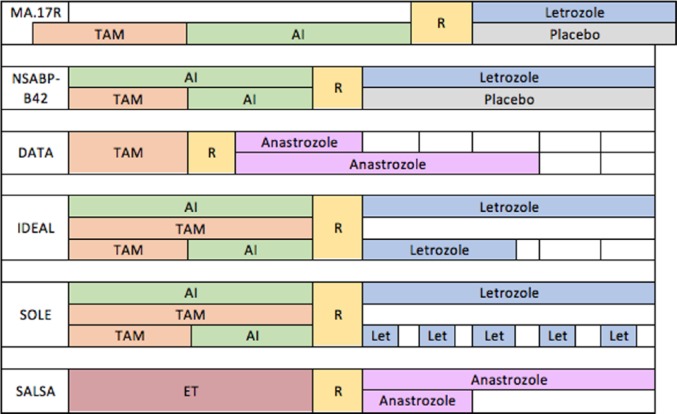
The benefit of 5 years of adjuvant endocrine therapy for women with hormone receptor-positive (HR) breast cancer (BC) is beyond discussion. Nevertheless, the risk of recurrence of luminal BC persists for 15 years or more after diagnosis. Consequently, approaches of extended adjuvant therapy have been investigated in large clinical trials, with the ultimate aim of further reducing the risk of recurrence in patients with HR BC.
A review of recently published trial data is presented to provide a solid basis for discussion. A discussion of the side effects of long-term endocrine treatment, multigenetic tests aiming to identify patients at particular risk, and an outlook for further promising targets are additional aims of this review.
Extended adjuvant therapy seems beneficial in reducing distant relapse and contralateral BC for a selected group of patients with HR BC, particularly if aromatase inhibitors (AIs) are used after initial tamoxifen therapy. However, patients with lower risk of recurrence and initial AI therapy may suffer more from side effects than benefit from extended therapy.
对于激素受体阳性(HR)乳腺癌(BC)女性患者,5年辅助内分泌治疗的益处毋庸置疑。然而,管腔型BC诊断后15年或更长时间仍存在复发风险。因此,大型临床试验对延长辅助治疗方法进行了研究,最终目的是进一步降低HR BC患者的复发风险。
本文回顾了近期发表的试验数据,为讨论提供坚实基础。讨论长期内分泌治疗的副作用、旨在识别特定风险患者的多基因检测以及对更有前景的进一步靶点的展望是本综述的其他目的。
延长辅助治疗似乎有利于降低特定HR BC患者群体的远处复发和对侧BC风险,特别是在初始他莫昔芬治疗后使用芳香化酶抑制剂(AI)时。然而,复发风险较低且初始接受AI治疗的患者可能更多地遭受副作用,而非从延长治疗中获益。