Yuan Li, Li Shaolin, Zhou Qi, Wang Dong, Zou Dongling, Shu Jin, Huang Yu
Department of Radiological Medicine, Chongqing Medical University, Chongqing 400016, P.R. China.
Department of Gynecologic Oncology, Chongqing Cancer Institute, Chongqing 400030, P.R. China.
Oncol Lett. 2017 Dec;14(6):7311-7317. doi: 10.3892/ol.2017.7157. Epub 2017 Oct 10.
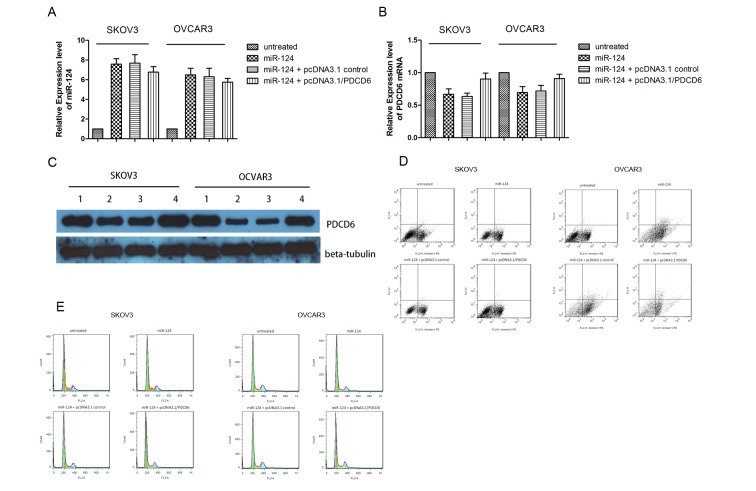
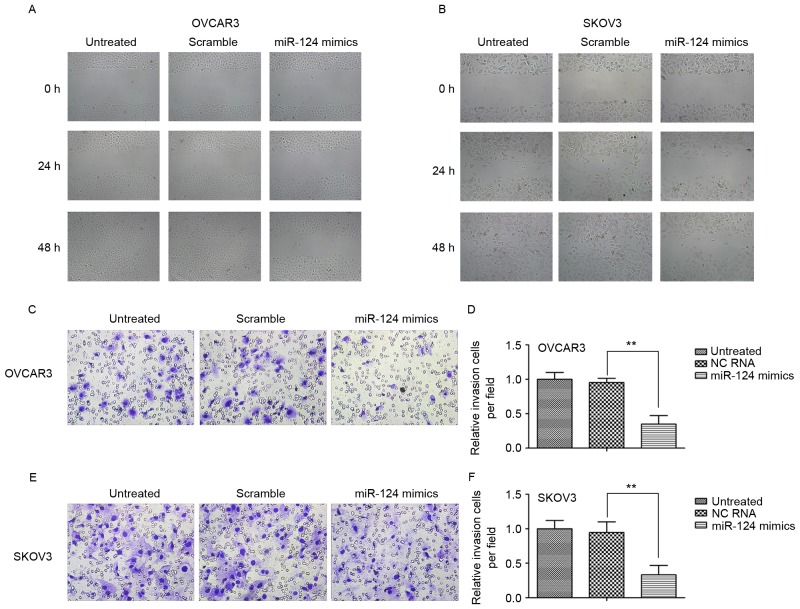
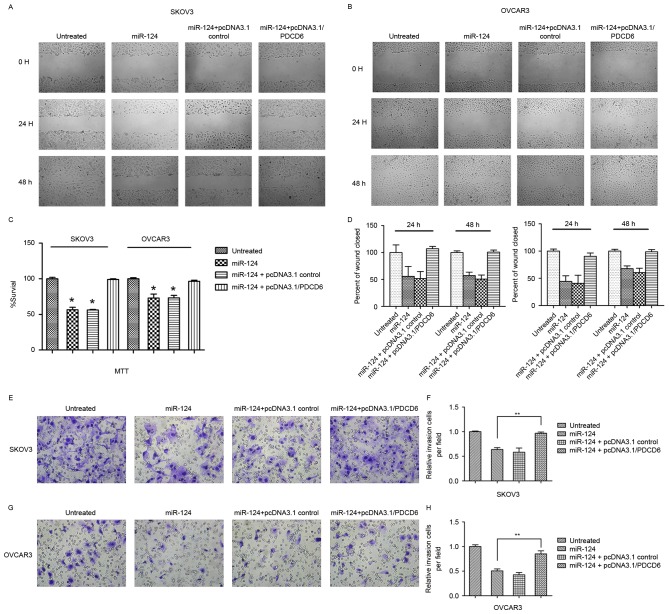
Epithelial ovarian cancer remains the most common type of malignant tumor of the female reproductive system worldwide. Routine surgery and chemotherapy are the best treatments available for patients with ovarian cancer; however, almost 40% of ovarian cancer cases are intractable, with poor 5-year survival rates. MicroRNAs (miRNA) are endogenous small non-coding RNA molecules that function in transcriptional and post-transcriptional regulation of gene expression in various cellular processes. Recent studies demonstrated that microRNA (miR)-124 was downregulated in numerous types of tumors; however, the function and mechanism underlying miR-124 in epithelial ovarian cancer remain unclear. The present study revealed that miR-124 may be significantly downregulated in epithelial ovarian cancer. Using prediction algorithms and luciferase reporter gene assays, the present study identified and confirmed programmed cell death 6 (PDCD6) as a novel, direct target of miR-124. Overexpression of miR-124 suppressed PDCD6 expression, inhibited cell proliferation, migration and invasion, and induced apoptosis in SKOV3 and OCVAR3 cells . In the present study, overexpression of PDCD6 in epithelial ovarian cancer cells co-transfected with miR-124 effectively reversed the miR-124-induced apoptosis. Therefore, the results of the present study suggested that miR-124 is a tumor suppressor miRNA and a potential target for future treatment of ovarian malignant neoplasms.
上皮性卵巢癌仍然是全球女性生殖系统中最常见的恶性肿瘤类型。常规手术和化疗是卵巢癌患者可采用的最佳治疗方法;然而,几乎40%的卵巢癌病例难以治疗,5年生存率较低。微小RNA(miRNA)是内源性小非编码RNA分子,在各种细胞过程中参与基因表达的转录和转录后调控。最近的研究表明,微小RNA(miR)-124在多种类型的肿瘤中表达下调;然而,miR-124在上皮性卵巢癌中的功能和机制仍不清楚。本研究表明,miR-124在上皮性卵巢癌中可能显著下调。通过预测算法和荧光素酶报告基因检测,本研究鉴定并证实程序性细胞死亡6(PDCD6)是miR-124的一个新的直接靶点。miR-124的过表达抑制了PDCD6的表达,抑制了SKOV3和OCVAR3细胞的增殖、迁移和侵袭,并诱导了细胞凋亡。在本研究中,在与miR-124共转染的上皮性卵巢癌细胞中过表达PDCD6有效地逆转了miR-124诱导的细胞凋亡。因此,本研究结果表明,miR-124是一种肿瘤抑制性miRNA,是未来治疗卵巢恶性肿瘤的潜在靶点。