Department of Medicine, Harvard Medical School, Jeff and Penny Vinik Center for Allergic Disease Research, Division of Rheumatology, Immunology and Allergy, Brigham and Women's Hospital, Boston, Massachusetts, USA.
Department of Medicine, Department of Pharmacology, University of California, San Diego, California, USA.
Mucosal Immunol. 2018 May;11(3):615-626. doi: 10.1038/mi.2017.99. Epub 2017 Dec 20.
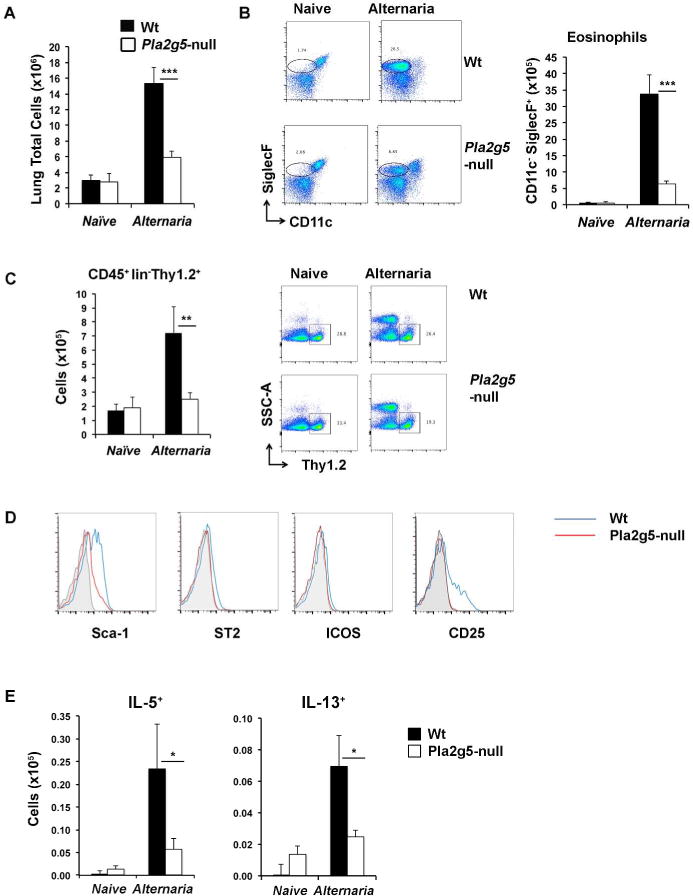
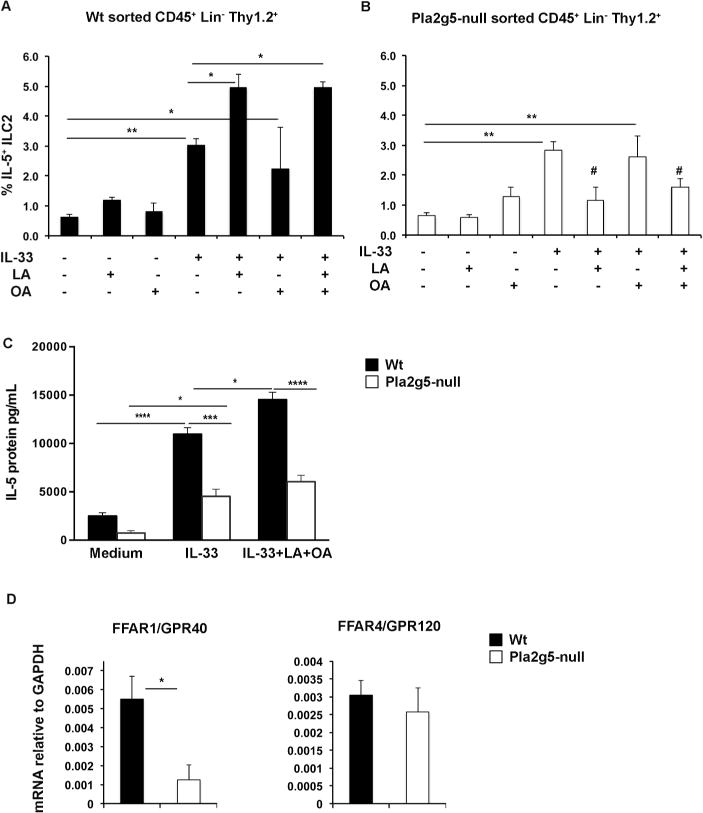
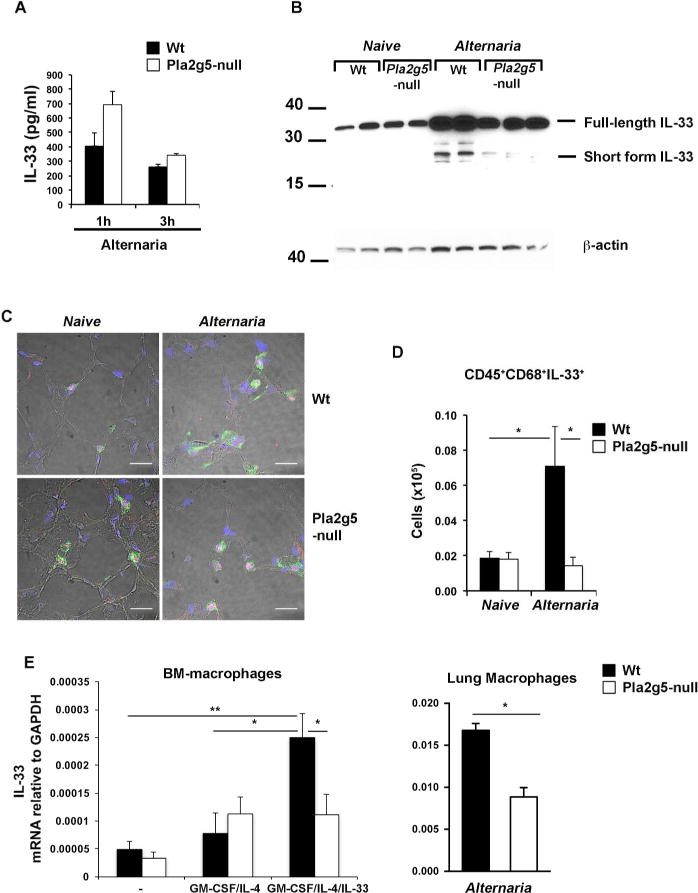
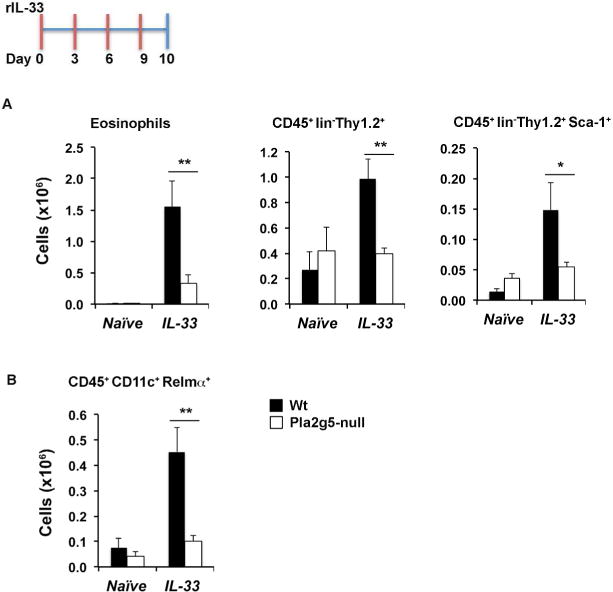
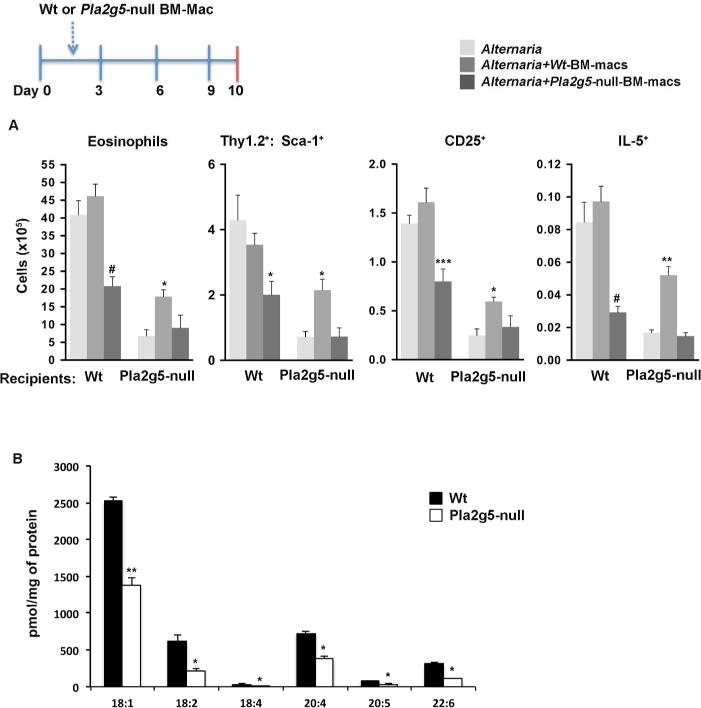
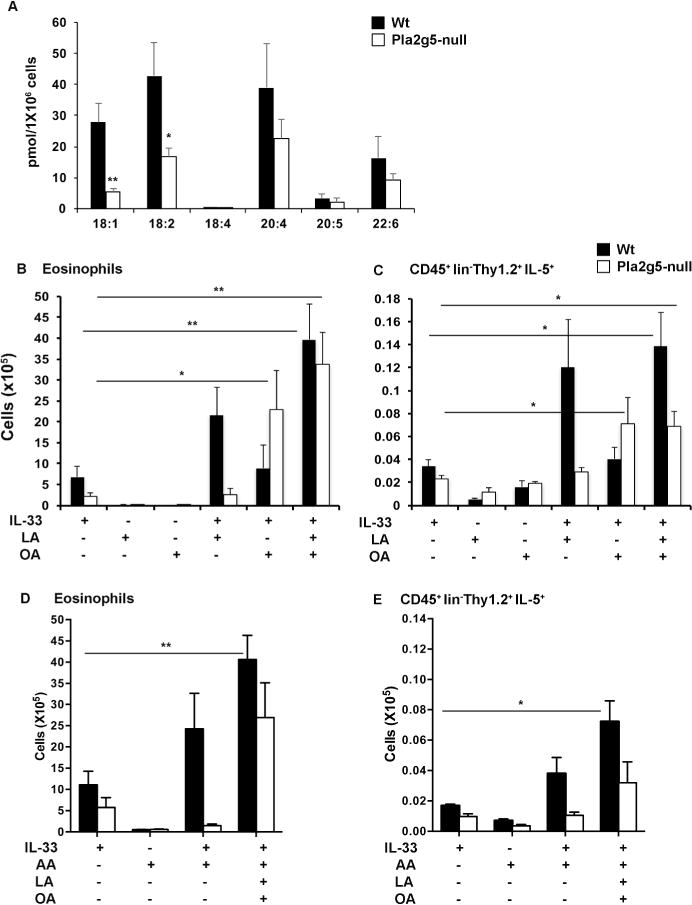
Group V phospholipase A (Pla2g5) is a lipid-generating enzyme necessary for macrophage effector functions in pulmonary inflammation. However, the lipid mediators involved and their cellular targets have not been identified. Mice lacking Pla2g5 showed markedly reduced lung ILC2 activation and eosinophilia following repetitive Alternaria Alternata inhalation. While Pla2g5-null mice had Wt levels of immediate IL-33 release after one Alternaria dose, they failed to upregulate IL-33 in macrophages following repeated Alternaria administration. Unexpectedly, while adoptive transfer of bone marrow-derived (BM)-macrophages restored ILC2 activation and eosinophilia in Alternaria-exposed Pla2g5-null mice, exogenous IL-33 did not. Conversely, transfers of Pla2g5-null BM-macrophages reduced inflammation in Alternaria-exposed Wt mice. Mass spectrometry analysis of free fatty acids (FFAs) demonstrated significantly reduced FFAs (including linoleic acid (LA) and oleic acid (OA)) in lung and BM-macrophages lacking Pla2g5. Exogenous administration of LA or LA+OA to Wt mice sharply potentiated IL-33-induced lung eosinophilia and ILC2 expansion in vitro and in vivo. In contrast, OA potentiated IL-33-induced inflammation and ILC2 expansion in Pla2g5-null mice, but LA was inactive both in vivo and in vitro. Notably, Pla2g5-null ILC2s showed significantly reduced expression of the FFA-receptor-1 compared to Wt ILC2s. Thus, macrophage-associated Pla2g5 contributes significantly to type-2 immunity through regulation of IL-33 induction and FFA-driven ILC2 activation.
组 V 磷脂酶 A(Pla2g5)是一种产生脂质的酶,对于肺部炎症中的巨噬细胞效应功能是必需的。然而,涉及的脂质介质及其细胞靶标尚未确定。缺乏 Pla2g5 的小鼠在重复吸入 Alternaria Alternata 后,肺 ILC2 的激活和嗜酸性粒细胞增多明显减少。虽然 Pla2g5 缺陷小鼠在一次 Alternaria 剂量后具有与 Wt 水平相当的即刻 IL-33 释放,但它们在重复给予 Alternaria 后未能上调巨噬细胞中的 IL-33。出乎意料的是,虽然骨髓来源(BM)-巨噬细胞的过继转移恢复了暴露于 Alternaria 的 Pla2g5 缺陷小鼠中的 ILC2 激活和嗜酸性粒细胞增多,但外源性 IL-33 没有。相反,Pla2g5 缺陷小鼠 BM 巨噬细胞的转移减少了暴露于 Alternaria 的 Wt 小鼠的炎症。游离脂肪酸(FFA)的质谱分析表明,缺乏 Pla2g5 的肺和 BM 巨噬细胞中 FFA(包括亚油酸(LA)和油酸(OA))显著减少。外源性给予 LA 或 LA+OA 可显著增强 Wt 小鼠体内和体外 IL-33 诱导的肺嗜酸性粒细胞增多和 ILC2 扩增。相比之下,OA 增强了 Pla2g5 缺陷小鼠中 IL-33 诱导的炎症和 ILC2 扩增,但 LA 在体内和体外均无活性。值得注意的是,与 Wt ILC2 相比,Pla2g5 缺陷 ILC2 表现出 FFA 受体-1 的表达显著降低。因此,与巨噬细胞相关的 Pla2g5 通过调节 IL-33 诱导和 FFA 驱动的 ILC2 激活,对 2 型免疫有重要贡献。