Institute of Innovative Research, Tokyo Institute of Technology, 4259 Nagatsuta-cho, Midori-ku Yokohama, Kanagawa 226-8503, Japan.
Phys Rev E. 2017 Dec;96(6-1):062305. doi: 10.1103/PhysRevE.96.062305. Epub 2017 Dec 5.
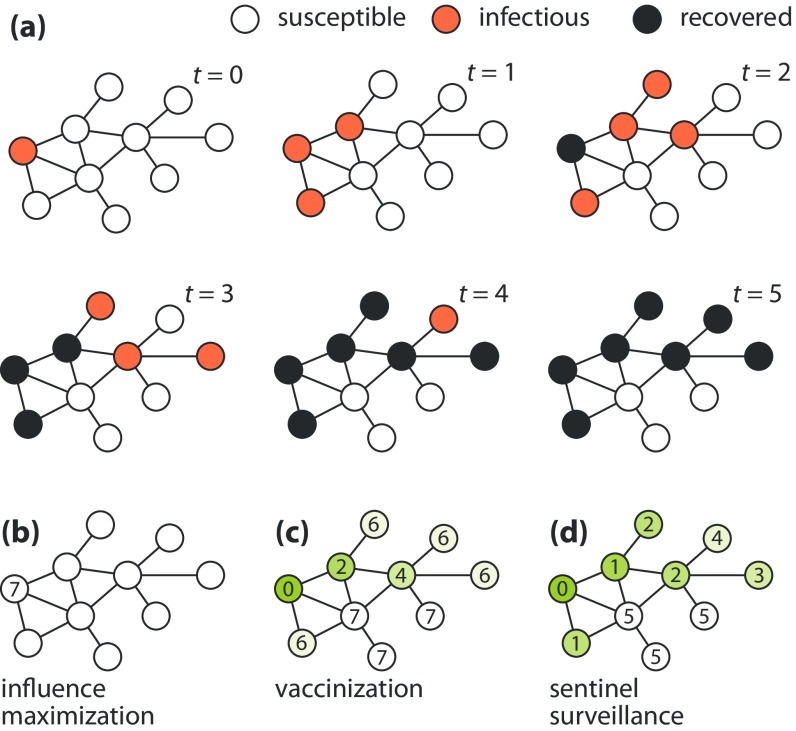
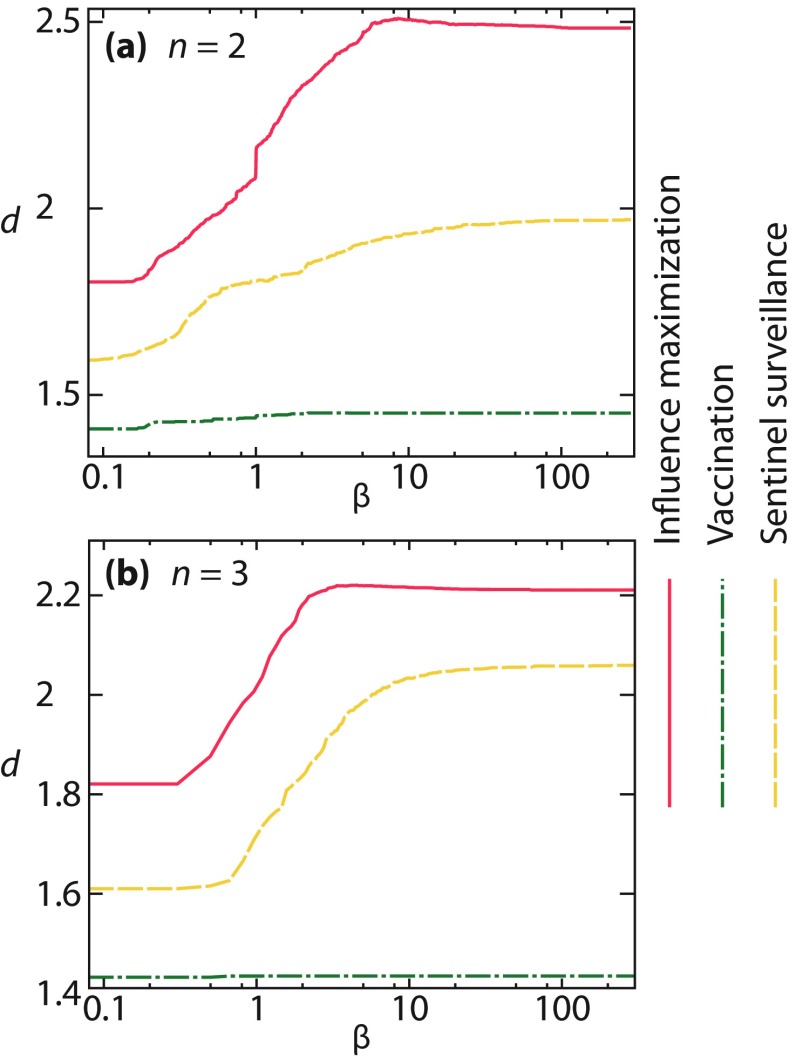
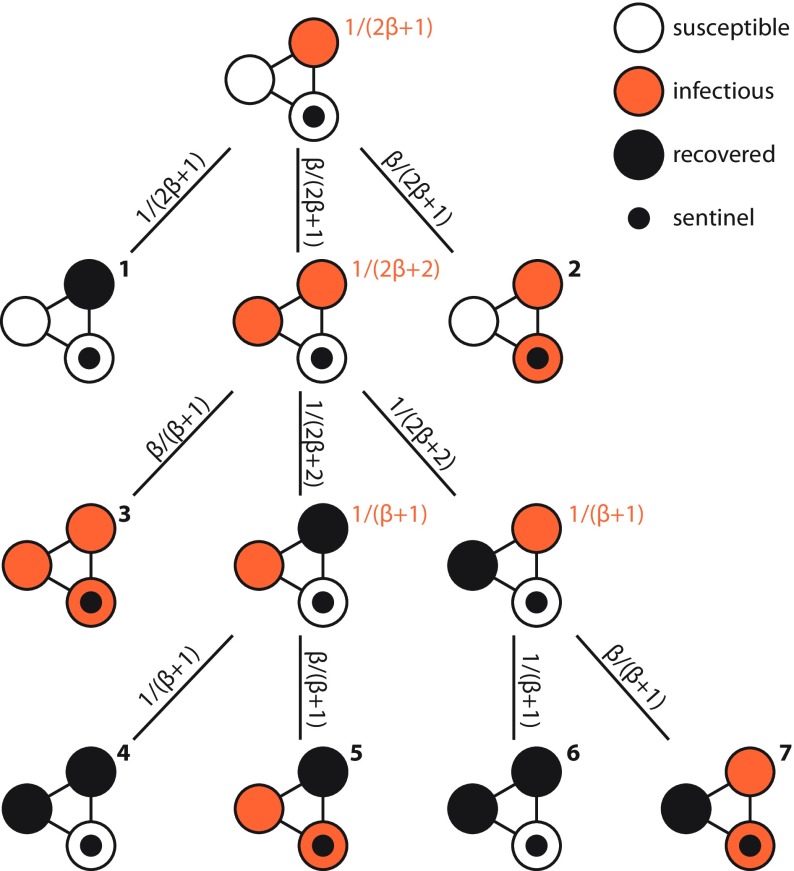
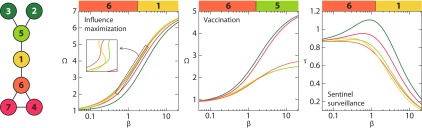
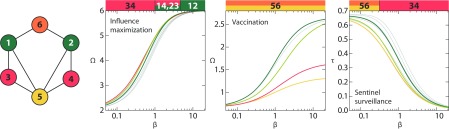
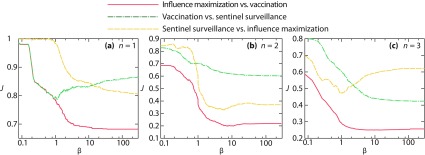
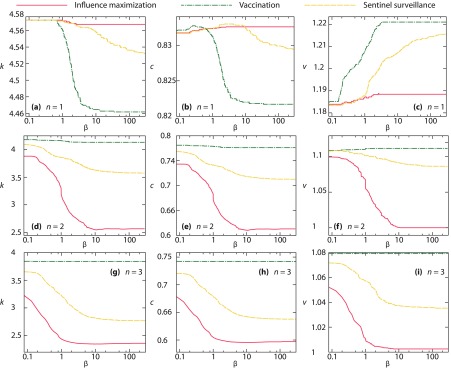
We investigate three aspects of the importance of nodes with respect to susceptible-infectious-removed (SIR) disease dynamics: influence maximization (the expected outbreak size given a set of seed nodes), the effect of vaccination (how much deleting nodes would reduce the expected outbreak size), and sentinel surveillance (how early an outbreak could be detected with sensors at a set of nodes). We calculate the exact expressions of these quantities, as functions of the SIR parameters, for all connected graphs of three to seven nodes. We obtain the smallest graphs where the optimal node sets are not overlapping. We find that (i) node separation is more important than centrality for more than one active node, (ii) vaccination and influence maximization are the most different aspects of importance, and (iii) the three aspects are more similar when the infection rate is low.
我们研究了节点在易感染-感染-移除(SIR)疾病动力学方面的三个重要性方面:影响力最大化(给定一组种子节点的预期爆发规模)、疫苗接种的效果(删除节点会减少多少预期爆发规模)以及哨兵监测(通过在一组节点上的传感器可以多早检测到爆发)。我们计算了这些数量的精确表达式,作为 SIR 参数的函数,适用于所有三个到七个节点的连通图。我们得到了最优节点集不重叠的最小图。我们发现:(i)对于多个活动节点,节点分离比中心性更重要;(ii)疫苗接种和影响力最大化是最重要的两个方面;(iii)当感染率较低时,这三个方面更为相似。