Johns Hopkins University Bloomberg School of Public Health, Baltimore, MD, USA.
Medical University of South Carolina and Ralph H. Johnson Veterans Administration Medical Center, Charleston, SC, USA.
Trials. 2018 Jan 18;19(1):46. doi: 10.1186/s13063-017-2406-5.
Alzheimer's disease (AD) is characterized not only by cognitive and functional decline, but also often by the presence of neuropsychiatric symptoms. Apathy, which can be defined as a lack of motivation, is one of the most prevalent neuropsychiatric symptoms in AD and typically leads to a worse quality of life and greater burden for caregivers. Treatment options for apathy in AD are limited, but studies have examined the use of the amphetamine, methylphenidate. The Apathy in Dementia Methylphenidate Trial (ADMET) found that treatment of apathy in AD with methylphenidate was associated with significant improvement in apathy in two of three outcome measures, some evidence of improvement in global cognition, and minimal adverse events. However, the trial only enrolled 60 participants who were followed for only 6 weeks. A larger, longer-lasting trial is required to confirm these promising findings.
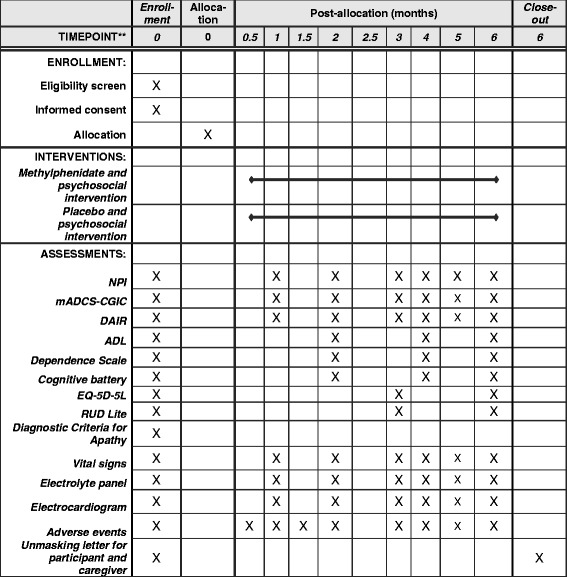
The Apathy in Dementia Methylphenidate Trial 2 (ADMET 2) is a phase III, placebo-controlled, masked, 6-month, multi-center, randomized clinical trial targeted to enroll 200 participants with AD and apathy. Participants are randomly assigned 1:1 to 20 mg methylphenidate per day prepared as four over-encapsulated tablets or to matching placebo. The primary outcomes include (1) the mean difference in the Neuropsychiatric Inventory Apathy subscale scores measured as change from baseline to 6 months, and (2) the odds of having a given rating or better on the modified AD Cooperative Study Clinical Global Impression of Change ratings at month 6 compared with the baseline rating. Other outcomes include change in cognition, safety, and cost-effectiveness measured at monthly follow-up visits up to 6 months.
Given the prevalence of apathy in AD and its impact on both patients and caregivers, an intervention to alleviate apathy would be of great benefit to society. ADMET 2 follows on the promising results from the original ADMET to evaluate the efficacy of methylphenidate as a treatment for apathy in AD. With a larger sample size and longer follow up, ADMET 2 is poised to confirm or refute the original ADMET findings.
ClinicalTrials.gov, NCT02346201 . Registered on 26 January 2015.
阿尔茨海默病(AD)的特征不仅是认知和功能下降,而且经常伴有神经精神症状。冷漠,可定义为缺乏动力,是 AD 中最常见的神经精神症状之一,通常会导致生活质量更差,照顾者的负担更大。AD 冷漠的治疗选择有限,但已有研究检查了安非他命,哌醋甲酯的使用。痴呆症哌醋甲酯治疗冷漠试验(ADMET)发现,AD 中哌醋甲酯治疗冷漠与三种结局测量中的两种冷漠的显著改善相关,认知能力的改善证据,以及最小的不良事件。然而,该试验仅招募了 60 名参与者,随访时间仅为 6 周。需要更大、更持久的试验来证实这些有希望的发现。
痴呆症哌醋甲酯治疗冷漠试验 2(ADMET 2)是一项 III 期、安慰剂对照、盲法、6 个月、多中心、随机临床试验,目标是招募 200 名患有 AD 和冷漠的参与者。参与者以 1:1 的比例随机分配,每天服用 20 毫克哌醋甲酯,制备为四个过包衣片剂,或服用匹配的安慰剂。主要结局包括(1)从基线到 6 个月时神经精神疾病问卷冷漠子量表评分的平均差异,以及(2)与基线评分相比,在 6 个月时,在改良 AD 合作研究临床变化总体印象评分中获得特定评分或更高评分的可能性。其他结局包括认知、安全性和成本效益的变化,每月随访,最长可达 6 个月。
鉴于 AD 中冷漠的普遍性及其对患者和照顾者的影响,减轻冷漠的干预措施将对社会大有裨益。ADMET 2 是在原始 ADMET 的有希望的结果基础上进行的,以评估哌醋甲酯作为 AD 冷漠治疗的疗效。通过更大的样本量和更长的随访时间,ADMET 2 有望证实或反驳原始 ADMET 的发现。
ClinicalTrials.gov,NCT02346201。于 2015 年 1 月 26 日注册。