Department of Pediatrics, University of Minnesota, Minneapolis, MN.
Department of Pediatrics and Immunology, Indiana University School of Medicine, Indianapolis, IN.
Blood. 2018 Apr 12;131(15):1743-1754. doi: 10.1182/blood-2017-08-800623. Epub 2018 Jan 18.
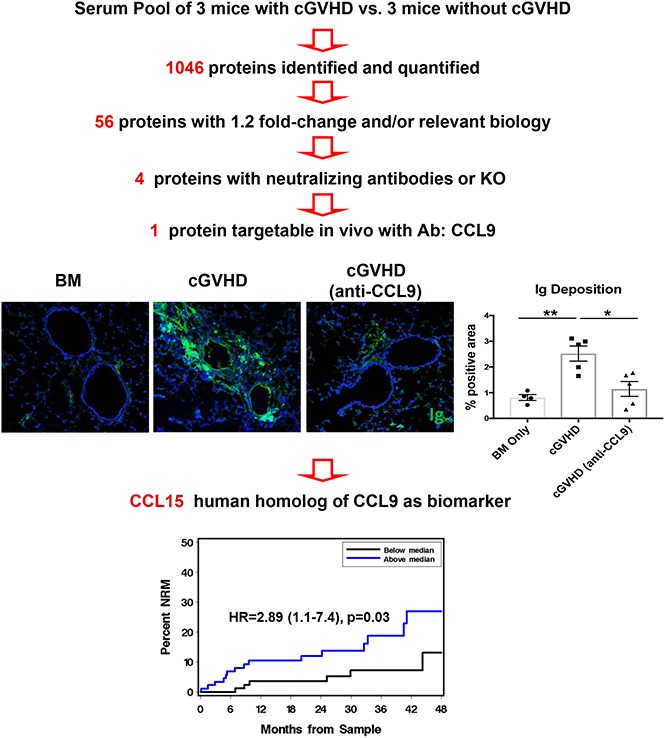
Improved diagnostic and treatment methods are needed for chronic graft-versus-host disease (cGVHD), the leading cause of late nonrelapse mortality (NRM) in long-term survivors of allogenic hematopoietic cell transplantation. Validated biomarkers that facilitate disease diagnosis and classification generally are lacking in cGVHD. Here, we conducted whole serum proteomics analysis of a well-established murine multiorgan system cGVHD model. We discovered 4 upregulated proteins during cGVHD that are targetable by genetic ablation or blocking antibodies, including the RAS and JUN kinase activator, CRKL, and CXCL7, CCL8, and CCL9 chemokines. Donor T cells lacking CRK/CRKL prevented the generation of cGVHD, germinal center reactions, and macrophage infiltration seen with wild-type T cells. Whereas antibody blockade of CCL8 or CXCL7 was ineffective in treating cGVHD, CCL9 blockade reversed cGVHD clinical manifestations, histopathological changes, and immunopathological hallmarks. Mechanistically, elevated CCL9 expression was present predominantly in vascular smooth muscle cells and uniquely seen in cGVHD mice. Plasma concentrations of CCL15, the human homolog of mouse CCL9, were elevated in a previously published cohort of 211 cGVHD patients compared with controls and associated with NRM. In a cohort of 792 patients, CCL15 measured at day +100 could not predict cGVHD occurring within the next 3 months with clinically relevant sensitivity/specificity. Our findings demonstrate for the first time the utility of preclinical proteomics screening to identify potential new targets for cGVHD and specifically CCL15 as a diagnosis marker for cGVHD. These data warrant prospective biomarker validation studies.
需要改进慢性移植物抗宿主病(cGVHD)的诊断和治疗方法,这是异体造血细胞移植后长期幸存者晚期非复发相关死亡率(NRM)的主要原因。cGVHD 缺乏有助于疾病诊断和分类的经过验证的生物标志物。在这里,我们对一个成熟的多器官系统 cGVHD 小鼠模型进行了全血清蛋白质组学分析。我们发现 cGVHD 期间有 4 种上调蛋白可通过基因敲除或阻断抗体靶向,包括 RAS 和 JUN 激酶激活物 CRKL,以及趋化因子 CXCL7、CCL8 和 CCL9。缺乏 CRK/CRKL 的供体 T 细胞可防止与野生型 T 细胞相关的 cGVHD、生发中心反应和巨噬细胞浸润的发生。虽然阻断 CCL8 或 CXCL7 的抗体在治疗 cGVHD 方面无效,但 CCL9 阻断可逆转 cGVHD 的临床表现、组织病理学变化和免疫病理学特征。从机制上讲,升高的 CCL9 表达主要存在于血管平滑肌细胞中,并且仅在 cGVHD 小鼠中可见。与对照相比,在之前发表的 211 例 cGVHD 患者队列中,血浆 CCL15 浓度(CCL9 的人同源物)升高,并与 NRM 相关。在 792 例患者队列中,在第+100 天测量的 CCL15 不能以具有临床相关敏感性/特异性的方式预测接下来 3 个月内发生的 cGVHD。我们的研究结果首次证明了临床前蛋白质组学筛选在识别 cGVHD 的潜在新靶标中的效用,特别是 CCL15 作为 cGVHD 的诊断标志物。这些数据需要前瞻性的生物标志物验证研究。