Gibcus Johan H, Samejima Kumiko, Goloborodko Anton, Samejima Itaru, Naumova Natalia, Nuebler Johannes, Kanemaki Masato T, Xie Linfeng, Paulson James R, Earnshaw William C, Mirny Leonid A, Dekker Job
Program in Systems Biology, Department of Biochemistry and Molecular Pharmacology, University of Massachusetts Medical School, 368 Plantation Street, Worcester, MA 01605, USA.
Wellcome Centre for Cell Biology, University of Edinburgh, King's Buildings, Max Born Crescent, Edinburgh EH9 3BF, Scotland, UK.
Science. 2018 Feb 9;359(6376). doi: 10.1126/science.aao6135. Epub 2018 Jan 18.
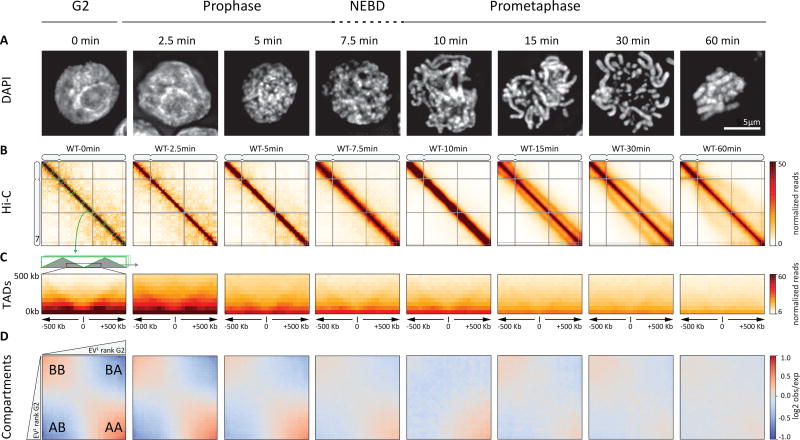
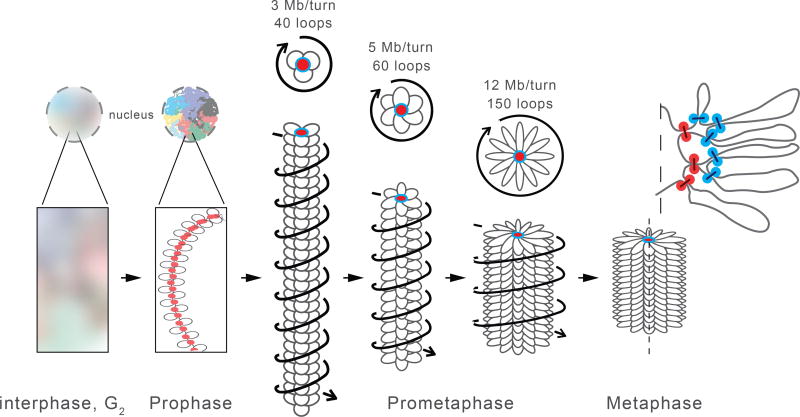
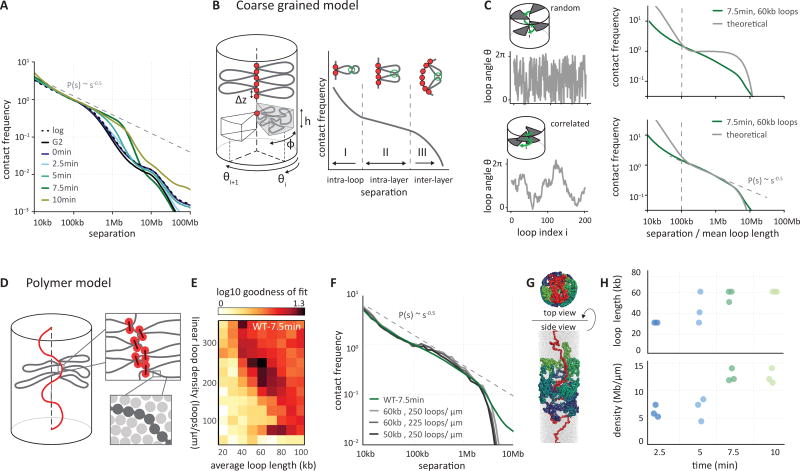
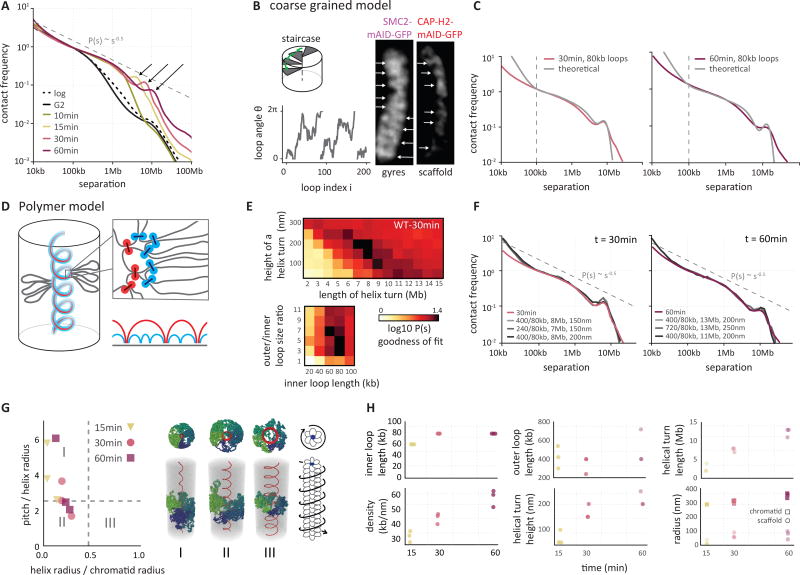
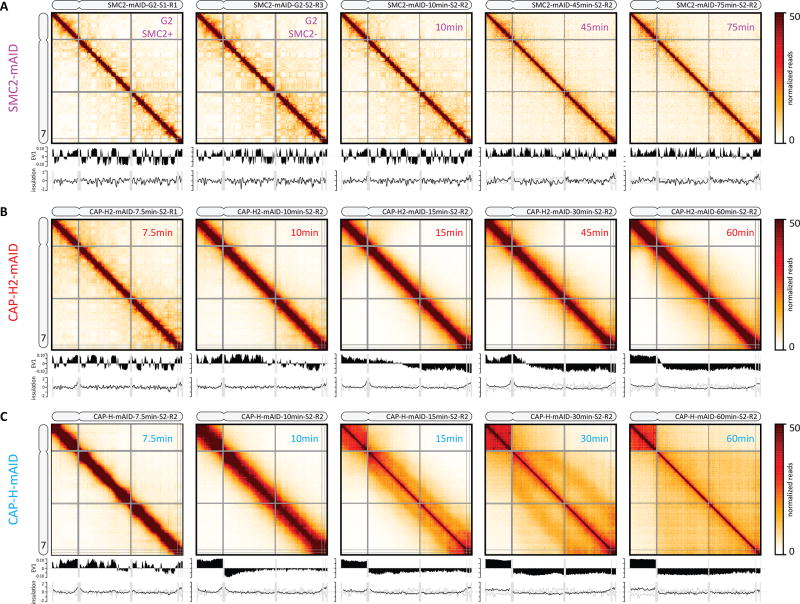
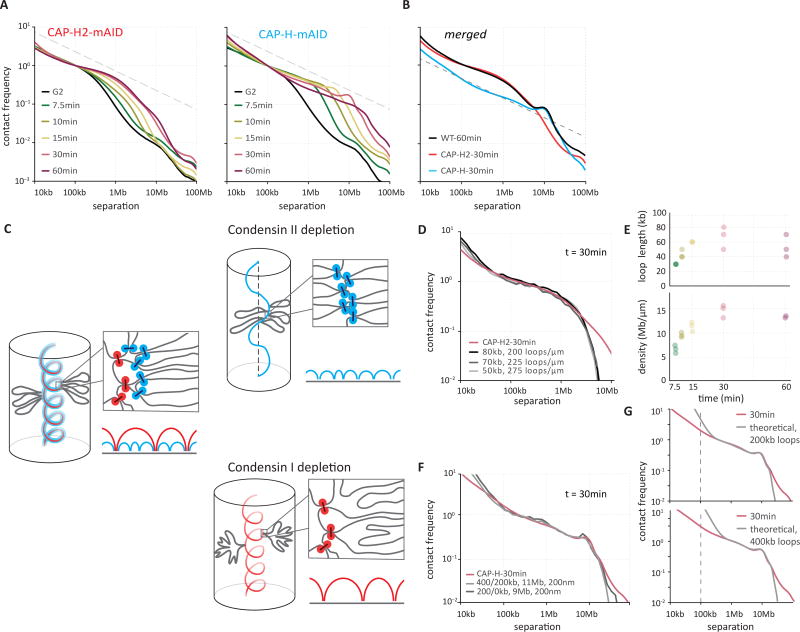
Mitotic chromosomes fold as compact arrays of chromatin loops. To identify the pathway of mitotic chromosome formation, we combined imaging and Hi-C analysis of synchronous DT40 cell cultures with polymer simulations. Here we show that in prophase, the interphase organization is rapidly lost in a condensin-dependent manner, and arrays of consecutive 60-kilobase (kb) loops are formed. During prometaphase, ~80-kb inner loops are nested within ~400-kb outer loops. The loop array acquires a helical arrangement with consecutive loops emanating from a central "spiral staircase" condensin scaffold. The size of helical turns progressively increases to ~12 megabases during prometaphase. Acute depletion of condensin I or II shows that nested loops form by differential action of the two condensins, whereas condensin II is required for helical winding.
有丝分裂染色体折叠成紧密的染色质环阵列。为了确定有丝分裂染色体形成的途径,我们将同步化的DT40细胞培养物的成像和Hi-C分析与聚合物模拟相结合。我们在此表明,在前期,间期组织以凝聚素依赖的方式迅速丧失,并形成连续60千碱基(kb)环的阵列。在前中期,约80 kb的内环嵌套在约400 kb的外环内。环阵列获得一种螺旋排列,连续的环从中央“螺旋楼梯”凝聚素支架发出。在前中期,螺旋圈的大小逐渐增加到约12兆碱基。凝聚素I或II的急性缺失表明,嵌套环是由两种凝聚素的差异作用形成的,而凝聚素II是螺旋缠绕所必需的。