Bin Huraib Ghaleb, Al Harthi Fahad, Arfin Misbahul, Rizvi Sadaf, Al-Asmari Abdulrahaman
Department of Dermatology, Prince Sultan Military Medical City, Riyadh, Saudi Arabia.
Scientific Research Center, Medical Services Department for Armed Forces, Riyadh, Saudi Arabia.
Clin Med Insights Arthritis Musculoskelet Disord. 2018 Jan 11;11:1179544117751434. doi: 10.1177/1179544117751434. eCollection 2018.
Psoriasis is a complex autoimmune disease caused by the interaction of genetic and environmental factors. gene polymorphism has been reported to affect psoriasis susceptibility; however, no data are available for Middle Eastern populations.
The aim of this study was to investigate the association of PTPN22 (1858C/T) R620W polymorphism with psoriasis in a Saudi cohort.
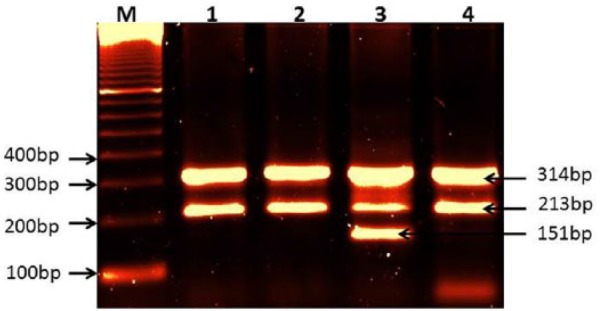
Saudi subjects (n = 306) including patients with psoriasis (n = 106) and matched controls (n = 200) were studied for variants using tetra-primer amplification refractory mutation system-polymerase chain reaction method. The frequencies of alleles and genotypes of PTPN22 (1858C/T) polymorphism were compared between patients and controls.
The frequency of CT genotype of PTPN22 (1858C/T) polymorphism was significantly higher, whereas that of CC genotype was lower in patients with psoriasis than in controls (< .001, relative risk [RR] = 7.151). The homozygous genotype TT was absent in both the patients and healthy controls. The frequency of allele T encoding tryptophan (W) was significantly increased (< .001, RR = 5.76), whereas that of allele C encoding arginine (R) decreased in psoriasis cases as compared with controls (< .001, RR = 0.173) indicating that individuals carrying allele T are more susceptible to psoriasis than noncarriers.
PTPN22 (1858C/T) polymorphism is positively associated with susceptibility of psoriasis in Saudis and can be developed as biomarker for evaluating psoriasis risk. However, further studies on PTPN22 polymorphism in larger samples from different geographical areas and ethnicity are warranted.
银屑病是一种由遗传和环境因素相互作用引起的复杂自身免疫性疾病。据报道,基因多态性会影响银屑病易感性;然而,中东人群尚无相关数据。
本研究旨在调查沙特人群中蛋白酪氨酸磷酸酶非受体型22(PTPN22)基因(1858C/T)R620W多态性与银屑病的相关性。
采用四引物扩增阻滞突变系统-聚合酶链反应方法,对包括银屑病患者(n = 106)和匹配对照(n = 200)在内的306名沙特受试者进行变异研究。比较患者和对照中PTPN22基因(1858C/T)多态性的等位基因和基因型频率。
银屑病患者中PTPN22基因(1858C/T)多态性的CT基因型频率显著更高,而CC基因型频率低于对照(<0.001,相对危险度[RR]=7.151)。患者和健康对照中均未出现纯合基因型TT。与对照相比,银屑病患者中编码色氨酸(W)的等位基因T频率显著增加(<0.001,RR = 5.76),而编码精氨酸(R)的等位基因C频率降低(<0.001,RR = 0.173),表明携带等位基因T的个体比非携带者更易患银屑病。
PTPN22基因(1858C/T)多态性与沙特人银屑病易感性呈正相关,可作为评估银屑病风险的生物标志物。然而,有必要对来自不同地理区域和种族的更大样本进行PTPN22基因多态性的进一步研究。