Farmer Julie, McLeod Logan, Siddiqi Arjumand, Ravaghi Vahid, Quiñonez Carlos
Discipline of Dental Public Health, Faculty of Dentistry, University of Toronto, Ontario, Canada.
Department of Economics, Lazaridis School of Business & Economics, Wilfrid Laurier University, Waterloo, Ontario, Canada.
SSM Popul Health. 2016 Apr 16;2:226-236. doi: 10.1016/j.ssmph.2016.03.009. eCollection 2016 Dec.
To compare the magnitude of, and contributors to, income-related inequalities in oral health outcomes within and between Canada and the United States over time.
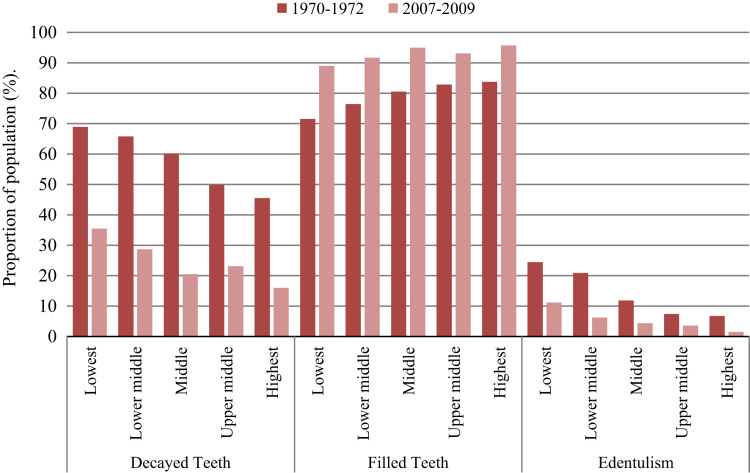
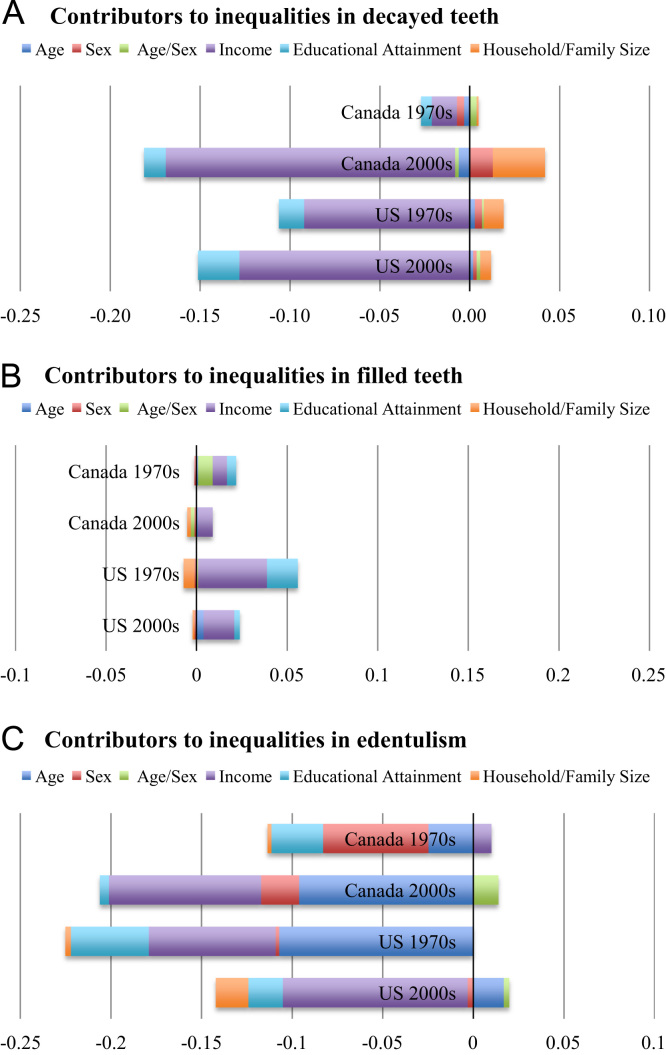
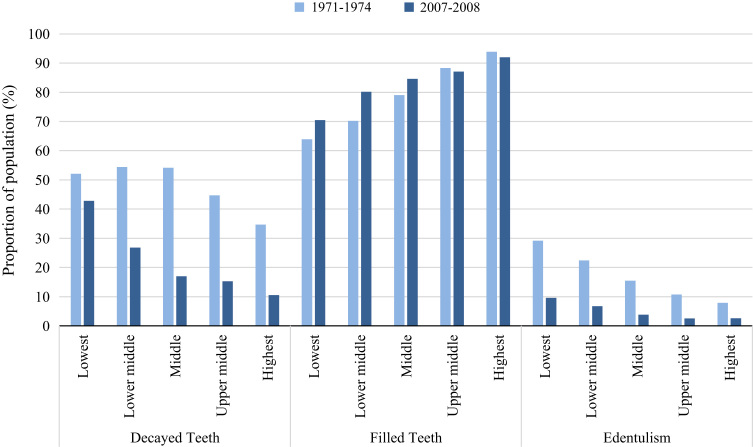
The concentration index was used to estimate income-related inequalities in three oral health outcomes from the Nutrition Canada National Survey 1970-1972, Canadian Health Measures Survey 2007-2009, Health and Nutrition Examination Survey I 1971-1974, and National Health and Nutrition Examination Survey 2007-2008. Concentration indices were decomposed to determine the contribution of demographic and socioeconomic factors to oral health inequalities.
Our estimates show that over time in both countries, inequalities in decayed teeth and edentulism were concentrated among the poor and inequalities in filled teeth were concentrated among the rich. Over time, inequalities in decayed teeth increased and decreased for measures of filled teeth and edentulism in both countries. Inequalities were higher in the United States compared to Canada for filled and decayed teeth outcomes. Socioeconomic characteristics (education, income) contributed greater to inequalities than demographic characteristics (age, sex). As well, income contributed more to inequalities in recent surveys in both Canada and the United States.
Inequalities in oral health have persisted over the past 35 years in Canada and the United States, and are associated with age, sex, education, and income and have varied over time.
比较加拿大和美国随时间推移口腔健康结果中与收入相关的不平等程度及其影响因素。
采用集中指数来估计1970 - 1972年加拿大国家营养调查、2007 - 2009年加拿大健康措施调查、1971 - 1974年美国第一次健康与营养检查调查以及2007 - 2008年美国国家健康与营养检查调查中三项口腔健康结果与收入相关的不平等情况。对集中指数进行分解,以确定人口统计学和社会经济因素对口腔健康不平等的贡献。
我们的估计表明,随着时间推移,在这两个国家中,龋齿和无牙情况的不平等集中在贫困人口中,而补牙情况的不平等集中在富裕人口中。随着时间推移,两国中龋齿不平等情况有所增加,补牙和无牙情况的不平等有所减少。在美国,补牙和龋齿结果的不平等程度高于加拿大。社会经济特征(教育程度、收入)对不平等的贡献大于人口统计学特征(年龄、性别)。此外,在加拿大和美国最近的调查中,收入对不平等的贡献更大。
在过去35年中,加拿大和美国口腔健康方面的不平等一直存在,且与年龄、性别、教育程度和收入相关,并随时间而变化。