Bay Annika, Sandberg Camilla, Thilén Ulf, Wadell Karin, Johansson Bengt
Department of Public Health and Clinical Medicine, Umeå University, Sweden.
Department of Nursing, Umeå University, Sweden.
Int J Cardiol Heart Vasc. 2018 Jan 12;18:7-11. doi: 10.1016/j.ijcha.2017.12.002. eCollection 2018 Mar.
Physical activity improves health, exercise tolerance and quality of life in adults with congenital heart disease (CHD), and exercise training is in most patients a high-benefit low risk intervention. However, factors that influence the confidence to perform exercise training, exercise self-efficacy (ESE), in CHD patients are virtually unknown. We aimed to identify factors related to low ESE in adults with CHD, and potential strategies for being physically active.
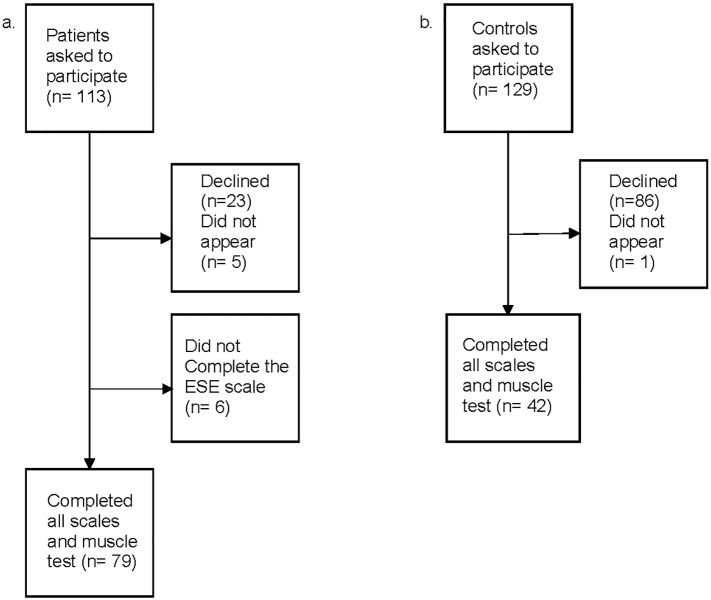
Seventy-nine adults with CHD; 38 with simple lesions (16 women) and 41 with complex lesions (17 women) with mean age 36.7 ± 14.6 years and 42 matched controls were recruited. All participants completed questionnaires on ESE and quality of life, carried an activity monitor (Actiheart) during four consecutive days and performed muscle endurance tests.
ESE in patients was categorised into low, based on the lowest quartile within controls, (≤ 29 points, n = 34) and high (> 29 points, n = 45). Patients with low ESE were older (42.9 ± 15.1 32.0 ± 12.4 years, = 0.001), had more complex lesions (65% 42%, = 0.05) more often had New York Heart Association functional class III (24% vs. 4%, p = 0.01) and performed fewer shoulder flexions (32.5 ± 15.5 47.7 ± 25.0, = 0.001) compared with those with high ESE. In a logistic multivariate model age (OR; 1.06, 95% CI 1.02-1.10), and number of shoulder flexions (OR; 0.96, 95% CI 0.93-0.99) were associated with ESE.
In this study we show that many adults with CHD have low ESE. Age is an important predictor of low ESE and should, therefore, be considered in counselling patients with CHD. In addition, muscle endurance training may improve ESE, and thus enhance the potential for being physically active in this population.
体育活动可改善先天性心脏病(CHD)成人患者的健康状况、运动耐力和生活质量,并且运动训练对大多数患者而言是一种高收益低风险的干预措施。然而,影响CHD患者进行运动训练信心即运动自我效能(ESE)的因素几乎尚不明确。我们旨在确定与CHD成人患者低ESE相关的因素以及保持身体活跃的潜在策略。
招募了79例CHD成人患者;其中38例为简单病变患者(16例女性),41例为复杂病变患者(17例女性),平均年龄36.7±14.6岁,以及42例匹配的对照者。所有参与者均完成了关于ESE和生活质量的问卷调查,连续四天佩戴活动监测仪(Actiheart)并进行肌肉耐力测试。
根据对照者中最低四分位数(≤29分,n = 34)将患者的ESE分为低水平和高水平(>29分,n = 45)。与高ESE患者相比,低ESE患者年龄更大(42.9±15.1对32.0±12.4岁,P = 0.001),病变更复杂(65%对42%,P = 0.05),纽约心脏协会心功能分级III级的情况更常见(24%对4%,P = 0.01),并且肩部屈曲次数更少(32.5±15.5对47.7±25.0,P = 0.001)。在逻辑多变量模型中,年龄(比值比[OR]:1.06,95%置信区间[CI] 1.02 - 1.10)和肩部屈曲次数(OR:0.96,95% CI 0.93 - 0.99)与ESE相关。
在本研究中,我们表明许多CHD成人患者的ESE较低。年龄是低ESE的重要预测因素,因此在为CHD患者提供咨询时应予以考虑。此外,肌肉耐力训练可能会改善ESE,从而增强该人群进行身体活动的潜力。