
线粒体解偶联蛋白:细胞氧化还原信号的微妙调节剂。
Mitochondrial Uncoupling Proteins: Subtle Regulators of Cellular Redox Signaling.
机构信息
1 Department of Mitochondrial Physiology, Institute of Physiology of the Czech Academy of Sciences , Prague, Czech Republic .
2 UCLA Cardiovascular Research Laboratory, David Geffen School of Medicine at UCLA , Los Angeles, California.
出版信息
Antioxid Redox Signal. 2018 Sep 1;29(7):667-714. doi: 10.1089/ars.2017.7225. Epub 2018 Mar 14.
SIGNIFICANCE
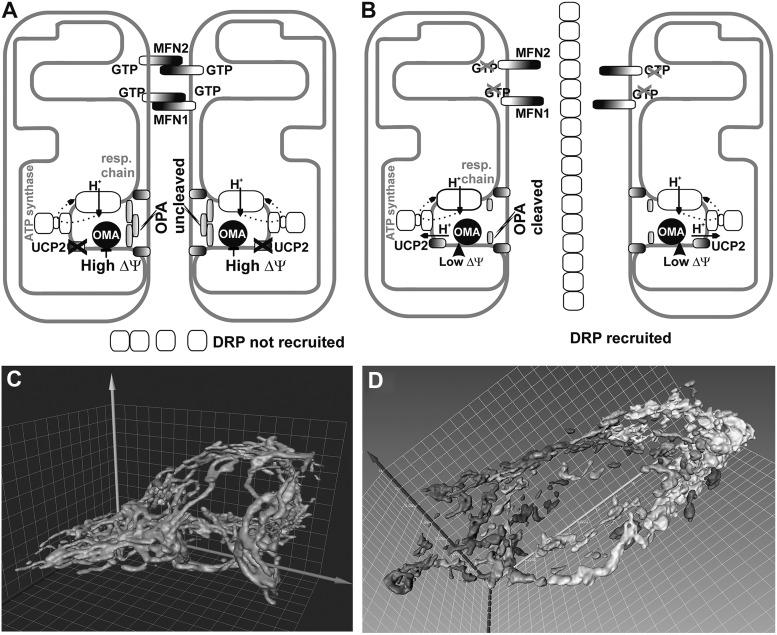
Mitochondria are the energetic, metabolic, redox, and information signaling centers of the cell. Substrate pressure, mitochondrial network dynamics, and cristae morphology state are integrated by the protonmotive force Δp or its potential component, ΔΨ, which are attenuated by proton backflux into the matrix, termed uncoupling. The mitochondrial uncoupling proteins (UCP1-5) play an eminent role in the regulation of each of the mentioned aspects, being involved in numerous physiological events including redox signaling. Recent Advances: UCP2 structure, including purine nucleotide and fatty acid (FA) binding sites, strongly support the FA cycling mechanism: UCP2 expels FA anions, whereas uncoupling is achieved by the membrane backflux of protonated FA. Nascent FAs, cleaved by phospholipases, are preferential. The resulting Δp dissipation decreases superoxide formation dependent on Δp. UCP-mediated antioxidant protection and its impairment are expected to play a major role in cell physiology and pathology. Moreover, UCP2-mediated aspartate, oxaloacetate, and malate antiport with phosphate is expected to alter metabolism of cancer cells.
CRITICAL ISSUES
A wide range of UCP antioxidant effects and participations in redox signaling have been reported; however, mechanisms of UCP activation are still debated. Switching off/on the UCP2 protonophoretic function might serve as redox signaling either by employing/releasing the extra capacity of cell antioxidant systems or by directly increasing/decreasing mitochondrial superoxide sources. Rapid UCP2 degradation, FA levels, elevation of purine nucleotides, decreased Mg, or increased pyruvate accumulation may initiate UCP-mediated redox signaling.
FUTURE DIRECTIONS
Issues such as UCP2 participation in glucose sensing, neuronal (synaptic) function, and immune cell activation should be elucidated. Antioxid. Redox Signal. 29, 667-714.
意义
线粒体是细胞的能量、代谢、氧化还原和信息信号中心。质子动力势 Δp 或其势能成分 ΔΨ 通过基质中质子回流(称为解偶联)将底物压力、线粒体网络动力学和嵴形态状态整合在一起。线粒体解偶联蛋白 (UCP1-5) 在调节上述每个方面中起着重要作用,参与包括氧化还原信号在内的许多生理事件。最新进展:UCP2 的结构,包括嘌呤核苷酸和脂肪酸 (FA) 结合位点,强烈支持 FA 循环机制:UCP2 排出 FA 阴离子,而解偶联是通过质子化 FA 的膜回流实现的。由磷脂酶切割的新生 FA 是首选。由此产生的 Δp 耗散降低了依赖于 Δp 的超氧化物形成。预计 UCP 介导电抗氧化保护及其损伤将在细胞生理学和病理学中发挥主要作用。此外,预计 UCP2 介导的天冬氨酸、草酰乙酸和苹果酸与磷酸盐的反向转运将改变癌细胞的代谢。
关键问题
已经报道了广泛的 UCP 抗氧化作用和参与氧化还原信号;然而,UCP 激活的机制仍存在争议。关闭/打开 UCP2 的质子传递功能可能通过利用/释放细胞抗氧化系统的额外容量或通过直接增加/减少线粒体超氧化物源来作为氧化还原信号。UCP2 快速降解、FA 水平升高、嘌呤核苷酸降低、Mg 减少或丙酮酸积累增加可能引发 UCP 介导的氧化还原信号。
未来方向
应阐明 UCP2 参与葡萄糖感应、神经元(突触)功能和免疫细胞激活等问题。抗氧化。氧化还原信号。29, 667-714。






 Zotero 插件