Université Côte d'Azur, INSERM, CNRS, IPMC, team labeled "Laboratory of Excellence (LABEX) Distalz", 660 route des Lucioles, 06560, Sophia-Antipolis, Valbonne, France.
State Key Laboratory of Cellular Stress Biology, Innovation Center for Cell Signaling network, School of Life Sciences, Xiamen University, Xiamen, Fujian, 361102, China.
Cell Death Differ. 2018 May;25(5):873-884. doi: 10.1038/s41418-017-0016-0. Epub 2018 Jan 19.
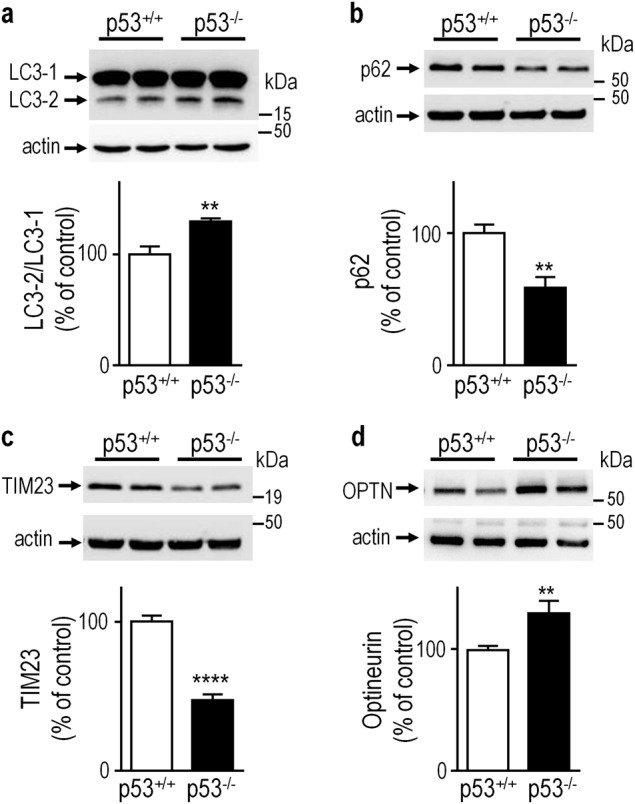
p53 is a transcription factor that is implicated in the control of both apoptotic and autophagic cell death. This tumor suppressor elicits both pro-autophagic and anti-autophagic phenotypes depending of its intracellular localization. The ability of p53 to repress autophagy has been exclusively associated to its cytoplasmic localization. Here, we show that transcriptional activity of p53 also contributes to autophagy down-regulation. Thus, nuclear p53 controls PINK1, a key protein involved in the control of mitophagy, by repressing its promoter activity, protein and mRNA levels, ex-vivo and in vivo. We establish that deletion of an identified p53 responsive element on PINK1 promoter impacts p53-mediated PINK1 transcriptional repression and we demonstrate a p53-PINK1 physical interaction by chromatin immunoprecipitation. Accordingly, we show that only nuclear p53 accounts for its ability to repress PINK1 gene transcription. Further, we demonstrate ex-vivo and in vivo that p53 invalidation in human cells increases LC3 maturation as well as optineurin and NDP52 autophagy receptors expression and down-regulates TIM23, TOM20 and HSP60 mitophagy markers. Importantly, this phenotype is mimicked by TP53 invalidation in mice brain. Finally, by combining pharmacological and genetic approaches, we show that the p53-mediated negative regulation of autophagy is PINK1-dependent. Thus pifithrin-α-mediated blockade of p53 transcriptional activity enhances LC3 maturation and reduces p62, TIM23, TOM20 and HSP60 protein levels. This pifithrin-α-associated pro-mitophagy phenotype is fully abolished by PINK1 depletion. This data unravels a novel pathway by which nuclear p53 can repress autophagy/mitophagy that could underlie important dysfunctions in both neurodegenerative and cancer diseases.
p53 是一种转录因子,参与凋亡和自噬细胞死亡的控制。这种肿瘤抑制因子根据其细胞内定位表现出促进自噬和抗自噬表型。p53 抑制自噬的能力仅与其细胞质定位有关。在这里,我们表明 p53 的转录活性也有助于自噬下调。因此,核 p53 通过抑制其启动子活性、蛋白和 mRNA 水平,在体外和体内控制参与线粒体自噬控制的关键蛋白 PINK1。我们确定 PINK1 启动子上鉴定的 p53 反应元件的缺失会影响 p53 介导的 PINK1 转录抑制,并通过染色质免疫沉淀证明了 p53-PINK1 物理相互作用。因此,我们表明只有核 p53 才能解释其抑制 PINK1 基因转录的能力。此外,我们证明体外和体内 p53 在人细胞中的失活会增加 LC3 成熟以及 optineurin 和 NDP52 自噬受体的表达,并下调 TIM23、TOM20 和 HSP60 线粒体自噬标志物。重要的是,这种表型在小鼠大脑中 TP53 失活时被模拟。最后,通过结合药理学和遗传学方法,我们表明 p53 介导的自噬负调控依赖于 PINK1。因此,pifithrin-α 介导的 p53 转录活性阻断增强了 LC3 成熟并降低了 p62、TIM23、TOM20 和 HSP60 蛋白水平。这种 pifithrin-α 相关的促线粒体自噬表型完全被 PINK1 耗尽所消除。这些数据揭示了核 p53 可以抑制自噬/线粒体自噬的新途径,这可能是神经退行性疾病和癌症疾病中重要功能障碍的基础。