Department of Chemistry, Life Science and Environmental Sustainability, University of Parma, Parma, Italy.
Molecular Neuropsychiatry Research Branch, NIDA Intramural Research Program, Baltimore, MD, USA.
Transl Psychiatry. 2018 Jan 22;8(1):23. doi: 10.1038/s41398-017-0087-1.
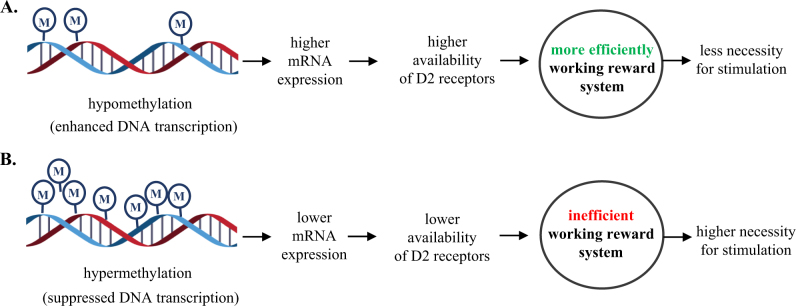
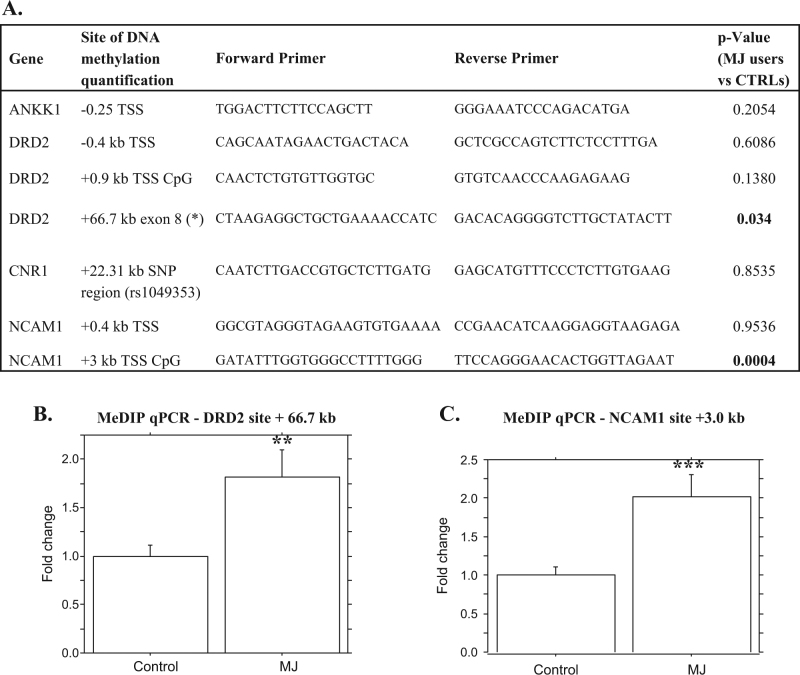
Genetic and sociodemographic risk factors potentially associated with cannabis use (CU) were investigated in 40 cannabis users and 96 control subjects. DNA methylation analyses were also performed to explore the possibility of epigenetic changes related to CU. We conducted a candidate gene association study that included variants involved in the dopaminergic (ANKK1, NCAM1 genes) and endocannabinoid (CNR1, CNR2 gene) pathways. Sociodemographic data included gender, marital status, level of education, and body mass index. We used MeDIP-qPCR to test whether variations in DNA methylation might be associated with CU. We found a significant association between SNP rs1049353 of CNR1 gene (p = 0.01) and CU. Differences were also observed related to rs2501431 of CNR2 gene (p = 0.058). A higher education level appears to decrease the risk of CU. Interestingly, females were less likely to use cannabis than males. There was a significantly higher level of DNA methylation in cannabis users compared to controls in two of the genes tested: hypermethylation at exon 8 of DRD2 gene (p = 0.034) and at the CpG-rich region in the NCAM1 gene (p = 0.0004). Both genetic variants and educational attainment were also related to CU. The higher rate of DNA methylation, evidenced among cannabis users, may be either a marker of CU or a consequence of long-term exposure to cannabis. The identified genetic variants and the differentially methylated regions may represent biomarkers and/or potential targets for designs of pharmacological therapeutic agents. Our observations also suggest that educational programs may be useful strategies for CU prevention.
我们调查了 40 名大麻使用者和 96 名对照者,以确定与大麻使用(CU)相关的遗传和社会人口学风险因素。我们还进行了 DNA 甲基化分析,以探索与 CU 相关的表观遗传变化的可能性。我们进行了候选基因关联研究,包括涉及多巴胺能(ANKK1、NCAM1 基因)和内源性大麻素(CNR1、CNR2 基因)途径的变体。社会人口学数据包括性别、婚姻状况、教育程度和体重指数。我们使用 MeDIP-qPCR 来测试 DNA 甲基化的变化是否与 CU 相关。我们发现 CNR1 基因的 SNP rs1049353 与 CU 显著相关(p=0.01)。还观察到与 CNR2 基因的 rs2501431 相关(p=0.058)。较高的教育程度似乎降低了 CU 的风险。有趣的是,女性使用大麻的可能性低于男性。与对照组相比,在两个测试的基因中,大麻使用者的 DNA 甲基化水平显著升高:DRD2 基因外显子 8 的高甲基化(p=0.034)和 NCAM1 基因中富含 CpG 的区域(p=0.0004)。遗传变异和教育程度也与 CU 相关。在大麻使用者中,证据表明 DNA 甲基化水平较高,可能是 CU 的标志物,也可能是长期接触大麻的结果。鉴定的遗传变异和差异甲基化区域可能代表生物标志物和/或潜在的药物治疗剂设计靶点。我们的观察结果还表明,教育计划可能是预防 CU 的有用策略。