Carlisi Daniela, De Blasio Anna, Drago-Ferrante Rosa, Di Fiore Riccardo, Buttitta Giuseppina, Morreale Marco, Scerri Christian, Vento Renza, Tesoriere Giovanni
Laboratory of Biochemistry, Department of Experimental Biomedicine and Clinical Neurosciences (BioNec), University of Palermo, Polyclinic, Palermo, Italy.
Associazione Siciliana per la Lotta contro i Tumori (ASLOT), Palermo, Italy.
Cell Death Discov. 2017 Dec 4;3:17078. doi: 10.1038/cddiscovery.2017.78. eCollection 2017.
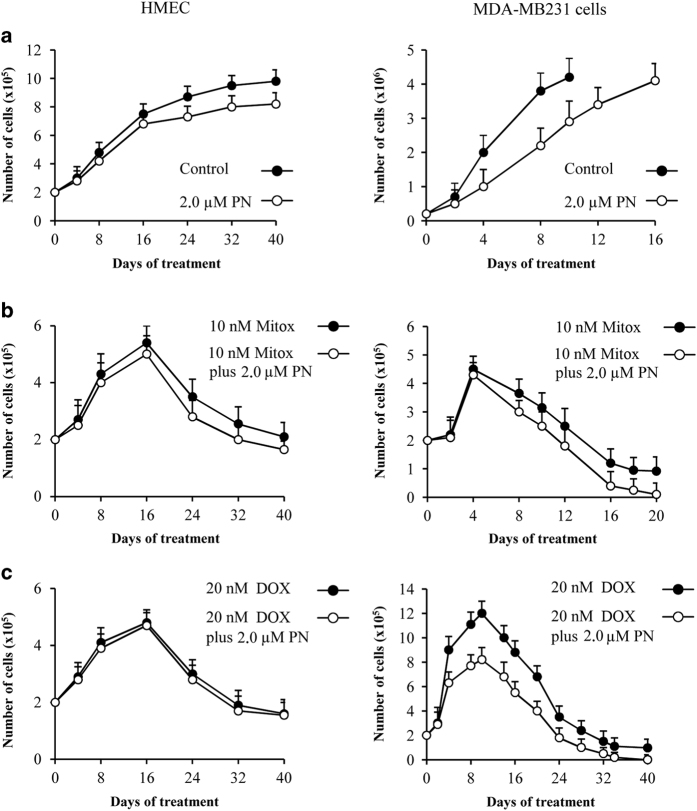
Triple-negative breast cancer is a group of aggressive cancers with poor prognosis owing to chemoresistance, recurrence and metastasis. New strategies are required that could reduce chemoresistance and increases the effectiveness of chemotherapy. The results presented in this paper, showing that parthenolide (PN) prevents drug resistance in MDA-MB231 cells, represent a contribution to one of these possible strategies. MDA-MB231 cells, the most studied line of TNBC cells, were submitted to selection treatment with mitoxantrone (Mitox) and doxorubicin (DOX). The presence of resistant cells was confirmed through the measurement of the resistance index. Cells submitted to this treatment exhibited a remarkable increment of NF-E2-related factor 2 (Nrf2) level, which was accompanied by upregulation of catalase, MnSOD, HSP70, Bcl-2 and P-glycoprotein. Moreover, as a consequence of overexpression of Nrf2 and correlated proteins, drug-treated cells exhibited a much lower ability than parental cells to generate ROS in response to a suitable stimulation. The addition of PN (2.0 M) to Mitox and DOX, over the total selection time, prevented both the induction of resistance and the overexpression of Nrf2 and correlated proteins, whereas the cells showed a good ability to generate ROS in response to adequate stimulation. To demonstrate that Nrf2 exerted a crucial role in the induction of resistance, the cells were transiently transfected with a specific small interfering RNA for Nrf2. Similarly to the effects induced by PN, downregulation of Nrf2 was accompanied by reductions in the levels of catalase, MnSOD, HSP70 and Bcl-2, prevention of chemoresistance and increased ability to generate ROS under stimulation. In conclusion, our results show that PN inhibited the development of the resistance toward Mitox and DOX, and suggest that these effects were correlated with the prevention of the overexpression of Nrf2 and its target proteins, which occurred in the cells submitted to drug treatment.
三阴性乳腺癌是一组侵袭性癌症,由于化疗耐药、复发和转移,预后较差。需要新的策略来降低化疗耐药性并提高化疗效果。本文展示的结果表明,小白菊内酯(PN)可预防MDA-MB231细胞中的耐药性,这是对这些可能策略之一的贡献。MDA-MB231细胞是研究最多的三阴性乳腺癌细胞系,用米托蒽醌(Mitox)和阿霉素(DOX)进行筛选处理。通过测量耐药指数确认耐药细胞的存在。接受这种处理的细胞显示出NF-E2相关因子2(Nrf2)水平显著升高,同时过氧化氢酶、锰超氧化物歧化酶、热休克蛋白70、Bcl-2和P-糖蛋白上调。此外,由于Nrf2及其相关蛋白的过表达,药物处理的细胞在受到适当刺激时产生活性氧的能力比亲代细胞低得多。在整个筛选期间,向Mitox和DOX中添加PN(2.0μM)可防止耐药性的诱导以及Nrf2及其相关蛋白的过表达,而细胞在受到适当刺激时显示出良好的产生活性氧的能力。为了证明Nrf2在耐药诱导中起关键作用,用针对Nrf2的特异性小干扰RNA瞬时转染细胞。与PN诱导的效应类似,Nrf2的下调伴随着过氧化氢酶、锰超氧化物歧化酶、热休克蛋白70和Bcl-2水平的降低、化疗耐药性的预防以及刺激下产生活性氧能力的增加。总之,我们的结果表明PN抑制了对Mitox和DOX的耐药性发展,并表明这些效应与预防Nrf2及其靶蛋白的过表达相关,这种过表达发生在接受药物处理的细胞中。